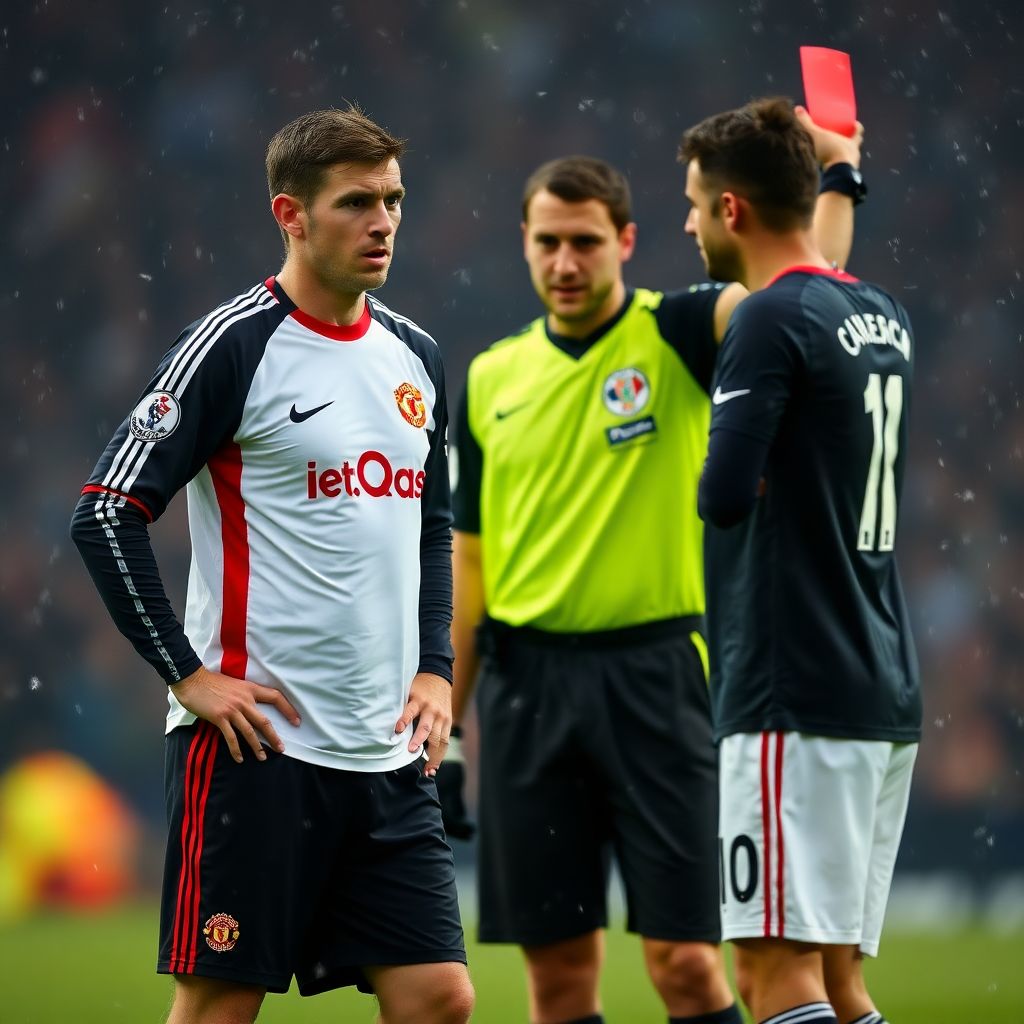
Carrick slams referee after Martinez’s red card: “A shocking decision”
Manchester United head coach Michael Carrick launched a fierce criticism of the referee after his team’s 2-1 defeat to Leeds United, describing Lisandro Martinez’s sending-off as one of the worst decisions he has witnessed on a football pitch.
The turning point of the match came when Martinez was shown a straight red card following an aerial duel with Dominic Calvert-Lewin. The defender was adjudged to have pulled his opponent’s hair during the challenge, a decision that dramatically altered the flow of the game. United, who had been building momentum, were forced to play with ten men and ultimately left the pitch empty-handed.
Carrick argued that the contact between Martinez and Calvert-Lewin was minimal and without any malicious intent. In his view, the incident was blown out of proportion and did not warrant the most severe punishment available to the referee.
He stressed that, in his opinion, the episode did not qualify as a deliberate hair pull or an aggressive act, but rather as incidental contact that happens routinely in tight aerial battles. The manager underlined that football is a contact sport and that such situations should be judged within that context.
What especially angered Carrick was the fact that the referee had the opportunity to review the incident on the pitch-side monitor yet still chose to uphold the red card. He labelled this outcome “shocking,” insisting that the slow-motion replays only reinforced his belief that Martinez had been harshly treated.
Carrick went further, drawing attention to what he sees as a worrying pattern. He pointed out that this was the second consecutive match in which a major decision had gone against his team in similar fashion. For him, the Martinez dismissal was not an isolated incident, but the latest example of refereeing calls that have undermined United’s efforts this season.
According to Carrick, the cumulative effect of such decisions is not just about a single match result. Playing with ten men forces a complete tactical reshuffle, drains the players physically, and places the team under constant defensive pressure. He suggested that it is becoming increasingly difficult for his side to maintain consistency when they feel key decisions are repeatedly going against them.
Despite the controversy, Manchester United remain third in the Premier League table with 55 points. Carrick acknowledged that the team is still in a strong position, but hinted that they could be even closer to the top had they not been on the wrong end of these contentious calls. For a club with ambitions of challenging for major titles, the margins are fine, and a red card in a tight game can be decisive.
The Martinez incident also feeds into the broader debate about how VAR and on-field reviews are being used in modern football. While the technology was introduced to reduce clear and obvious errors, managers like Carrick argue that it can sometimes magnify minor contacts into major offenses. When slow-motion replays are dissected frame by frame, actions that look natural at full speed can appear more deliberate or violent than they actually are.
Carrick’s frustration reflects a common concern among coaches and players: the lack of consistency. Some matches see similar contact go unpunished, while in others a player is dismissed. This unpredictability makes it difficult for defenders to know where the line is drawn and increases the feeling of injustice when a teammate is sent off for something that often goes unnoticed in other games.
From a psychological standpoint, such decisions can weigh heavily on a squad. Players may start to feel that they are being targeted or that luck is conspiring against them. Carrick will now have to balance his outspoken defence of Martinez with the need to keep his group focused on upcoming fixtures rather than dwelling on the referee’s call.
Tactically, losing Martinez is also a blow. The defender’s aggressive style, ability to read the game, and composure on the ball are key components of United’s build-up play from the back. His suspension will force Carrick to reshuffle his defensive line, possibly breaking up established partnerships and testing the depth of the squad at a crucial stage of the season.
The sending-off also raises questions about how defenders are expected to compete in aerial duels. Physical contact, grappling for position, and minor clashes are integral to these situations. If every touch is interpreted as a potential foul or violent conduct, the nature of defending could be fundamentally altered. Carrick’s comments suggest he believes this match was a step in that direction, and not in a positive way.
Looking ahead, Carrick emphasized internally that his team must respond on the pitch rather than relying on sympathy over refereeing controversies. While he has been vocal in his criticism, he knows that the only way to counteract the impact of such decisions is through strong performances and results that keep United firmly embedded in the top positions.
At the same time, episodes like the Martinez red card are likely to fuel renewed calls for clearer guidelines on what constitutes violent conduct, especially in ambiguous situations involving hair pulling, shirt tugging, or hand contact in aerial challenges. Coaches and players want a framework that reduces subjectivity and prevents similar incidents from dominating post-match discussions.
For Martinez personally, the incident is a difficult one to take. Renowned for his combative nature, he now faces the challenge of adapting his game to avoid giving referees any opportunity to interpret his physical style as excessive. Carrick’s public backing will be important for the defender’s confidence, but so will his ability to channel this frustration into disciplined, controlled performances once he returns from suspension.
In the wider context of United’s season, the loss to Leeds and the manner in which it occurred will be a test of character. Teams battling at the top often have to overcome moments that feel unjust. How Carrick and his players respond – both mentally and tactically – will go a long way toward determining whether they can convert their current league position into a successful campaign.
For now, Carrick’s message is clear: he believes his team has been unfairly treated in back-to-back matches, and he sees the red card shown to Lisandro Martinez as one of the most baffling, and damaging, refereeing decisions of the season.