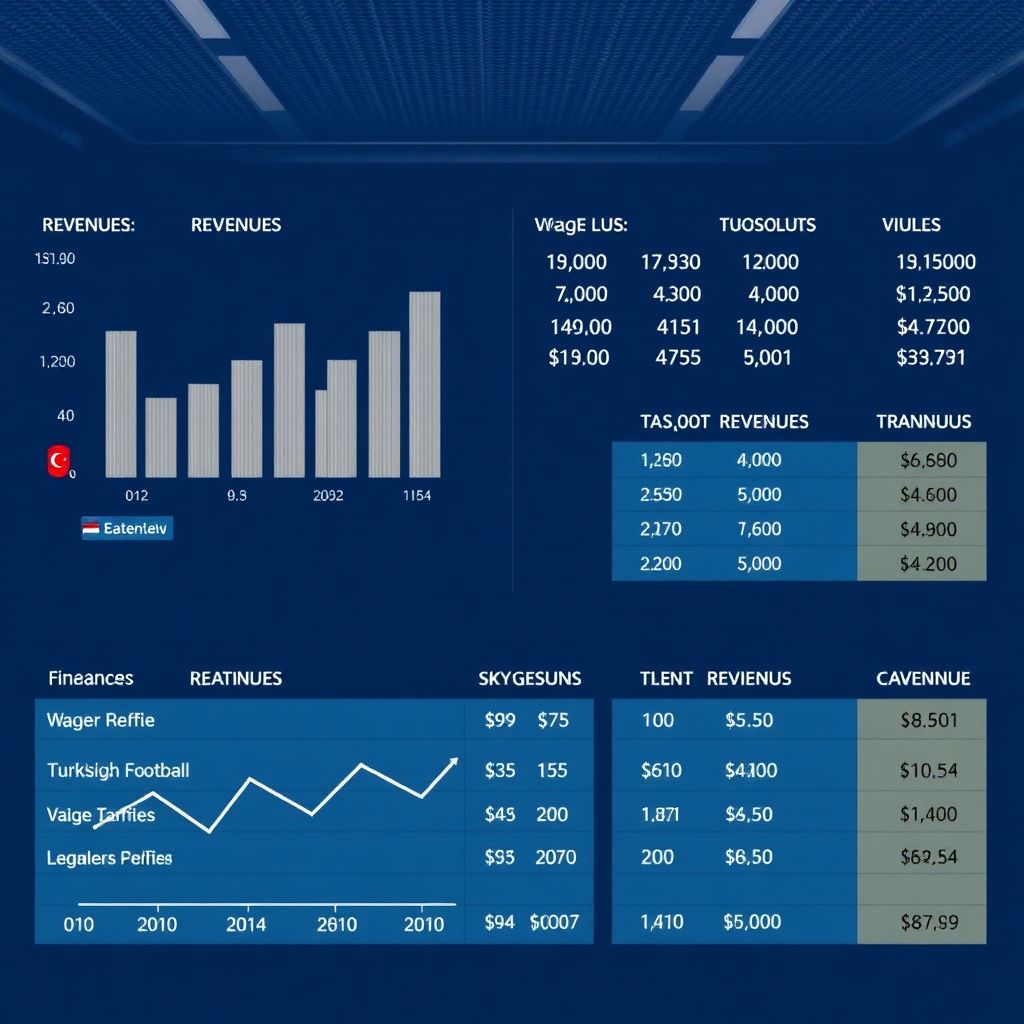
To understand the economics of Turkish football you need a structured view of club revenues, wage bills, and transfer activity, not just turkish super lig transfer news and rumors. This guide explains how to map income, costs, and risks so you can read club accounts, evaluate strategies, and avoid Financial Fair Play breaches.
Executive summary: compact findings on Turkey’s football economy
- Most Super Lig clubs rely heavily on broadcast money and European competition, making budgets fragile when performance drops or exchange rates move.
- Wages and signing bonuses often outgrow stable income, especially for the highest paid players in turkish super lig salaries, pushing clubs toward short-term transfer gains.
- turkish football clubs financial fair play issues usually stem from poor wage control, speculative transfer bets, and weak governance rather than low revenue alone.
- Loan deals, options to buy, and sell-on clauses dominate live turkish super lig transfer market values, so cash received today may hide future liabilities.
- Effective risk management means scenario-based turkey super lig club budget and revenue analysis, strict wage-to-income limits, and early restructuring of expensive contracts.
Revenue streams: matchday, broadcast, sponsorship and merchandise dynamics
This framework suits analysts, club staff, agents, and serious fans who want to interpret Turkish club finances and build safe, realistic budgets. It is not for executing real-money transfers or giving legal, tax, or investment advice; you must always consult licensed professionals before financial or contractual decisions.
Focus on four structural revenue buckets and track them separately over time:
- Matchday and stadium-related income – tickets, VIP boxes, hospitality, parking, and in-stadium spending. In Turkey, fan passion is strong but stadium utilization and pricing discipline vary heavily by club and results.
- Broadcast and central distributions – domestic TV contracts, international rights, and UEFA prize money. These are critical for Super Lig sides; relegation or missing Europe can instantly break fragile budgets.
- Commercial, sponsorship and naming rights – shirt sponsors, technical suppliers, sleeve and back sponsors, stadium naming, and regional partners. Currency mismatch (Euro-based costs vs TRY contracts) is a major embedded risk here.
- Merchandise and digital income – official stores, online sales, licensing, and digital content. For big clubs, this is strategic for global brand building, even if margins can be squeezed by piracy and unofficial products.
Do not rely only on a single good season, title, or European run when planning budgets; design your model around a conservative “no Europe” and “mid-table” scenario, then treat upside as a safety buffer, not as a base case.
Transfer market mechanics: domestic sales, foreign inflows and loan strategies
To safely interpret and plan around the Turkish transfer market you need a few core tools and data sources, beyond basic turkish super lig transfer news and rumors.
- Access to reliable financial reports
- Club annual reports and investor presentations for listed clubs.
- Domestic federation disclosures and UEFA reports for European participants.
- Use these to separate transfer fees, agent fees, and amortisation.
- Databases of live turkish super lig transfer market values
- Public valuation platforms and reputable scouting databases.
- Cross-check against actual transaction prices; values are indicative, not binding.
- Legal and regulatory frameworks
- FIFA, UEFA, and TFF regulations on transfers, registration, loans, and homegrown rules.
- Club-specific rules such as internal wage caps or board approvals above certain thresholds.
- Analytics for turkey super lig club budget and revenue analysis
- Spreadsheets or BI tools to simulate transfer scenarios: fee, installments, bonuses, resale clauses.
- Basic FX modeling because many contracts are euro-based while income is largely in TRY.
- Risk and compliance checks
- Internal FFP monitoring to understand how much wage and amortisation capacity remains.
- Third-party reviews to avoid hidden obligations (agents, image rights, side letters).
With these in place, you can judge whether a domestic sale, foreign inflow, or complex loan with option to buy strengthens the club or just defers today’s problems into future seasons.
Wages and contracts: salary structures, bonuses and off-balance obligations
Before designing or assessing wage structures in Turkey, be alert to these core risks and limitations:
- Exchange-rate shocks can suddenly make foreign-currency salaries unsustainable in TRY terms.
- Hidden bonuses, image-rights deals, and unofficial promises often escape initial budgeting.
- Short-term fixes (late-season bonuses, new signings) may violate Financial Fair Play thresholds.
- Inadequate documentation creates legal disputes that are expensive and reputationally damaging.
Use the following safe, practical steps to structure contracts, keeping an eye on turkish football clubs financial fair play issues and long-term sustainability.
- Map your current wage and bonus landscape
Build a clean list of all players, coaches, and key staff with their fixed and variable pay.- Include base salary, appearance fees, win bonuses, signing-on fees, and loyalty bonuses.
- Estimate off-balance obligations such as side letters, agent success fees, or informal promises.
- Set a hard wage-to-revenue ceiling
Choose a maximum percentage of recurring football income that may go to total squad cost.- Use conservative revenue projections that ignore one-off transfers and exceptional European runs.
- Benchmark against peers and UEFA guidance; remain comfortably below FFP thresholds.
- Design a tiered salary structure
Create clear internal tiers (e.g., star, starter, rotation, prospect) rather than one-off negotiations for every player.- Ensure internal logic: starters cannot consistently earn less than backups without causing friction.
- Keep the very top tier small; this is where highest paid players in turkish super lig salaries tend to cluster.
- Shift incentives from fixed to performance-based pay
Make a meaningful share of total compensation conditional on safe, measurable performance targets.- Use squad and club objectives (minutes played, league position, European qualification) not just goals or assists.
- Cap total achievable bonuses so they cannot unintentionally break your wage ceiling.
- Structure contracts to manage FX and duration risk
Decide which contracts are in local currency and which in foreign currency, and over what term.- Prefer shorter terms and lower fixed pay for risky, older, or unproven players.
- Use options and performance triggers instead of guaranteed long-term commitments.
- Document every obligation clearly
Ensure all elements of pay and bonuses are written into the main contract or official annexes.- Avoid verbal promises and informal messages; courts and FIFA bodies rely on documents.
- Centralise records so finance, legal, and sporting departments work from the same information.
- Run an annual FFP and sustainability check
Test how your wage bill and contract structure behave under stressful scenarios.- Model missing Europe, an early cup exit, or lower broadcast distributions.
- If the model fails under mild stress, adjust wages and squad size before regulators intervene.
Ownership, governance and regulation: investors, boards and supervisory bodies
Use this checklist to verify whether a Turkish club’s governance and regulatory setup supports sustainable economics.
- Clear separation of roles: owners, board, executives, and coaching staff have defined responsibilities.
- Major transfers and contracts above a set threshold require board or committee approval.
- Regular, timely financial reporting to shareholders, regulators, and the public where required.
- Documented risk policy for FX exposure, debt levels, and contingent liabilities.
- Compliance unit or officer monitoring FFP, tax, and labour-law obligations.
- Independent audit of annual accounts and, ideally, some internal audit capacity.
- Recorded conflict-of-interest policy for agents, related parties, and connected companies.
- Sporting strategy aligned with financial capacity, not driven by short-term politics or elections.
- Board skills mix that includes finance, legal, and risk expertise, not only former players and fans.
- Transparent communication with supporters around strategy, constraints, and long-term plans.
Debt, insolvency and financial discipline: credit profiles and enforcement
Common mistakes in the Turkish context tend to repeat; use this list to actively avoid them.
- Stacking short-term bank loans and factoring to cover structural operating losses.
- Borrowing in foreign currency against local-currency income without proper hedging.
- Using expected transfer income to justify over-spending before deals are formally signed.
- Ignoring tax and social-security arrears because they feel less urgent than player wages.
- Renegotiating old debts by simply extending maturities, without changing spending behaviour.
- Accepting aggressive covenants that hand too much control to lenders in a downturn.
- Assuming future stadium, sponsorship, or naming-rights projects will automatically solve debt problems.
- Underestimating reputational damage and sporting sanctions from delayed payments to players and clubs.
- Failing to build a basic cash-flow forecast that looks at weekly and monthly obligations, not just annual totals.
- Over-relying on a single wealthy backer instead of building a structurally balanced budget.
Risk modeling and forecasting: scenario analysis, stress tests and contingency planning
If detailed forecasting models are not feasible, these alternative approaches still help manage risk around club finances and turkish football clubs financial fair play issues.
- Simple rules-based budgeting
Use fixed, conservative rules (for example, a maximum wage-to-income ratio and hard limits on transfer amortisation) instead of complex forecasting. This is suitable for smaller clubs or early-stage analysts with limited data. - Qualitative risk matrices
Map major risk factors (FX, injuries, poor league position, sponsor loss) on a probability/impact grid. Prioritise mitigation efforts for high-impact items even without precise numerical models. - Peer-comparison benchmarking
Regularly compare your club’s size, wage profile, and transfer activity with similar Super Lig teams using public reports and live turkish super lig transfer market values. This gives a quick “outlier check” even if you lack internal models. - External expert reviews
Commission periodic assessments from independent auditors, legal firms, or specialised consultants. Their outside view can spot hidden obligations, structural weaknesses, or FFP risks you might miss internally.
Comparative overview of major Turkish clubs’ financial profiles
This qualitative table illustrates how to compare leading clubs on revenue dependency, wage pressure, and transfer behaviour without relying on exact unpublished figures.
| Club (example) | Revenue profile | Wage pressure | Net transfer trend | Key economic risk flags |
|---|---|---|---|---|
| Galatasaray | High dependence on European income and strong commercial brand. | Typically high due to experienced, star-heavy squads. | Mix of big incoming signings with occasional player sales to rebalance. | FX exposure on euro wages; results-driven revenue volatility. |
| Fenerbahçe | Large fanbase and commercial reach, significant matchday potential. | Substantial, reflecting ambitions for titles and Europe. | Often active in the market with changing net position between windows. | Pressure to invest heavily each season; political and fan expectations. |
| Beşiktaş | Strong urban market and sponsorship appeal. | Elevated, especially when rebuilding squads after underperformance. | Tends toward short-term solutions and free transfers with high wages. | Risk of short-termism and ballooning bonus obligations. |
| Trabzonspor | More balanced reliance on local support and targeted commercial deals. | Significant but often below Istanbul giants in absolute terms. | Potential to profit from developing and selling players. | Vulnerability to swings in European qualification and local economic factors. |
Practical concerns managers and analysts commonly face
How can I quickly see whether a Turkish club’s wage bill is sustainable?
Compare total squad cost to recurring football income, excluding one-off transfers. If the percentage is high even under conservative revenue assumptions, the structure is fragile. Then stress test against missing Europe or finishing mid-table.
What should I watch for in complex loan and option deals?

Identify total potential cost: loan fee, wage share, future option or obligation, and bonuses. Check how these flow across seasons and how they affect FFP calculations, not just this year’s cash outlay.
How do turkish football clubs financial fair play issues usually start?
They often begin with a few “exceptional” signings or renewals that break internal wage logic, followed by missed sporting targets and falling revenues. The gap then gets patched with debt and asset sales until regulators intervene.
Are public valuations in live turkish super lig transfer market values reliable?

They are reference points, not prices. Treat them as a starting estimate for negotiation and risk analysis, then adjust for age, contract length, injury history, and strategic value to the squad.
What is the safest way to structure performance bonuses?
Link bonuses to club-level achievements and minutes played rather than narrow personal stats. Cap the total bonus pool and test it in a downside scenario so success does not unexpectedly break your budget.
How can I factor FX risk into player salary decisions?
Model salaries both in contract currency and in TRY under different exchange-rate scenarios. Consider partial hedging, mixed-currency rosters, and shorter terms for high FX-exposed contracts.
When should a club consider selling rather than renewing a key player?
When wage demands exceed your top internal tier, the player’s resale value is peaking, or extending the deal would lock you into unsustainable long-term guarantees. Compare the renewal cost to the opportunity of reinvesting a transfer fee.