
For a budget-first reformer in Turkey, the most realistic approach is a hybrid: German-style governance and monitoring, Spanish and Dutch community programs, and Turkey’s own scale and passion for sport. Prioritise low-cost clubs, school-based services, and targeted football youth academies, then add premium elements only where data show clear impact.
Executive summary – cost-effective contrasts
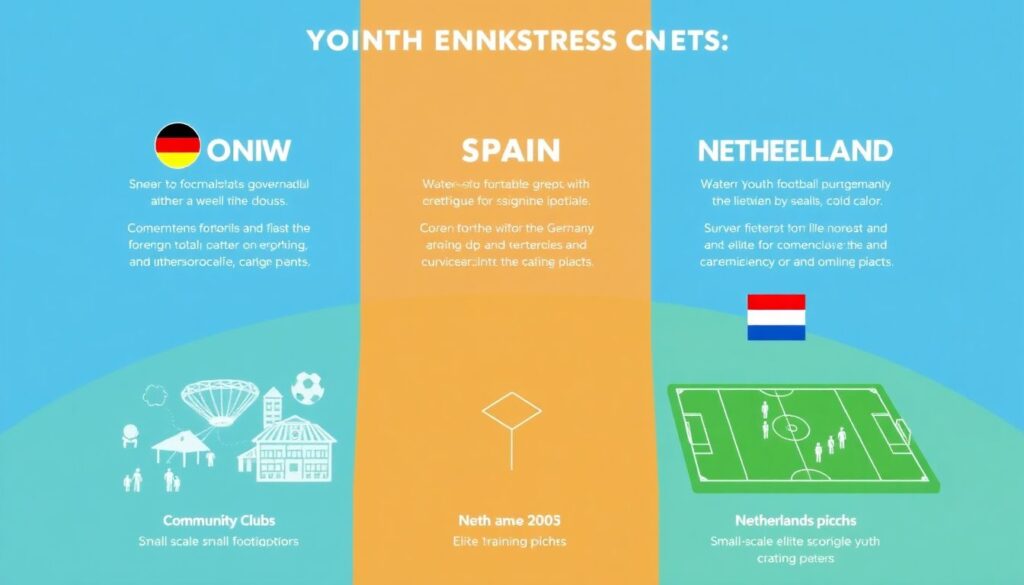
- Germany is strongest for system governance, coaching standards, and monitoring, but is expensive to copy fully.
- Spain delivers high impact through club-based and community initiatives tightly linked to local identity and football culture.
- The Netherlands focuses on small-scale, high-quality youth pathways with clear transitions from school to work and sport.
- Turkey has reach, political will, and a vibrant sports scene, but programmes are fragmented and under-monitored.
- For football youth academy Germany Spain Netherlands Turkey comparisons, Germany and the Netherlands lead on structure, Spain on creativity, Turkey on untapped volume.
- The most cost-effective model for Turkey is to standardise minimum quality (German/Dutch), use Spanish-style local clubs, and concentrate high-cost services on the most at-risk youth.
Policy origins and trajectories: youth development in Turkey, Germany, Spain, and the Netherlands
When comparing youth development models, including youth football development programs Europe Germany Spain Netherlands and Turkey, work with clear criteria rather than prestige or stereotypes. The following selection criteria help policymakers choose which elements to borrow and adapt.
- Clarity of national goals: How explicitly does the country define youth outcomes in education, employment, civic participation, and sport (e.g., football talent pipelines)?
- Stability of legal framework: Are youth policies grounded in laws and long-term strategies, or mainly in short-term projects and ministerial programmes?
- Degree of decentralisation: What responsibilities sit with national ministries versus municipalities, schools, clubs, and NGOs?
- Integration of sport and education: Are sports academies, including the best european football academies comparison Germany Spain Netherlands, structurally linked to schools and vocational training?
- Inclusiveness mechanisms: How are low-income, migrant, refugee, and rural youth reached and retained in programmes?
- Data and monitoring capacity: Are participation, progression, and employment tracked consistently across regions?
- Funding predictability: Are youth organisations and academies funded through multi-year budgets or unstable year-to-year grants?
- Partnership culture: Is there a habit of cooperation between ministries, municipalities, clubs, and private sponsors, especially around football youth academy Germany Spain Netherlands Turkey initiatives?
- Scalability and adaptability: Can pilots be scaled nationally without huge cost increases or loss of quality?
Using these criteria, Germany scores high on law-based stability and monitoring; Spain on local ownership and pathways into professional sport; the Netherlands on integration of education and apprenticeships; Turkey on scale and political visibility but less on consistent implementation.
Financing models and per-capita budgeting: where to save and where to invest
Budget choices should be driven by per-youth costs and measurable outcomes. Below is a comparison of financing models that can support both general youth work and football-specific academies, such as those connected to professional football scouting and placement services Europe youth academies.
| Variant | Who it suits | Pros | Cons | When to choose |
|---|---|---|---|---|
| Centralised state-funded model | Countries building a unified national standard (Germany-style) | Clear minimum quality; easier to enforce coaching and safeguarding standards; supports national football academy networks. | High fiscal pressure; risk of bureaucracy; less room for local innovation. | When the main gap is uneven quality across regions and the state can commit to stable, medium-term funding. |
| Municipal co-financing with project add-ons | Medium and large municipalities with active mayors (Spain, many Dutch cities) | Responsive to local needs; encourages city-club partnerships; can align with EU or regional funds. | Patchy coverage; weaker municipalities fall behind; project cycles can disrupt continuity. | When there are capable cities ready to co-invest and experiment with youth clubs and academies. |
| Club-led sports academy partnership | Football-rich ecosystems (Spain, Netherlands, big Turkish clubs) | Uses existing football infrastructure; strong motivation for talent development; easier to link to professional pathways. | Risk of selection bias toward already talented or wealthier youth; education and psychosocial support may be secondary. | When there is a critical mass of clubs and an explicit framework to ensure education and inclusion, not only elite sport. |
| NGO-private hybrid model | Regions with active civil society and corporate sponsors | Diversifies funding; flexible and innovative; can test models before state scaling. | Unequal access; heavy dependence on donor interests; unstable in crises. | When the state budget is tight but there is corporate interest in youth and sport-based social responsibility. |
| Performance-based voucher scheme | Systems with strong data capacity (Germany, the Netherlands) | Money follows the young person; incentivises results; supports a mix of providers (schools, clubs, NGOs, academies). | Complex to design fairly; risk of excluding hardest-to-reach youth; requires robust monitoring. | When baseline services are in place and the priority is boosting quality and outcomes without raising overall spending. |
For Turkey, a mixed model is most realistic: centralise minimum standards and per-capita funding formulas, but let municipalities and clubs co-finance facilities, particularly in football youth academy Germany Spain Netherlands Turkey style partnerships. Reserve performance-based elements for mature, data-rich regions.
Institutional architecture: ministries, municipalities, and delivery partners
Institutional design determines whether financing models actually translate into services. Below are scenario-based recommendations, with explicit budget and premium options.
- If the national budget is constrained but cities are dynamic, then:
- Budget option: establish basic youth centres in schools and municipal sports facilities, sharing staff and infrastructure.
- Premium option: co-brand municipal academies with top clubs and universities, similar to how the best european football academies comparison Germany Spain Netherlands link education, sport, and research.
- If a strong ministry wants control but lacks local implementation capacity, then:
- Budget option: define a simple national service package (hours of youth work, basic coaching, minimum staff ratios) and fund it per capita.
- Premium option: create regional centres of excellence in partnership with professional clubs and professional football scouting and placement services Europe youth academies.
- If municipal capacity is uneven across Turkey, then:
- Budget option: cluster weaker municipalities under regional support units (inspired by Dutch inter-municipal cooperation) for shared trainers, monitoring, and curriculum.
- Premium option: pair selected high-potential cities with German or Dutch partner cities to co-develop data systems and elite academy standards.
- If football is the dominant youth engagement channel (common in Turkey and Spain), then:
- Budget option: embed life skills, tutoring, and career guidance into existing club training times, turning local clubs into multi-purpose youth hubs.
- Premium option: develop dual-career pathways combining school, vocational training, and high-performance academies, as seen in many youth football development programs Europe Germany Spain Netherlands.
- If NGOs are active but fragmented, then:
- Budget option: frame a light national accreditation system, offering small grants for NGOs that align with core youth outcomes.
- Premium option: fund multi-year backbone organisations to coordinate regional networks, evaluation, and capacity building.
Program portfolios and measurable indicators: education, employment, and civic engagement
To choose a programme mix, use a simple, data-driven checklist rather than copying one country wholesale.
- Map current provision: List all public, municipal, club, and NGO services per district, including football academies and after-school programmes, and identify gaps in education, employment, and civic engagement.
- Prioritise low-cost, high-reach activities: Favour school-based clubs, mentoring, volunteering schemes, and community sport before creating expensive new centres.
- Define 5-7 core indicators: For example, school completion, basic skills, entry into work or training, regular club participation, volunteering, and reduced risky behaviour.
- Link each programme to indicators: Do not fund any activity, including a football academy, unless its expected contribution to at least one indicator is explicit.
- Start with pilots in diverse settings: Test the portfolio in a big city, a mid-size town, and a rural area; compare cost per positive outcome.
- Adjust based on cost-effectiveness: Expand programmes with the lowest cost per successful outcome, even if they are less glamorous than elite academies.
- Formalise progression routes: Ensure documented pathways from school to vocational training, to jobs, and-where relevant-to semi-professional or professional sport.
Access, equity, and inclusion: reaching marginalized youth on a tight budget
Equity measures often fail not because of low spending but because of design mistakes. Avoid these traps when adapting elements from Germany, Spain, and the Netherlands to Turkey.
- Locating services only in central, visible facilities and ignoring peri-urban or remote neighbourhoods where need is higher.
- Assuming that open access is enough; in practice, marginalised youth require active outreach through schools, social workers, and peer leaders.
- Designing elite football academies without free pathways or scholarships, effectively excluding talented but poor young people.
- Copying complex German or Dutch assessment tools without training, resulting in tick-box exercises rather than real support plans.
- Prioritising short, image-focused campaigns over consistent weekly activities that build trust.
- Failing to integrate psychosocial support and guidance counselling into sports and cultural programmes.
- Underusing families, community leaders, and alumni as low-cost multipliers for recruitment and mentoring.
- Not monitoring who drops out of programmes and why, especially among migrant, refugee, and rural youth.
- Relying only on internet-based registration, which can exclude those with limited connectivity or digital skills.
Scalability, monitoring, and practical reform steps for budget-first implementation
For Turkey, the best option for national standards and monitoring is closest to Germany, the best for community energy and football pathways resembles Spain, and the best for small-scale quality and transition to work mirrors the Netherlands. A blended, budget-aware model that pilots, measures, and scales selectively is the most practical route.
Quick reference for implementers
Which country model is the best starting point for Turkey?
Use Germany primarily for governance, standards, and monitoring; Spain for community-based clubs and football-centred engagement; the Netherlands for linking education, apprenticeships, and youth work. Combine, do not copy, and always simplify to match Turkish administrative capacity.
How should Turkey adapt German practices without overspending?
Borrow Germany’s clarity on minimum service packages, staff qualifications, and data systems, but implement them in phases. Start with simple indicators and digital tools, then gradually expand coverage and complexity as capacity and budgets grow.
What concrete lessons from Spain are most cost-effective?
Spain’s use of local football clubs and cultural associations as multi-purpose youth hubs is relatively cheap. Integrate tutoring, volunteering, and civic projects into existing club structures instead of building new stand-alone centres.
How can Dutch experience help with school-to-work transitions?
The Netherlands shows the value of strong links between schools, vocational training providers, and employers. Turkey can replicate this by creating local partnerships and simple referral mechanisms, tied to clear indicators such as job placement and sustained employment.
How to join football academy in Germany Spain Netherlands for Turkish players?
Turkish players usually need to be scouted through tournaments, partner clubs, or talent ID camps organised by European academies. Families should focus on strong local training, language skills, and education, then connect with reputable academies that have transparent selection processes.
What is the safest way to use professional football scouting and placement services Europe youth academies?
Check whether the service is officially registered, has clear contracts, and works with recognised clubs or academies. Avoid agents who promise guaranteed contracts or ask for high upfront fees without written agreements and verifiable references.
How can Turkey protect inclusion while developing elite academies?

Require every elite academy to run community programmes, offer scholarships, and report on participation by low-income and marginalised youth. Tie part of public funding to inclusive recruitment, retention, and education outcomes.