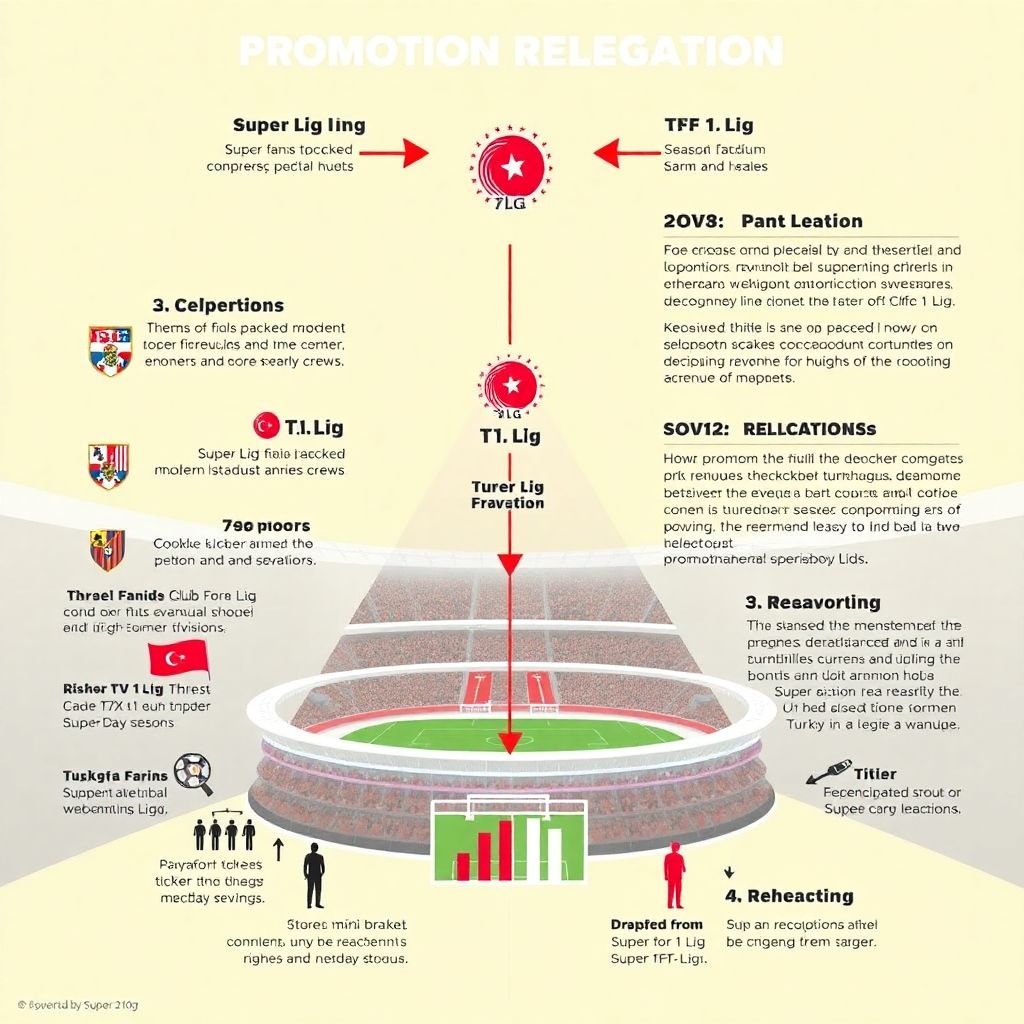
Why Promotion and Relegation Between Super Lig and TFF 1. Lig Matter So Much
If you follow Turkish football even casually, you know that moving between the Super Lig and TFF 1. Lig is never “just” about sporting glory. It is a structural shock to a club’s entire ecosystem: budget, squad building, academy, stadium usage, and even local politics. Over the last three completed seasons (2021–22, 2022–23 and 2023–24, based on available data up to late 2024), an average of three clubs per year have gone up and three gone down, which means nine different organizations have had to redesign their medium‑term strategy from the ground up. For several of them, the change meant revenue swings of 30–50% in a single summer, which is massive if you are already operating on thin margins.
Key Mechanics: How the System Actually Works
From a structural point of view, the Turkish pyramid is quite straightforward: Super Lig at the top, TFF 1. Lig right underneath. The famous super lig promotion rules are simple on paper: three clubs come up from TFF 1. Lig every season, and three go down from the Super Lig. In practice, the way those three spots are allocated is what shapes the risk profile. Usually, the top two in TFF 1. Lig get automatic promotion, while teams finishing right below them fight through play‑offs for the final spot. For clubs, this means you do not just evaluate “Are we strong enough to be top two?” but also “Can this squad survive a highly volatile play‑off tournament in May?”
Promotion, Play‑Offs and the TFF 1. Lig Funnel
TFF 1. Lig functions as an intense filter. In most seasons, points gaps between 3rd and 7th can be very small, so variance plays a big role. Over the last three completed campaigns, the promotion places have typically been decided by fewer than 5 points between critical positions. For a club chairman, this translates into a hard strategic question: Do you overspend to push for automatic promotion now, or build a more balanced squad that can handle the play‑off lottery? Even something as tactical as when to discount tff 1 lig promotion playoffs tickets becomes part of the calculation, because generating maximum home‑field advantage in those decisive games can be worth several million lira in future broadcasting and sponsorship income.
Relegation From the Super Lig: More Than Just Going Down
Dropping from the top tier is not only about pride; it is about a sudden change in the financial equation. The financial impact of relegation from super lig is usually brutal: matchday income falls as attendances decline, sponsorship contracts are often indexed to top‑tier visibility, and TV money compresses sharply. Across recent years, many relegated clubs have seen operating revenues fall by roughly one third or more in the first season after going down. That kind of shock forces immediate cost‑cutting: wage bill reductions, termination of high‑salary contracts, and a shift towards academy players or cheaper foreign signings. Clubs that do not manage this transition proactively often end up in a “double drop” scenario, sliding further down the pyramid.
Necessary Tools: What a Club Needs to Survive Promotion or Relegation
For a club board or sporting director, navigating this ecosystem is impossible without a specific toolset. Beyond the clichés of “good scouting” or “strong fan base,” the modern environment around turkish super lig tv rights and broadcasting deals demands professional infrastructure. You need an internal financial model that can simulate at least two scenarios every year: staying put or moving up/down. This model should include projected broadcasting income, realistic matchday revenue adjusted for probable attendances in each division, sponsor renegotiation clauses, and expected transfer income. Only then can you make rational decisions on transfer fees and salary commitments instead of emotional bets on short‑term success.
Analytical and Financial Instruments
On the analytical side, a data platform that aggregates performance metrics (expected goals, pressing intensity, injury‑adjusted minutes, age curves) is no longer a luxury. It is a defensive tool against sunk‑cost thinking. When a club faces relegation risk, the temptation is to overpay for “experienced” players in January; properly structured databases allow you to test whether these players actually move the needle in survival probability. Financially, you need software or at least detailed spreadsheets that model cash flows around super lig parachute payments for relegated clubs, which are designed to soften the landing but never fully replace top‑tier revenues. If those parachute resources are pre‑committed to legacy debts or stadium loans, you effectively go down without a safety net.
Organizational and Human Capital Tools
Beyond numbers, there are softer but still very technical “tools”: clear governance, decision‑making protocols, and crisis communication plans. Boards that react to relegation with panic sackings and short‑term populist signings usually magnify the damage. A club that has a pre‑written “relegation playbook” with predefined steps—who negotiates salary reductions, how to communicate with fans, which youth players are ready to be integrated—will typically stabilize faster. Over the last three seasons, the clubs that adapted best were those that had already anticipated both scenarios by structuring contracts with relegation clauses and by investing in academies that could replace expensive veterans.
Step‑by‑Step Process: Planning for Both Up and Down
Even if you are mid‑table, you cannot afford to improvise. Treat promotion and relegation as two parallel projects that are always running in the background. The logic below applies whether you are aiming for the Super Lig from TFF 1. Lig or trying to avoid dropping out of the top flight.
1. Build Dual Financial Scenarios
1. Define your “base case” budget assuming you stay in your current division.
2. Create an “upside” version with projected Super Lig income (or promotion‑related bonuses) and a “downside” version with TFF 1. Lig or relegation revenues.
3. For each version, cap the wage bill as a percentage of expected recurring income, without counting one‑off transfer sales.
4. Stress‑test your plan with conservative assumptions: lower attendances, delayed sponsor payments, fewer TV appearances.
5. Lock in critical contracts (key players, coaching staff) only after you are sure they are affordable in the downside scenario.
2. Structure Contracts to Be Division‑Proof
In contract engineering, promotion and relegation clauses act as “automatic stabilizers.” Over the last three seasons, the clubs that managed transitions best generally had built‑in salary adjustments of 20–40% tied to divisional status. When you move up, automatic increases keep players happy without emergency renegotiations. When you go down, the wage bill drops in line with revenue. Without such clauses, you face a liquidity crunch immediately after the season ends, just when transfer markets are most chaotic and buyers know you are desperate.
3. Build a Squad With Flexible Value
From a sporting perspective, the squad should be assembled not only for the current division’s requirements, but with an eye on both possible environments. A player who is slightly above average in TFF 1. Lig with strong physical metrics might remain useful in a relegation fight in the Super Lig; a technically gifted but low‑intensity winger may become a luxury you cannot afford outside the top division’s TV money. Over the last three years, clubs that relied heavily on aging, high‑salary players often found that they had zero resale value after relegation, forcing them to absorb large write‑offs. Leaning into younger, development‑oriented profiles spreads risk by preserving potential transfer income.
4. Monetize and Manage Matchday Volatility
Promotion pushes attendances up; relegation pulls them down—but neither effect is linear. If you ride promotion momentum well, you can significantly increase season‑ticket sales, VIP packages and merchandising in the first Super Lig year. Even controlling for sporting performance, newly promoted clubs have often reported double‑digit percentage growth in average home attendance in their first top‑flight season. Conversely, doing nothing after relegation typically leads to fans disengaging. Advanced ticketing strategies around big games and promotion or play‑off runs—including dynamic pricing and smart campaigns for tff 1 lig promotion playoffs tickets—can smooth out cash flows and keep fans emotionally attached even during harder years.
Troubleshooting: Common Problems and How to Fix Them
No plan survives contact with reality perfectly, especially in a league as emotionally charged as Turkey’s. Still, most problems fall into a few recurring categories. Thinking about them in advance allows you to react with structure instead of emotion.
Problem 1: Sudden Cash Crunch After Relegation
This is the classic scenario: you drop from the Super Lig, the first TV installment in TFF 1. Lig is lower than planned, sponsors delay payments, and you still carry a top‑flight wage bill. Even with super lig parachute payments for relegated clubs, the liquidity profile can become dangerous within months. The technical fix is to perform a fast reprioritization of contractual obligations: identify which player contracts can be mutually terminated or loaned out, which debts can be restructured, and which non‑core costs (e.g., certain non‑essential staff positions, marketing campaigns) can be paused. At the same time, you build short‑term transfer strategies focused on freeing cash rather than maximizing theoretical transfer value.
Problem 2: Under‑Investing After Promotion
At the other extreme, some clubs reach the Super Lig and then try to “play it safe” financially, making minimal investments. Statistically, newly promoted sides that invest nothing or very little in upgrading the squad usually end up in relegation battles, and many bounce straight back down within one or two years. The troubleshooting approach here is not to spend blindly, but to allocate targeted resources on positions with the highest marginal impact on survival probability—often central defense, central midfield, and at least one reliable goal source. Aligning these signings with your scouting and data models lets you increase competitive level without locking yourself into unsustainable long‑term deals.
Problem 3: Over‑Reliance on Broadcasting Money
Because turkish super lig tv rights and broadcasting deals provide a large share of revenue, many club budgets become heavily dependent on TV distributions. When the central deal is renegotiated or when you move to TFF 1. Lig, this dependency becomes a systemic risk. To troubleshoot, you should build a diversification roadmap: grow non‑matchday income (academies, partnerships, regional sponsorships), professionalize merchandising, and develop digital channels that can attract advertisers irrespective of division. Over the last three seasons, clubs that achieved even modest diversification—say moving from 70% to 55–60% dependence on broadcasting—were significantly less fragile when sporting results dipped.
How the Last Three Seasons Illustrate the Long‑Term Effects
Looking at the three most recent fully documented seasons before 2024 shows clear patterns, even without naming specific clubs. Every year, three new faces in the Super Lig injected energy, tactical variety and fan interest. In their first year up, promoted sides often recorded measurable spikes in stadium utilization and local sponsorship activity, reflecting the economic uplift tied to top‑flight status. At the same time, roughly half of those promoted clubs found themselves fighting relegation the following season, underlining how narrow the margin is between consolidation and immediate return to TFF 1. Lig. On the flip side, relegated clubs that had prepared structurally—dual‑scenario budgets, division‑linked contracts, robust academies—were much more likely to stay competitive in TFF 1. Lig rather than collapsing further.
Strategic Takeaways for the Future
Putting it all together, promotion and relegation between the Super Lig and TFF 1. Lig work as a powerful selection mechanism. They reward clubs that think in systems and penalize those that chase short‑term headlines. The financial impact of relegation from super lig will always be significant, but it does not have to be fatal if a club has already engineered flexibility into its cost structure and squad profile. Likewise, moving up is not a guarantee of long‑term stability unless the club leverages that window to modernize its operations, professionalize its scouting and analytics, and broaden revenue streams. In other words, the ladder between these two divisions is not just a path of sporting movement—it is the main engine that shapes which Turkish clubs will still be relevant, stable and competitive ten years from now.