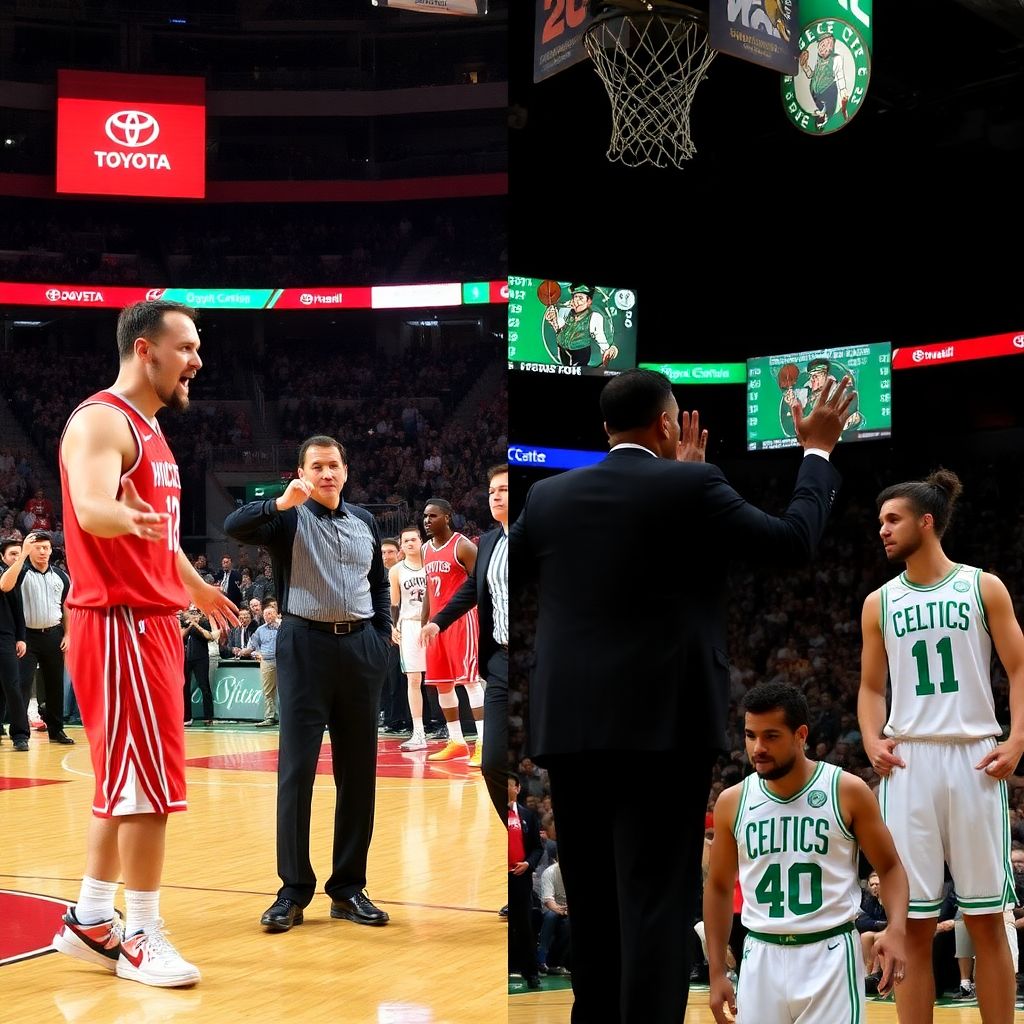
Alperen Şengün ejected after double technical in Rockets’ home defeat to Celtics
Houston Rockets center Alperen Şengün saw his night end early after being tossed from the game with two technical fouls in a heated matchup against the Boston Celtics. The clash at Toyota Center ended with a 114–93 victory for the visiting Celtics, but the storyline extended far beyond the final score, as emotions boiled over on the Rockets’ side both on the court and on the sidelines.
Boston controlled the game for long stretches behind an impressive scoring display from its backcourt. Derrick White led all scorers with 28 points, repeatedly breaking down the defense with confident drives and timely perimeter shooting. Payton Pritchard added 27 points, stepping into a major offensive role and punishing the Rockets whenever they left him any room on the arc.
The Celtics also dominated the glass and the interior thanks to the energy and size of their frontcourt rotation. Neemias Queta delivered a powerful double-double type performance with 10 points and a commanding 19 rebounds, constantly creating second-chance opportunities and limiting Houston to one-and-done possessions. Luka Garza came off the bench and chipped in 19 points, using his footwork and touch around the basket to keep the Rockets’ defense under constant pressure.
On the other side, Houston never quite found an offensive rhythm. Kevin Durant finished with 15 points as one of the few consistent scoring options for the Rockets throughout the night. Alperen Şengün closed his shortened evening with 13 points and 9 rebounds, flirting with a double-double before his ejection. Despite his statistical contribution, Şengün visibly struggled with the officiating and the physicality of Boston’s defense, which often crowded him in the paint and challenged his every touch near the rim.
The tension began building well before Şengün’s dismissal. Late in the third quarter, Rockets head coach Ime Udoka was thrown out of the game after a fierce exchange with the referees. Udoka received two quick technical fouls as he argued calls near the sideline, leaving Houston without its head coach for the entire fourth quarter. His ejection appeared to be a turning point emotionally, as frustration spread among the Rockets’ players and coaching staff.
Midway through the final period, that frustration reached its peak with Şengün. After driving into the lane and failing to draw a whistle on what he believed was clear contact, the Turkish center erupted in anger. Turning toward the official, he shouted in protest, and the referee immediately issued a technical foul. Instead of backing away, Şengün continued his verbal reaction, which led to a second technical being assessed almost instantly. With two technical fouls, he was automatically disqualified and had to leave the floor.
The sequence underscored just how frayed Houston’s nerves had become. The crowd at Toyota Center reacted loudly as Şengün walked toward the locker room, and the Rockets, already struggling to mount a comeback, were forced to finish the contest without their main interior presence. For a young core still learning to manage high-pressure situations, it was another lesson in composure and how quickly a game can slip away when emotions override focus.
Statistically, Şengün’s night suggested he was on track for another productive all-around performance. His 13 points and 9 rebounds came in limited minutes, and he continued to function as a hub in the half-court offense, facilitating from the high post and low block. However, Boston’s physical defense, combined with a relatively tight whistle on some possessions and a looser one on others, clearly wore on him as the game progressed. The missed foul call that triggered his outburst was simply the breaking point after a series of contentious moments.
For Udoka, the double technical and ejection late in the third quarter also highlighted a recurring theme this season: the fine line between defending his players and crossing the boundary with the officials. By challenging calls as fiercely as he did, he sent a message of solidarity to his team, but his early exit removed a critical voice of calm and strategy at a time when the Rockets needed organization and composure to claw back into the game.
From Boston’s perspective, the win was as much about discipline as it was about talent. The Celtics stuck to their game plan, moved the ball well, and trusted their depth. White and Pritchard’s scoring bursts were backed by relentless rebounding from Queta and efficient finishing from Garza. While Houston became increasingly emotional, Boston maintained focus, kept their defensive rotations tight, and capitalized whenever the Rockets lost their shape.
One sequence in particular captured the contrast between the two teams. In the second half, Alperen Şengün delivered a clever interior pass that would normally have resulted in an easy basket, showcasing the vision and creativity that have turned him into one of the most promising big men in the league. Yet plays like that were overshadowed by the late-game chaos, with his ejection ultimately defining the narrative of his night rather than his skillful touches on offense.
The defeat and the ejections raise important questions for Houston going forward. Şengün is the centerpiece of the Rockets’ interior attack and a key figure in their long-term plans. Ensuring that he channels his competitive fire more constructively will be crucial if he is to take the next step toward becoming a franchise cornerstone. Emotional outbursts that lead to technical fouls not only hurt his individual production but also disrupt the team’s rhythm and rotations.
At the same time, these incidents can be part of a natural growth curve for young stars. Many elite players have gone through similar phases, learning through experience how to communicate more effectively with referees and how to absorb missed calls without losing control. For Şengün, this game may serve as a turning point: an example he and the coaching staff can revisit in film sessions to talk about response, body language, and leadership on the floor.
In the Western Conference race, every game matters, and Houston cannot afford to let emotions repeatedly tip close contests in the opponent’s favor. The Rockets’ coaching staff will likely emphasize discipline, both tactical and emotional, in the wake of this loss. That includes setting clearer boundaries during conversations with officials and creating internal standards for how players respond to adversity, especially in critical fourth-quarter stretches.
The ejections also added an extra layer to an already intense matchup between a rebuilding team and a seasoned contender. For neutral observers, the game illustrated the difference between a squad still finding its identity and one that has already established a winning culture. Boston relied on its structure, spacing, and next-man-up mentality, while Houston’s frustration showed how quickly things can unravel when calls don’t go their way and composure slips.
Beyond this single game, Şengün’s performance before his ejection reaffirmed why expectations around him continue to grow. His ability to score inside, attack the boards, and facilitate for teammates sets him apart from many young big men. If he can pair that skill set with steadier emotional control in high-tension moments, he has the potential to be not just a statistical leader, but also a stabilizing force for the Rockets.
While the final scoreline and the double ejections will dominate the headlines, the underlying story is one of growth, maturity, and the lessons that come with hard nights in the NBA. For Alperen Şengün and Houston, this loss to the Celtics will sting, but it can also serve as a catalyst: a reminder that talent must be matched by composure if a young team wants to consistently challenge the league’s elite.
—
Spurs beat Thunder for the fourth time this season
In the Western Conference, another key matchup unfolded between two teams battling near the top of the standings. The San Antonio Spurs defeated the reigning champions, the Oklahoma City Thunder, 116–106, marking their fourth victory over the Thunder this season.
San Antonio relied on a balanced offensive attack. Keldon Johnson led the way with 25 points, setting the tone with aggressive drives and timely jumpers. Victor Wembanyama added 22 points and 14 rebounds, showcasing his length on both ends of the floor and influencing the game as a scorer and rim protector. De’Aaron Fox, orchestrating the offense, delivered 15 points and 10 assists, controlling the tempo and repeatedly putting his teammates in advantageous positions.
Oklahoma City, dealing with a string of injuries, fought to stay competitive but ultimately came up short. Kenrich Williams stepped up with 25 points, taking on a larger offensive load than usual. Jaylin Williams contributed 24 points and 12 rebounds, battling inside and trying to compensate for the team’s absences. However, the Thunder were missing their biggest star: reigning MVP and All-Star Shai Gilgeous-Alexander, who was sidelined due to an abdominal strain. Without his scoring and playmaking, Oklahoma City struggled to match San Antonio’s execution in crucial moments.
For the Spurs, defeating the Thunder for the fourth time this season is more than just another regular-season win. It reinforces their ability to rise against top opposition and shows that their young core, led by Wembanyama and supported by Johnson and Fox, is learning how to close out games against championship-level opponents. As the conference battle continues, performances like this strengthen San Antonio’s confidence and underline their growing threat to the established powers in the West.