Setting the Scene: What “Top 5 European League” Really Means
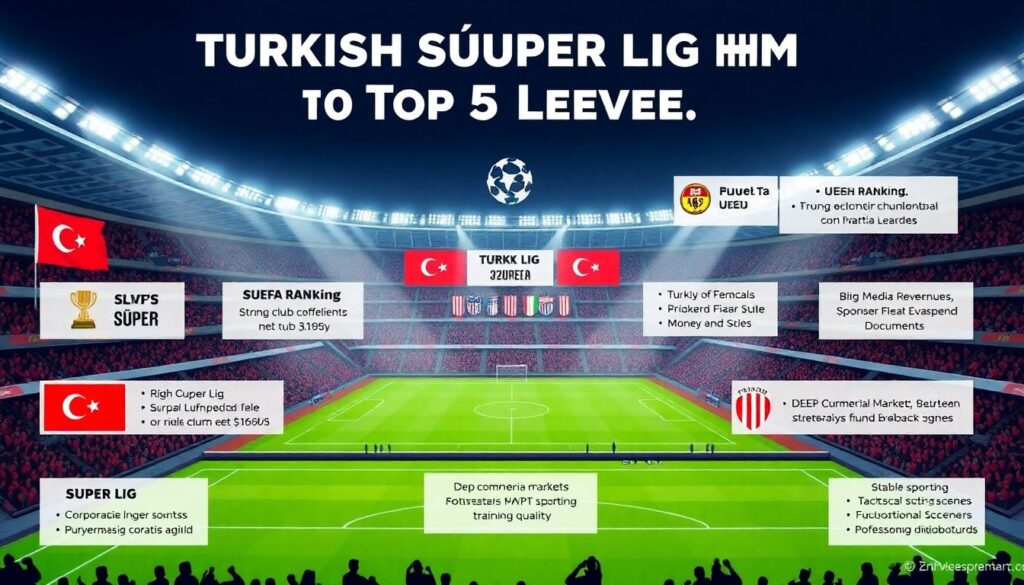
When people ask whether the Süper Lig can become a “Top 5 European league”, they usually mean more than just “is it fun to watch?”. In a technical sense, a top‑5 league in Europe combines high UEFA ranking, strong club coefficients, big media revenues, deep commercial markets and stable sporting quality. Right now, that set is basically: Premier League, La Liga, Bundesliga, Serie A and Ligue 1. For the Turkish top division to break in, it has to change its structural profile, not just sign a few aging stars or win a one‑off Europa League tie.
Let’s define a few terms so we’re on the same page. A domestic league coefficient is UEFA’s 5‑year points total from all clubs in continental competitions, divided by the number of teams, and it governs how many Champions League and Europa spots you get. Media rights value is the total sum broadcasters pay for live matches, often split into domestic and international packages. Matchday revenue covers income from tickets, hospitality and in‑stadium spending, while commercial revenue comes from sponsorships, kit deals and branding. When we ask if the Süper Lig can join the European elite, we’re really asking whether it can scale all four pillars at once: performance, money, governance and infrastructure.
—
Where the Süper Lig Stands Today (201/22–2023/24 snapshot)
UEFA ranking and on‑pitch performance
If we strip away emotion and look at the last three seasons of hard data (2021/22, 2022/23, 2023/24, with 2024/25 only partial by my knowledge cutoff), the Süper Lig is moving, but not at “top‑5” speed.
– UEFA association ranking
From 2021/22 through 2023/24, Türkiye has hovered roughly between 10th and 13th place in UEFA’s coefficient table. The exact number shifts year by year, but the key point: the Süper Lig is comfortably in the top‑15 band, occasionally flirting with the top‑10, but still clearly behind the big five plus regular over‑achievers like Portugal and the Netherlands.
– Club coefficients
Galatasaray, Fenerbahçe and Beşiktaş remain the main point generators. In 2022/23 and 2023/24:
* Turkish clubs usually field 2–3 teams in group stages across UEFA competitions.
* Average points per Turkish club per season have improved compared to the low of the late 2010s, but are still inconsistent—one strong run (say, a quarter‑final) often coexists with an early group‑stage exit from another side.
So the three‑year story is a gentle recovery from earlier decline, not a dramatic leap. To catch the top‑5, the Süper Lig would need several consecutive seasons where *multiple* Turkish teams go deep into the Champions League or Europa League at the same time.
—
Revenue scale vs the big leagues
Money doesn’t guarantee success, but in modern football, it heavily correlates with squad quality, depth and infrastructure. From 2021/22 to 2023/24, the revenue gap is the biggest structural reason the Turkish league sits outside the top‑5.
– Media rights
The combined domestic TV money of the Süper Lig over those seasons is a small fraction of the Premier League’s or even Ligue 1’s. While precise 2023/24 figures depend on contract renegotiations, you’re typically looking at a media‑rights pool closer to the level of the Eredivisie or the Portuguese league than to Italy or Germany. Discussions around new Super Lig TV rights deals Europe wide have underlined that international value is still underdeveloped: outside diaspora markets, the league has limited bargaining power with global broadcasters.
– Matchday income
Over the last three seasons, average attendances have improved for big-city clubs—especially Galatasaray and Fenerbahçe in title races—but the league as a whole still has a long tail of smaller clubs with low crowds. As a result, total matchday revenue for the Süper Lig is significantly behind even Ligue 1, which itself lags the top three.
– Commercial revenue
Sponsorship and merchandising are growing but remain vulnerable to currency volatility and domestic economic cycles. Even when headline shirt deals look big in lira, the euro‑denominated value is modest compared with top‑5 clubs.
From a pure revenue‑per‑club standpoint, the Süper Lig over 2021/22–2023/24 sits in the European second tier: ahead of many Eastern European leagues, roughly comparable to the best Scandinavian or Belgian sides, but clearly below the top‑5 plus Portugal and the Netherlands.
—
Key Obstacles Blocking a Top‑5 Breakthrough
1. Financial instability and currency risk
You can’t talk about Turkish football without mentioning macroeconomics. Between 2021 and 2024, the lira’s volatility has made financial planning extremely difficult. Club wage bills are often pegged in euros or dollars, but most income streams come in lira. When the currency swings, the same contract can suddenly become unsustainably expensive, and that’s exactly what has happened repeatedly.
The three seasons from 2021/22 to 2023/24 show recurring patterns:
– Clubs over‑extend on salaries and transfer fees to chase short‑term success or European qualification.
– Unexpected macro shocks drive up the real cost of those deals.
– Debt levels rise, and restructuring becomes almost routine.
This dynamic scares off long‑term investors and pushes clubs toward short contracts, stop‑gap signings and fire‑sale transfers. Structurally, that’s the opposite of what you see in the big five, where longer planning horizons and more stable TV contracts underpin multi‑year sporting projects.
—
2. Governance, ownership models and regulation
Many Süper Lig clubs still operate under association‑style or quasi‑member‑owned models with heavy political influence. That can sound romantic, but it often means:
– Election cycles and leadership changes every few years.
– Short planning horizons tied to presidential campaigns.
– Populist spending instead of data‑driven squad construction.
Compare that with the typical top‑5 club: mixed‑ownership models, professionalized boards, and stronger domestic licensing rules. UEFA’s Financial Fair Play and the new squad cost rules apply to everyone, but domestic enforcement in Türkiye has historically been more uneven. The last three seasons have seen tighter monitoring and some progress, yet there is still a gap in transparency and internal controls compared with, say, Germany’s licensing system.
—
3. Infrastructure and fan monetisation
Turkey has built a lot of new stadiums over the last decade, and that’s a huge plus. Still, stadiums don’t automatically translate into stable income. The 2021/22–2023/24 data suggests several problem points:
– Utilisation: outside the big three or four clubs, many stadiums run well below capacity for most games.
– Premium products: hospitality, VIP boxes and corporate sales are under‑developed relative to top‑5 clubs, where high‑margin seats are a major revenue driver.
– Digital engagement: the conversion of large fan bases into recurring revenue via memberships, OTT content and integrated CRM remains in its early stages.
Even something simple like selling Turkish Super Lig tickets online can be inconsistent across clubs. Some have modern e‑ticketing and dynamic pricing; others still have clunky, friction‑heavy systems that depress both attendance and yield.
—
4. Talent pipeline and export mechanics
On the pitch, the Süper Lig has long been known as a league that imports experienced foreign players, often in their late 20s or early 30s, while exporting relatively few high‑value domestic talents compared with, say, Portugal, the Netherlands or even Belgium. Data from the last three seasons reinforces the pattern:
– The biggest outgoing transfers from Turkish clubs are still rare and often one‑off events tied to a standout young player.
– The average age of incoming transfers has trended slightly down in recent years, but there’s still a bias toward short‑term fixes.
By contrast, “feeder” leagues like the Primeira Liga have built systematic pipelines: players arrive in their early 20s, develop for 2–3 seasons, then leave for €30–60 million fees. For the Süper Lig to close the financial gap, it needs to convert its scouting reach and youth academies into a reliable export engine, not just occasional surprises.
—
Opportunities That Could Push the Süper Lig Up the Ladder
1. Strategic use of media rights and streaming
One of the biggest levers is how the league reinvents its media product over the next rights cycles. The current deals have kept the system afloat, but they haven’t fully monetised the league’s international potential, especially among the global Turkish diaspora and neutral fans looking for high‑intensity matches.
Here’s where a more modern audiovisual strategy could help:
– Packaging: Instead of relying almost entirely on one domestic broadcaster, the league can split rights (weekend vs midweek, highlight vs long‑form, data‑rich “pro” feeds) to attract multiple partners.
– Direct‑to‑consumer: A dedicated OTT platform could complement classic TV contracts, especially for fans abroad.
– Analytics‑driven scheduling: Using data on audience peaks to select match times for marquee clashes and derbies.
Super Lig streaming subscription Europe offerings are still relatively niche compared with what you see for Serie A or La Liga, but that also means upside. The league can design products specifically for international consumers—English commentary, advanced stats overlays, flexible monthly plans—rather than just exporting a domestic feed.
—
2. Opening the door to smarter capital
Over the last three years, European football has seen a surge in multi‑club ownership and private equity funds entering broadcast and commercial structures. Turkish clubs are beginning to appear on the radar of these investors, but the environment is still perceived as high‑risk.
To change that, the clubs that want to attract serious money will have to:
– Improve transparency: audited accounts, clear debt restructuring plans, and realistic sporting targets.
– Separate politics from operations: defined governance rules that protect long‑term planning from short‑term interference.
– Build assets beyond players: de‑risking by investing in academies, training centres, data departments and digital platforms.
For someone looking to invest in Turkish football clubs, the sweet spot is likely medium‑sized teams in big cities that can grow stadium utilisation, build academy pipelines and flip players. If even a handful of such projects start to work and generate steady profits over the next cycle, that will change the league’s reputation across Europe.
—
3. Sponsorship and commercial optimisation
Commercial income is another obvious growth area. The league’s passion, atmosphere and intense rivalries are highly marketable if packaged correctly. Right now, Super Lig sponsorship opportunities are still under‑monetised relative to the emotional value of the product.
Ways to unlock value include:
– League‑level partnerships: selling naming rights, data sponsorships, and official category partners (crypto, fintech, travel) with guaranteed activation inventory across all clubs.
– Unified branding: consistent visual identity, digital content guidelines and social media standards to present the Süper Lig as a coherent premium product.
– Analytics‑driven pricing: using audience and engagement data from the last three seasons to set smarter rates for shirt and sleeve sponsors, LED boards and digital overlays.
Instead of every club negotiating in isolation based purely on historical prestige, the league can present aggregated reach metrics across a three‑year rolling window, which is exactly what top‑5 leagues do to keep sponsorship values rising, even when on‑field results fluctuate.
—
4. Youth development and data‑driven recruitment
If there’s one area where the Süper Lig can gain ground quickly, it’s talent optimisation. The raw material is there: a football‑obsessed population, big urban centres and a rich local scouting network. The challenge is converting that into structured development and modern recruitment.
Concrete steps that clubs can take over the next few seasons:
– Upgrade academies: better coaching education, sports science, nutrition and analytics integration at youth levels.
– Clear pathways: guarantee minutes for U‑23 players via squad management rules and loan networks.
– Data‑scouting: combine human scouting with data models that flag undervalued talents in secondary markets (Balkans, North Africa, Central Asia).
If more Turkish clubs become known as platforms where 18–22‑year‑olds get real minutes and supportive development, the league can reposition itself similar to how the Eredivisie has done over the last decade—still selling players, but at systematically higher fees based on clear track records.
—
Comparing Süper Lig Trajectories with Other “Challenger” Leagues
Lessons from Portugal and the Netherlands
Portugal and the Netherlands are the two clearest analogues of “chasing the big 5” while accepting a role as elite talent exporters. Over the last three seasons, their top clubs have:
– Generated strong UEFA coefficients through repeated deep runs in the Champions League and Europa League.
– Built transfer revenue as a structural line in the budget, not a bonus.
– Maintained a reasonably healthy ratio of wages to turnover (even if not perfect).
The Süper Lig, by contrast, has often flipped between “invest to qualify” and “sell to survive”, without a stable underlying model. The Portuguese and Dutch cases show that you can’t buy your way into the top‑5; you have to *build* a coherent identity first.
—
What about France and Germany as benchmarks?
France and Germany offer different blueprints:
– Germany: rigorous licensing, fan‑involved ownership, packed stadiums, and consistent matchday plus commercial growth.
– France: heavy reliance on TV money and player trading, plus a singular giant (PSG) that pushes the coefficient but also distorts domestic competition.
For the Süper Lig, Germany’s emphasis on governance and infrastructure is probably the more realistic template. Over 2021/22–2023/24, most Turkish clubs simply did not have the financial scale to emulate Ligue 1’s transfer market behaviour, but they *could* move closer to the Bundesliga in transparent regulation, fan engagement and stadium utilisation.
—
Fan Experience, Digital Reach and Global Brand
Why fan‑centric strategies matter as much as tactics
From 2021/22 through 2023/24, one under‑appreciated bright spot has been the visible increase in online engagement: social media followings of big Turkish clubs have continued to grow, and derby days generate global trending topics. The question is how to turn that into recurring cash flows and a stronger global brand.
Pieces of the puzzle include:
– Better international content: English‑language highlights, tactical breakdowns, player stories.
– Seamless digital purchasing: from match tickets to merchandise triggered directly inside club apps or social feeds.
– Flexible outing packages: bundling tickets, transport and hospitality options for domestic and foreign fans.
Here, even mundane details like how smoothly you can buy Turkish Super Lig tickets online matter. Frictionless UX turns curiosity into actual attendance and revenue. The big five have spent a decade optimising that funnel; the Süper Lig is catching up but still has plenty of low‑hanging fruit.
—
Text‑Based Diagrams: Where the Süper Lig Needs to Move
Current vs desired position in Europe
Let’s describe two simple ASCII‑style diagrams to summarise the strategic gap.
1) Competitive tier diagram (simplified)
Current perceived tiers (2023/24):
– Tier 1: Premier League
– Tier 2: La Liga, Bundesliga, Serie A
– Tier 3: Ligue 1
– Tier 4: Portugal, Netherlands
– Tier 5: Süper Lig, Belgium, Russia (when included), Scotland, others
Desired position for the Süper Lig within 10–15 years:
– Tier 1: Premier League
– Tier 2: La Liga, Bundesliga, Serie A
– Tier 3: Ligue 1, Süper Lig, Portugal, Netherlands
The goal isn’t necessarily to dethrone the Premier League; it’s to join the *stable* tier of leagues that consistently sit just below.
2) Revenue vs coefficient diagram (conceptual)
Imagine a horizontal axis for *revenues per club* and a vertical axis for *UEFA coefficient*.
– Top‑5 leagues are clustered in the upper‑right quadrant (high revenues, high coefficients).
– Portugal/Netherlands are in the upper‑middle (good coefficients, mid revenues).
– The Süper Lig currently sits in the mid‑left area (mid coefficients, relatively lower revenues).
The strategic journey is a diagonal move towards the upper‑right: simultaneous growth in income and competitive performance, not trading one off against the other.
—
So… Can the Süper Lig Become a Top‑5 European League?
Short‑ to medium‑term outlook (next 5–7 years)
Based on the trajectory from 2021/22 to 2023/24, it’s hard to argue that the Süper Lig will *numerically* crack the top‑5 in UEFA ranking or revenue by the early 2030s. The financial, structural and regulatory gaps are simply too big, and the big leagues are also evolving, not standing still.
However, the league can absolutely:
– Solidify its status as a top‑8 league in Europe.
– Edge closer to Portugal and the Netherlands in both coefficient and commercial strength.
– Become a more attractive destination for young talents and rational investors.
That alone would be a huge upgrade compared with its position a decade ago.
—
Long‑term scenario (10–15 years)
If we zoom out, a more optimistic but still realistic scenario appears—*if* key reforms take place:
– Financial stabilisation: wage bills tied more strictly to turnover, currency risks hedged, and serious cost controls enforced.
– Governance modernisation: professionalised club management, reduced political interference, clear licensing standards.
– Media and digital strategy: smarter Super Lig TV rights deals Europe focused on both domestic security and international upside, plus a robust direct‑to‑consumer streaming ecosystem.
– Talent and data optimisation: systematic development and export of players, supported by analytics and sports science.
Under those conditions, the label “top‑5” becomes less critical. What really matters is that the Süper Lig evolves into a sustainably competitive, financially credible and globally visible league. In that world, buying a Super Lig streaming subscription Europe‑wide feels as normal as signing up for La Liga or Serie A, and sponsorship and ticketing ecosystems are delivering stable returns.
—
Actionable priorities for stakeholders
To close out, here is a concise checklist of what different actors should focus on over the next cycle:
– League and federation
– Tighten licensing rules and enforce wage‑to‑turnover caps.
– Centralise and professionalise commercial deals and branding.
– Invest in data infrastructure and international marketing.
– Clubs
– Shift from short‑term star chasing to long‑term squad building.
– Modernise ticketing, CRM and fan engagement systems.
– Build credible youth pathways and embrace data‑driven scouting.
– Investors and sponsors
– Look beyond headline volatility to long‑term fan‑base value.
– Partner with clubs on governance and digital transformation, not just shirt logos.
– Use multi‑year horizons and realistic return expectations.
If enough of these pieces move in the right direction, the question “Can the Süper Lig become a top‑5 European league?” might eventually feel less important than a more practical one: *How do we maximise the unique strengths of Turkish football within the global ecosystem?*