
Global tactical waves washing over the Süper Lig
The last decade has turned football into a kind of tactical stock market, where ideas rise in one league and are almost instantly traded to another. The Süper Lig used to pick trends with a delay, often via aging European stars or coaches at the end of their cycles. Now things are different: clubs are copying pressing patterns from the Bundesliga, build‑up schemes from La Liga and rest-defense concepts from Serie A almost in real time. When people talk about Süper Lig tactical analysis 2024, they no longer compare Turkey only to its own past; they check how quickly local clubs can mirror, refine or even localise the same principles we see on Champions League nights.
You can feel this change simply by watching a mid‑table game on a random Sunday. Full-backs step into midfield, keepers stand near the centre circle in possession, and wingers defend inside like extra No. 8s. Ten years ago, that would’ve looked experimental. Now it’s just another matchday.
How global trends reshape Turkish game models
If you strip away the noise and look purely at structures, three global ideas are shaping Turkish football most: high pressing, positional play and flexible back lines that morph between a three and a four. The European football tactics influence on Turkish clubs is clearest in how teams manage space rather than which famous names they sign. Big sides are defending higher with coordinated pressing triggers, trying to force long balls instead of dropping deep. In possession, more coaches are experimenting with 3+2 or 2+3 build‑up, using inverted full-backs and rotating midfield triangles. The aim is not only to keep the ball, but to control where the game is played and how transitions unfold, which has historically been a weak point for many teams in Turkey.
Pressing used to be about “running more”; now it’s about “running smarter”.
Necessary tools: people, data, and training ground tech

To actually apply these ideas, clubs need more than a laptop and a whiteboard. First, staff: assistants with strong tactical backgrounds, analysts who understand both video and numbers, and fitness coaches who can prepare players for high-intensity pressing. That’s where data analytics services for Süper Lig clubs have become crucial, providing detailed insight into pressing efficiency, line height, pass networks and individual player loads. Second, tools: multi-angle video systems, GPS vests, tracking data and software that can code phases of play instead of just cutting highlights. Finally, environment: a training culture where players are used to short, intense, tactically loaded sessions rather than old-school, volume-based fitness work that leaves little mental energy for complex ideas.
At smaller clubs, even one good analyst and a shared GPS kit can be a game changer.
Leveraging education and the coaching market
The second tool is education. The growth of modern football tactics coaching courses Turkey now offers has made it easier for young coaches to learn from European best practice without leaving the country for years. Many of them also spend time embedded with clubs abroad during licence modules, bringing back updated ideas on build-up structures, rest defence and set-piece design. At the same time, the coaching market is more fluid: Turkish clubs are quicker to appoint foreign assistants or analysts even when the head coach is local. This blend of local knowledge and imported expertise reduces the traditional “lag” between what top European sides are doing and what you see at a Friday-night game in Ankara or Izmir.
The challenge is keeping these people long enough to build continuity.
Step-by-step process: bringing world tactics into a Süper Lig dressing room
The first step is ruthless self-diagnosis. Before copying Guardiola or Klopp, a staff must ask three basic questions: What are our physical limits? How press-resistant are our defenders and midfielders? And how much tactical information can this group absorb across a season? From there, coaches can define a game model that fits the club’s reality, then borrow global ideas that plug into it. Expert analysts I’ve spoken with stress that “imported” tactics must be trimmed: for instance, turning a 90-minute high press into targeted 10–15 minute waves or using positional play only in settled possession, not in every phase. The goal is to build a coherent identity that references global trends but is not enslaved by them.
Blind imitation is the fastest route to chaos.
Designing sessions that translate theory to habits
Once the model is clear, the work shifts to the pitch. A typical weekly microcycle at a tactically ambitious club in Turkey now includes one day focused on pressing triggers and rest defence, one on build-up and chance creation, and one on set pieces. Drills are built around likely match scenarios: for instance, 7v5 build-up exercises to rehearse playing through a high press, or 8v8+2 games to practise counterpressing after losing the ball. Coaches use video clips from elite leagues not as “aspiration posters” but as concrete reference points: “Watch how this full-back tucks in; that’s your movement.” According to several Pro Licence tutors, that specificity is what separates modern staff from previous generations who relied more on general motivational speeches than clear tactical cues.
Players buy in quicker when they see exactly how a drill connects to match actions.
Integrating scouting with tactical needs
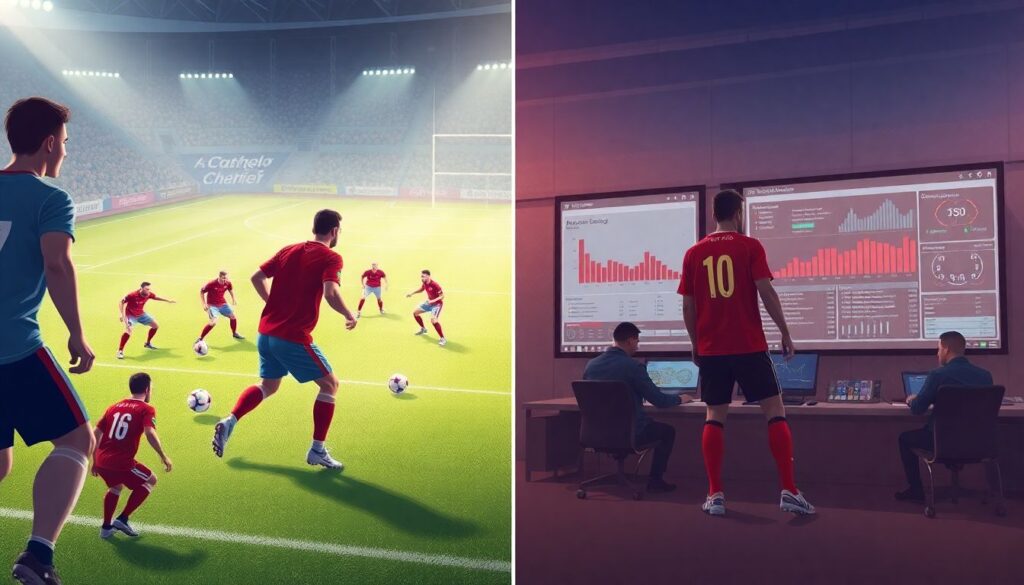
Tactical trends only stick if recruitment supports them. You cannot press high with slow centre-backs or play out from the back with keepers who panic under mild pressure. That’s why football scouting and recruitment agencies Turkey now work with, especially those that use data and video profiling, are being briefed in far more tactical detail: coaches request “aggressive ball-playing No. 6s who can defend wide spaces” instead of just “strong midfielders”. Scouts filter options according to tactical fit, then analysts dive into event data and tracking information to confirm whether a player’s habits match the game model. Done well, this process shortens adaptation time and reduces the number of expensively miscast signings who look good in isolation but weaken the overall structure.
In other words, the shopping list is written by the tactics, not by names.
Troubleshooting: why global ideas sometimes fail locally
When imported tactics go wrong in the Süper Lig, the symptoms are usually visible within a month: huge gaps between lines, exhausted forwards, defenders shouting at each other while the opposition counters into open space. One common issue is physical mismatch; pressing schemes copied from the Bundesliga can overload squads not conditioned for repeated high-intensity sprints. Another is cultural: some players are used to more freedom with the ball and may interpret structured possession as a restriction rather than a framework. Experts who consult clubs often recommend a phased rollout—starting with rest-defence and pressing in “hot zones” like after set pieces—rather than trying to transform every phase at once. When the game model looks broken, the answer is rarely “more running”; it’s usually “clearer priorities”.
If everything is a priority, nothing is.
Fixing communication and information overload
The most underrated troubleshooting tool is language—how coaches talk about tactics. In multi-national squads, a sophisticated plan explained poorly quickly becomes half-understood patterns, then chaos. Analysts with European experience suggest simplifying the vocabulary, limiting each line to two or three key cues per phase: for example, full-backs focus on “line height” and “inside cover”, forwards on “pressing angles” and “body shape”. Short, frequent video meetings work better than long lectures, especially after defeats when concentration drops. Where possible, staff use individual clips on players’ phones or tablets, combined with clear visual cues on the training pitch. When communication improves, you often see an immediate reduction in late reactions and positional errors, even if the underlying tactical model stays the same.
Understanding beats memorising every time.
Expert recommendations and future outlook
Analysts, scouts and coaches working at the top level in Turkey generally agree on three forward steps. First, deepen the link between clubs and universities to grow local analysts instead of importing them; that will strengthen the ecosystem around data and video. Second, invest in youth academies that teach pressing and build-up concepts early, so first-team coaches don’t have to start from zero with 24‑year‑olds. Third, use external specialists—whether from big clubs abroad or independent consultants—to audit game models at least once a season. This is where European football tactics influence on Turkish clubs can be most productive: not as blind copying, but as regular benchmarking against higher standards. With better structures, the constant flow of tactical ideas will feel less like a storm and more like a steady, predictable wind.
If Turkish clubs can align education, data and recruitment, the gap to Europe will shrink faster than many expect.
Where technology and expertise will meet next
Looking ahead, the clubs that benefit most from global trends will be those that treat information as a competitive weapon instead of a marketing toy. Several technical directors already predict that within a few years, most top-flight sides will have in-house xG models and tracking analysis rather than outsourcing everything, even if they still partner with external companies for specialised tasks. The growing market of data analytics services for Süper Lig clubs will likely pivot from “providing numbers” to “answering coaching questions”, becoming an extension of the staff rather than a distant supplier. Combined with increasingly demanding modern football tactics coaching courses Turkey is rolling out, that shift should tighten the feedback loop between what the world’s best teams are doing and how quickly those concepts can be translated, tested and improved on Turkish soil.