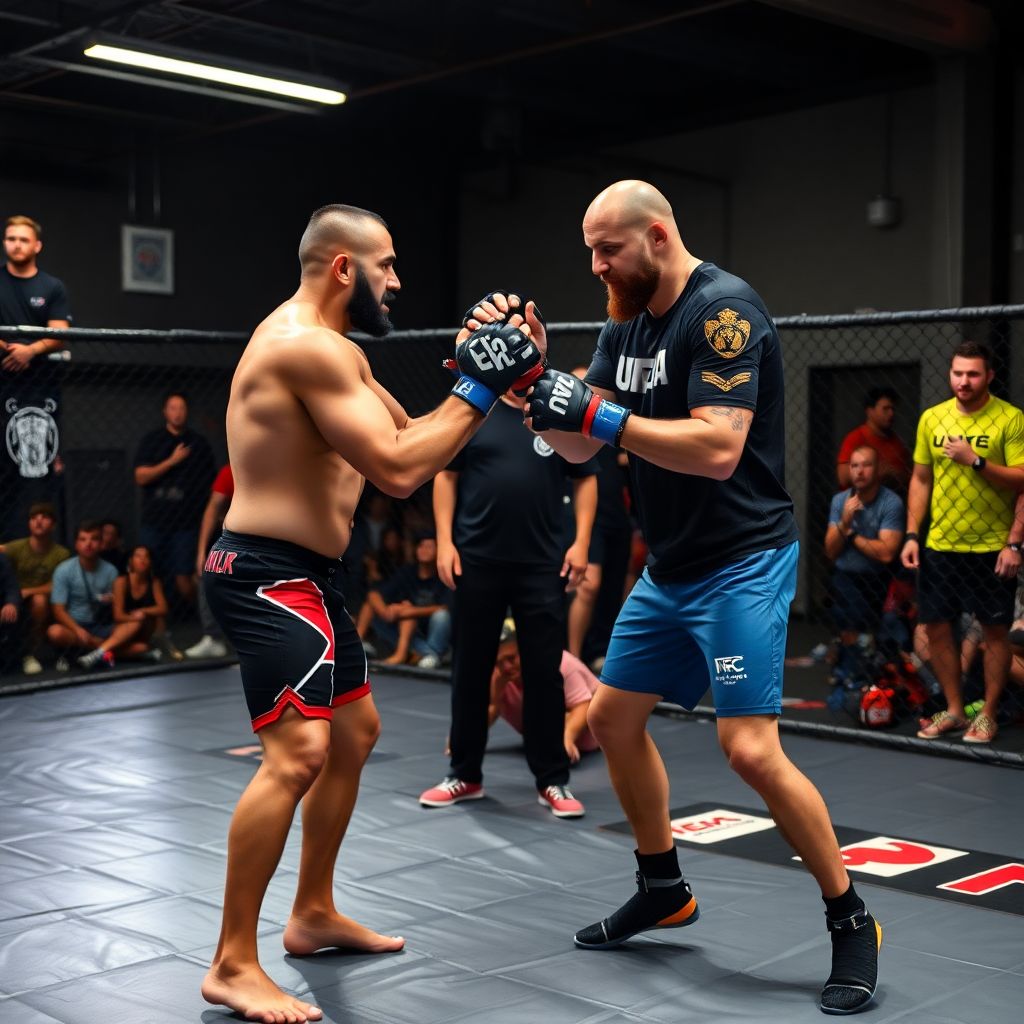
Mutual respect between Khamzat Chimaev and Demetrious Johnson has come to the forefront after the two stars shared the mats in a joint training session. Following their work together, both fighters offered detailed and admiring assessments of each other’s skills and mentality, revealing how much they took away from the experience.
Middleweight champion Khamzat Chimaev, who has built a reputation as one of the most dangerous and relentless fighters of his generation, did not hide his excitement about having the chance to train with a legend like Demetrious Johnson, widely viewed as one of the greatest lighter-weight fighters in MMA history.
Chimaev described the session as a special moment in his career, underlining how highly he rates Johnson’s abilities.
“Working with Demetrious Johnson was incredible,” he said. “He’s a legend, number one, and one of the best this sport has ever seen. His technique is unbelievable. If anyone in this sport can be called a ‘computer,’ it’s him.”
The middleweight star went on to explain that he has followed Johnson for years and used the former champion’s performances as a learning tool.
“I’ve grown by watching his fights,” Chimaev admitted. “I try to apply some of the things he does with my own body. Sometimes it works, sometimes it doesn’t, but having him here, being able to learn directly from him, is always amazing.”
Johnson, in turn, offered his own breakdown of what makes Chimaev so difficult to deal with on the mat. Known for his analytical approach and high fight IQ, Johnson focused on the details of Chimaev’s grappling style and the unique pressure he brings during exchanges.
According to Johnson, Chimaev’s passing game stood out immediately.
“Khamzat has a style where he can cut through my guard so easily,” Johnson explained. “He’ll place one hand on your body, around the stomach, and the other on your leg, and somehow his balance never breaks. Then he transitions extremely fast.”
Johnson emphasized that it’s not just Chimaev’s physicality that makes him dangerous; it’s the combination of strength, balance, and timing. The way Chimaev maintains his base while moving from one dominant position to another impressed even a veteran who has seen nearly everything in the sport.
What truly resonated with Johnson, however, was how Chimaev behaved as a teammate once the hard rounds were over. After the training session ended, Chimaev did not just pack up and leave. Instead, he stayed on the mats, talking with training partners, breaking down movements, and helping them refine techniques.
“Even after the session was done, he kept giving his teammates time,” Johnson noted. “He was explaining techniques, showing them what to do if an opponent is very fast, telling them how to pin someone down, where to place one hand on the stomach and the other on the wrist to control and pass.”
For Johnson, this willingness to teach and share knowledge is a direct reflection of Chimaev’s personality.
“That aspect of him, I really loved,” Johnson concluded. “It shows his character.”
—
Beyond the mutual compliments, this training encounter underlines a deeper theme: elite fighters never stop being students of the game. Chimaev, despite already holding a championship and being feared for his aggression and finishing ability, openly studies a smaller, technically brilliant fighter like Johnson to sharpen his own craft. This demonstrates how success at the highest level in MMA is built not only on power and toughness, but on humility and curiosity.
Demetrious Johnson, for his part, has long been praised for his technical precision, fluid transitions, and ability to chain together strikes, takedowns, and submissions. Seeing someone of Chimaev’s size and style try to adapt elements of Johnson’s movement shows how universally respected Johnson’s approach is. When a middleweight known for suffocating pressure tries to absorb ideas from a flyweight legend, it highlights how technique can transcend weight classes.
Their session also sheds light on the evolving nature of modern MMA training. Fighters no longer stay isolated within one gym or one style. Cross-training with champions from different divisions and backgrounds has become an essential way to stay ahead. Chimaev, who built his reputation on dominant wrestling and top control, gets exposed to Johnson’s timing, angles, and creativity. Johnson, meanwhile, tests his defensive instincts and guard retention against a bigger, more explosive grappler.
From a stylistic perspective, the pairing is fascinating. Chimaev is known for storming forward, closing distance quickly, driving opponents to the cage or the mat, and overwhelming them with pressure. Johnson made his name with constant motion, positional awareness, and the ability to counter from almost anywhere. To have both of these worlds collide in the gym creates a rare laboratory of high-level experimentation, where each tries to solve the puzzle the other presents.
The way Johnson described Chimaev’s guard passing hints at the technical depth behind Chimaev’s usually ferocious image. Fans often see only the chaos and intensity on fight night, but training partners and coaches know how much detail lies beneath. Proper hand placement, weight distribution, hip control, and step patterns all contribute to that “easy” guard pass Johnson mentioned. Coming from one of the most technically refined fighters ever, such praise is a strong endorsement of Chimaev’s skill set, not just his strength.
Chimaev’s reaction to Johnson can also be read as a blueprint for rising athletes. Instead of downplaying other stars or pretending he has nothing left to learn, he openly acknowledges Johnson as one of the best to ever do it. By saying he tried to mimic some of Johnson’s movements, even if they do not always fit his own body type, Chimaev shows the mindset that often separates champions from contenders: constant experimentation and willingness to fail in the gym in order to grow.
The mentoring moment described by Johnson, where Chimaev stayed to show techniques to teammates, reveals another layer: leadership through sharing. High-level fighters often accumulate a wealth of information, and how they use that knowledge says a lot about them. Some keep it for themselves, while others, like Chimaev in this scenario, choose to spread it within the team. Teaching reinforces understanding; by explaining how to handle a fast opponent or how to stabilize a position, Chimaev refines his own game while elevating those around him.
For fans, collaborations like this session between Chimaev and Johnson serve as a reminder that behind every highlight reel and championship belt are countless hours of quiet work with other great fighters. The respect they expressed for each other is not just polite talk; it reflects real appreciation for the complexities of the sport. Both men operate in different weight classes and at different stages of their careers, yet their interaction shows that excellence in MMA speaks a common language: technique, discipline, and a shared love for constantly improving.
Finally, the mutual admiration sends a positive message to the next generation of fighters and fans. Instead of rivalry turning into hostility, here we see competition combined with respect. Chimaev looks up to Johnson’s technical genius, while Johnson highlights Chimaev’s balance, speed of transition, and generosity as a teammate. In an era where trash talk often dominates headlines, this exchange stands out as proof that the sport still thrives on craftsmanship, mutual learning, and the recognition of greatness in others.