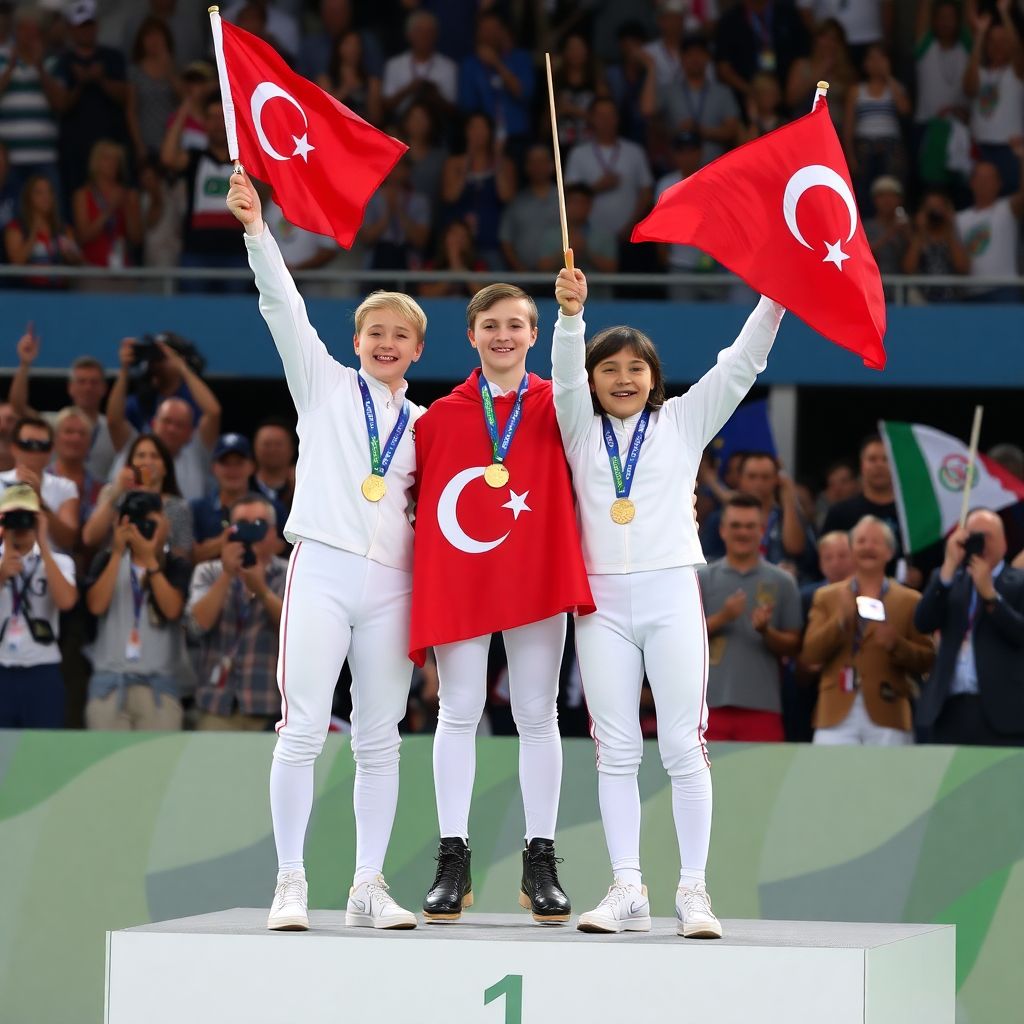
Bronze medal for Turkish national fencers in Brazil
The Turkish junior men’s sabre team has written an important chapter in the country’s fencing history, capturing the bronze medal at the World Cadets and Juniors Fencing Championships held in Rio de Janeiro, Brazil. Competing in the team sabre event, the national squad finished third after a dramatic and hard-fought victory over Italy.
According to the Turkish Fencing Federation, the event in Rio brought together the most promising young fencers from around the globe. In the junior men’s sabre team category, Turkey was represented by Furkan Yaman, Enes Talha, Kalender Berrak and Candeniz Berrak. The quartet showed consistent, high-level performance throughout the competition and ultimately secured a podium finish.
The bronze-medal match against Italy turned into a thriller. The duel, contested under intense pressure, was decided by the narrowest possible margin. The Turkish team edged past the Italian squad with a 45-44 score, sealing third place and claiming the bronze medal. The final touch, coming at 44-44, embodied both the mental toughness and technical precision that the young Turkish fencers have developed over recent years.
This result is especially meaningful given the depth of talent traditionally found in countries like Italy, which has a long and successful history in fencing. Beating such an established powerhouse in a direct elimination match is a strong indication that Turkey’s younger generation is closing the gap on the world’s leading nations in the sport.
The World Cadets and Juniors Fencing Championships in Rio de Janeiro feature individual and team competitions across multiple weapons and age categories. For the junior men’s sabre team, the bronze medal represents one of the standout achievements of the Turkish delegation at this prestigious tournament. The event is scheduled to conclude on Thursday, April 9, after several days of intense competition on the pistes.
Beyond the medal itself, the performance of Yaman, Talha, Kalender Berrak and Candeniz Berrak highlights the growing effectiveness of Turkey’s long-term investment in fencing. Over the past decade, the national federation has increased its focus on youth development, organizing more domestic tournaments, expanding training camps and collaborating with experienced coaches to raise the overall technical and tactical level of its athletes.
Reaching the top three in a world championship team event is a clear sign that these efforts are beginning to bear fruit. For the athletes, the bronze medal is both a reward for years of disciplined training and a stepping stone towards senior-level success. For the federation and the broader sports community, it serves as confirmation that the current development model is working.
Another important aspect of this achievement is the psychological impact on the team and on younger fencers watching from home. A tight 45-44 win in a medal match teaches invaluable lessons in resilience: how to manage nerves, how to stay focused in the final bouts and how to handle the pressure of fencing with everything on the line. These experiences often prove decisive later in athletes’ careers, especially when they step onto the piste at European Championships, World Cups or even the Olympic Games.
From a tactical perspective, team sabre competitions demand more than just individual talent. Success requires strategic lineup decisions, effective communication between teammates and the ability to adapt to different opponents and styles over the course of nine bouts. The Turkish squad’s ability to respond to Italy’s adjustments, maintain composure and close out the match in the final relay underscores their maturity and understanding of the team format.
This bronze medal also raises expectations for upcoming international events. With the World Cadets and Juniors Championships acting as a showcase for the stars of tomorrow, strong results here often foreshadow future success at the senior level. If the current trajectory continues, several members of this junior team could soon become mainstays of the senior national squad, representing Turkey in continental and world championships and vying for Olympic qualification.
The timing of this success is particularly significant for Turkish fencing. As the sport gains more visibility in the country, achievements on the world stage help inspire new generations to pick up the sabre, foil or épée. When young athletes see national colors on the podium, it becomes easier for coaches and clubs to attract new talent, secure better training conditions and deepen the talent pool across all age categories.
In practical terms, a world championship medal can also influence support from public institutions and sponsors. Strong international results often lead to increased funding for training programs, equipment and travel to additional high-level competitions, creating a positive cycle of growth and performance. The bronze from Rio de Janeiro may therefore have an impact that extends far beyond a single tournament.
As the World Cadets and Juniors Fencing Championships approach their conclusion on April 9, the Turkish delegation can already look back on a campaign marked by determination and progress. The junior men’s sabre team’s bronze medal stands out as a symbol of that progress: a sign that Turkish fencing is steadily establishing itself among the serious contenders on the international stage and that the nation’s young fencers are ready to challenge the traditional giants of the sport.