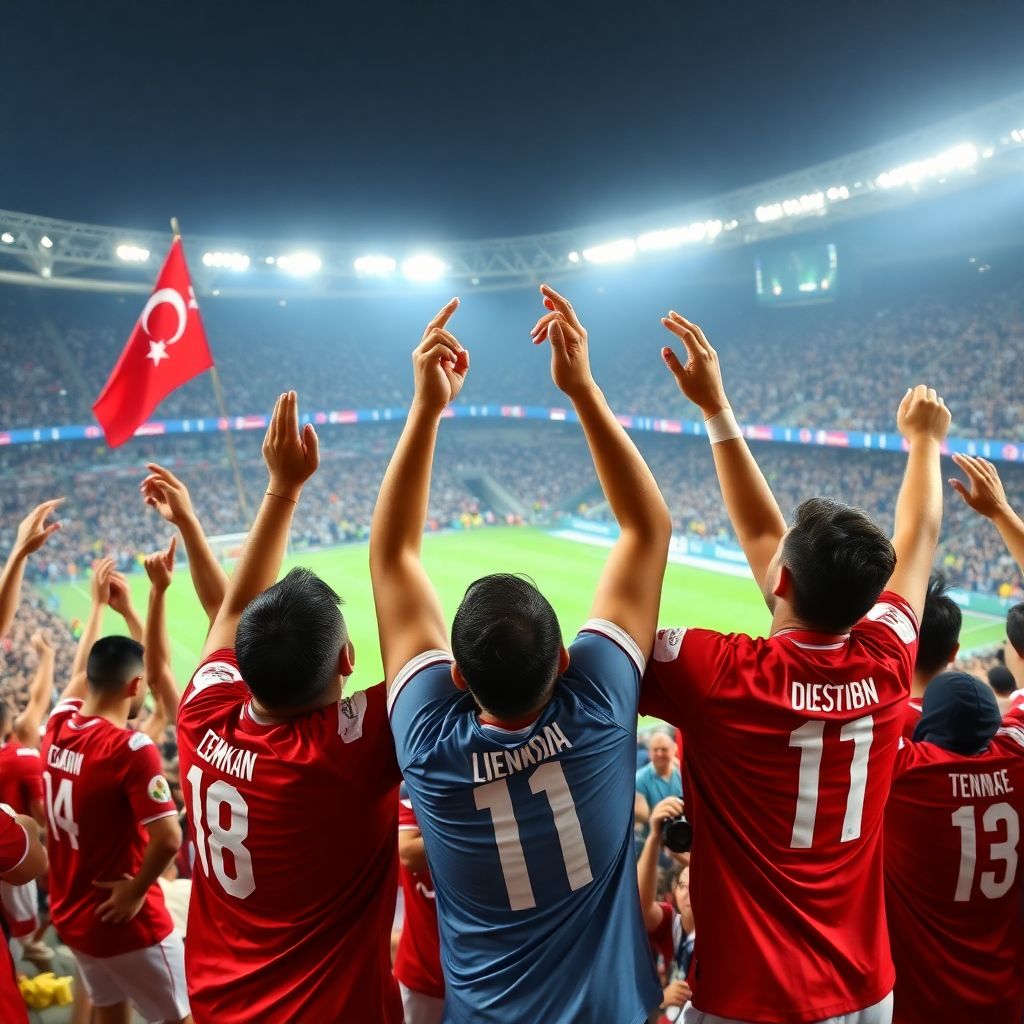
Turkey can realistically compete for a major trophy within 10 years, but only if structural issues are tackled: consistent coaching vision, better youth-to-senior transitions, smarter federation investment and stable qualification performances. The talent base is strong enough for dark‑horse runs at the Euro and, with luck and planning, a deep World Cup knockout appearance.
Executive summary: Turkey’s odds for a major title
- Turkey’s talent pool and club infrastructure are sufficient to target regular Euro knockouts and occasional quarter‑finals over the next decade.
- A sustained run toward a Euro semi‑final is more plausible than winning a World Cup, where depth and experience gaps are larger.
- Coaching continuity and a clear playing identity will influence Turkey national football team odds to win Euro more than individual “golden generation” hype.
- Academies and exports to top‑five European leagues are improving, but pathways from U17/U19 to senior level remain inconsistent.
- Without governance and investment reforms, Turkey will likely stay a dangerous outsider rather than a true tournament favourite.
- Short, safe steps for fans and bettors include focusing on match‑by‑match value rather than speculative bets to win entire tournaments.
Recent trajectory: performance since 2016
To judge whether the Turkish national team can compete for a major trophy in the next decade, it helps to define the recent performance cycle. Since around 2016, Turkey has oscillated between impressive qualifying campaigns and underwhelming tournament finals, particularly at the European Championship level.
This period has featured several promising generations, with players moving to leading clubs in England, Italy, Spain and Germany. At their best, Turkey has shown the capacity to beat or draw with higher‑ranked European sides, especially at home. Yet in final tournaments, the team has often struggled with game management, pressure and adapting tactics between group matches.
In UEFA competition terms, Turkey sits in an in‑between space: usually stronger than clear minnows, but not consistently at the level of continental heavyweights. This makes Turkey a classic “high‑variance” team: capable of a quarter‑final run in a good year, but also of exiting in the group stage when key details go wrong.
Over the next 10 years, a realistic projection is that Turkey will regularly qualify for the Euro, occasionally reach the knockouts and once or twice mount a serious challenge. Turning that challenge into an actual trophy requires converting this volatility into consistent, tournament‑specific performance through better planning and tactical flexibility.
Squad depth and talent pool: senior roster analysis
Squad depth is the engine behind any major trophy challenge. Turkey’s senior roster currently combines experienced internationals with a steady flow of younger players from domestic giants and European clubs. On paper, this mix allows for a competitive starting XI, but reveals depth concerns in certain positions.
- Goalkeepers: Usually reliable first‑choice options, but a limited pool of keepers playing every week in top‑five European leagues. This can matter against elite opponents where decision‑making under pressure is vital.
- Central defenders: One of Turkey’s traditional strengths, especially when key players are fit and in form abroad. However, injuries or suspensions quickly expose a drop‑off in pace, distribution or concentration among backups.
- Full‑backs / wing‑backs: Modern tournaments demand full‑backs who can both attack and defend in wide spaces. Turkey has emerging talents here, yet not the same depth as nations that consistently reach semi‑finals.
- Central midfielders: The most promising zone, with technically gifted players who can control tempo. The remaining challenge is balancing creativity with defensive stability against top pressing teams.
- Wingers and attacking midfielders: The national team regularly produces one or two standout dribblers or creators per cycle. Trophy‑winning sides typically field three or four at near‑elite level, offering more rotation and form protection.
- Centre‑forwards: Striker quality has fluctuated. There are seasons when Turkish strikers score heavily in strong European leagues, followed by cycles with fewer clinical options. This inconsistency directly affects Turkey national football team odds to win Euro or progress deep in World Cups.
Projection: with careful load management, dual‑national recruitment and a clear succession plan in each line, Turkey can field a squad capable of beating anyone in a single knockout game, though remaining depth gaps make a seven‑match title run unlikely without exceptional luck.
Academies, youth teams and transfer strategy
Academies and youth systems determine whether the current talent wave is a one‑off or part of a sustained trend. In Turkey, big clubs have upgraded youth facilities, but the key success factor is the transition from youth to senior football, both domestically and abroad.
- Domestic academy graduates to first teams: The main Istanbul and Anatolian clubs are promoting more academy players than in previous decades. However, some still struggle to give youngsters sustained league minutes, favouring short‑term foreign signings.
- Youth national teams (U17, U19, U21): Turkey’s youth sides periodically reach final tournaments, showing that raw talent is not the issue. The problem is converting promising U17 or U19 internationals into regular starters at 22-24, the core age for major tournaments.
- Export to top leagues: Increasingly, top Turkish prospects move early to Germany, Italy, England or France. When the moves are well chosen, they accelerate development; poorly planned transfers can leave players on the bench and stall progress.
- Loan and buy‑back strategies: Safe transfer strategy involves targeted loans to clubs that fit a player’s style. This is an area where Turkish clubs and the federation can coordinate better, using data to guide where prospects are sent.
- Dual‑national recruitment: Many high‑potential players grow up in European academies. Persuading them to represent Turkey is a strategic advantage, but it must be matched by a clear medium‑term development plan rather than short‑term call‑ups.
Projection: if Turkish clubs and the federation align around a long‑term pipeline, bridging youth success to senior impact, the national team can enter the 2030s with a deeper, more balanced squad that genuinely threatens semi‑finals at least once in the 10‑year window.
Coaching, tactics and national playing identity
Even a strong player pool needs coherent coaching and a stable tactical identity. In the last decade, Turkey has changed managers relatively frequently, alternating between more conservative and more expansive styles. This instability complicates long‑term planning and makes tournament performances harder to predict.
Strategic strengths in Turkey’s current identity
- Ability to switch between back‑three and back‑four structures, providing flexibility against different opponents.
- Technically skilled midfielders capable of short passing and quick combinations under pressure.
- Passionate, intense pressing in front of home crowds, which can overwhelm visiting teams in qualifiers and Nations League matches.
- Mental resilience in some comeback games, showing that the group can respond positively to setbacks when belief is strong.
Structural limitations that cap trophy potential
- Inconsistent game management in tournaments: conceding goals in key moments, difficulty closing out leads against top sides.
- Gaps between lines when pressing breaks down, leaving defenders exposed in transitions.
- Limited rehearsal of multiple game plans; at times Turkey has looked short of ideas when Plan A is neutralised.
- Pressure management issues at major finals, leading to cautious or rushed decisions that do not reflect qualifying performances.
Projection: if Turkey can secure a long‑term head coach with a clear identity and strong man‑management, sticking to that project through short dips in form, the team’s tactical ceiling is high enough to support at least one serious title push, especially at a Euro hosted in familiar conditions.
Qualification routes and key continental rivals
Pathways to trophies start with repeated, stable qualification. For Turkey, the Euro qualifiers and World Cup qualifiers are both opportunity and risk. Group draws vary widely: a favourable draw can open the path to a top‑two finish, while a tough group can leave little margin for error.
There are also practical considerations for fans and analysts. For instance, demand for Turkey national team tickets Euro qualifiers rises when the team is on a good run, intensifying home advantage. At the same time, public pressure surges, which has historically affected on‑pitch composure in key games.
Common misconceptions about Turkey’s competitive landscape
- “Turkey is in an easy confederation.” UEFA is deep; even second‑tier nations are well organised. Assuming straightforward qualification leads to underestimating mid‑level rivals and dropping points.
- “Big away wins mean Turkey is now a favourite.” Occasional impressive victories do not guarantee consistency at tournament level. Trophy contenders combine big wins with routine, controlled performances against weaker sides.
- “World Cup and Euro difficulty are similar.” The World Cup usually aggregates more athletic and tactically diverse opponents. It is safer to see Turkey as a future dark horse for the Euro, whereas a realistic view when you bet on Turkey to win World Cup is that it remains a long‑shot scenario.
- “Past golden generations guarantee future success.” Youth cycles are unpredictable. Relying on nostalgia rather than current squad assessment can distort expectations.
- “A single superstar can carry Turkey to a title.” Modern tournaments are about systems and depth. One standout player is not enough without solid structure and substitutes of similar quality.
Projection: if Turkey can turn qualifiers into a routine process-finishing in the top two of groups more often than not-and secure second‑seed status in major draws, the national team will regularly avoid the most dangerous early opponents, increasing the probability of at least one deep run.
Federation resources, infrastructure and investment needs
Behind on‑pitch performance lies the Turkish Football Federation and its resource allocation. Investment in training centres, analytics, sports science and coach education can add marginal gains that matter over a full tournament cycle. The question is less about raw money and more about how intelligently it is used.
Consider a simplified decision path for safer, impact‑driven investment:
// Pseudo-plan for federation investment
identify_gaps(national_team, youth_pathways, facilities)
prioritise("injury_prevention", "data_analysis", "coach_education")
for each season:
    invest_in(high_impact_projects)
    review(qualifier_results, player_availability, youth_promotions)
    adjust_strategy()
Concrete initiatives might include long‑term contracts with high‑level performance staff, centralised data systems for all national youth teams, and collaborative programmes with clubs to standardise physical and tactical benchmarks. Even fan‑facing areas, like improving access to a unified Turkey national football team merchandise store or simplifying travel information for away qualifiers, strengthen engagement and home advantage.
Projection: with more transparent planning and prioritisation of high‑impact areas such as sports science, analytics and coaching pathways, the federation can narrow the gap to Europe’s elite structures, giving Turkey a realistic platform to contend for at least one major semi‑final or better over the next decade.
Milestones and self-checklist for Turkey’s next decade
These measurable milestones outline what needs to happen for Turkey to credibly chase a major trophy, and also serve as a quick self‑checklist for analysts and fans.
Short‑term (1-3 years)
- Qualify for all major tournaments in this period without needing playoffs.
- Maintain coaching continuity for at least one full qualification plus tournament cycle.
- Establish two players per position who get regular minutes in top domestic or European leagues.
- Adopt a formal data and video analysis framework shared across all national teams.
Mid‑term (4-7 years)
- Reach at least one Euro quarter‑final with competitive performances against top‑tier nations.
- Ensure that every tournament squad includes multiple graduates from U17 and U19 national teams.
- Increase the number of key players with consistent roles in top‑five European leagues.
- Demonstrate stable finances and governance transparency within the federation.
Long‑term (8-10 years)
- Mount at least one serious challenge for a Euro semi‑final or better.
- Achieve direct qualification for two consecutive World Cups.
- Be widely perceived as a second‑tier European power just below the traditional elite.
- Show that coaching philosophy, youth development and federation strategy remain aligned across cycles.
Quick self‑check for observers and bettors
- Is the core squad playing regularly at high club levels, or relying on bench players and late‑career veterans?
- Has the head coach been in place long enough to build a clear identity?
- Are youth call‑ups based on a plan, not just short‑term hype?
- Do bookmakers still price Turkey as a volatile outsider, or as a stable contender at major events?
- When considering the best bookmakers for betting on Turkey national team outcomes, do you evaluate match‑by‑match value rather than only outright futures?
Persistent doubts and concise clarifications about Turkey’s prospects
Is winning a Euro in the next 10 years realistic for Turkey?
It is possible but not probable. A more grounded expectation is that Turkey becomes a regular tournament participant capable of a surprise semi‑final or final run if several factors align: form, injuries, favourable draw and tactical maturity.
How should fans approach betting on Turkey at major tournaments safely?
It is safer to focus on individual matches, group qualification and “to reach quarter‑final” style markets rather than heavy outright bets on Turkey to win an entire tournament. Always treat long‑shot bets as small‑stake entertainment, not an investment strategy.
Does playing abroad automatically make Turkish players better for the national team?

Not automatically. Playing regularly in competitive leagues helps, but sitting on the bench abroad can slow development. The key is consistent minutes at a good level, whether in the Süper Lig or a stronger foreign league.
Can emotional home crowds become a disadvantage in qualifiers?
Yes, when expectations turn to anxiety. While intense support usually helps, excessive pressure can make players rush decisions. Balanced, patient support maximises the advantage that home crowds and sold‑out stadiums provide.
Are frequent coaching changes always bad for Turkey?
Occasional change can reset a stagnant project, but frequent switches disrupt tactical learning and relationships. For a long‑term trophy push, continuity with demanding performance standards is far more effective than cycling managers every setback.
Will better youth results guarantee future senior success?
No. Youth trophies show that talent exists, but the crucial step is integrating those players into senior football with clear development plans. Without this bridge, youth success does not translate into major senior titles.
Does fan spending on tickets and merchandise directly improve national team results?
Indirectly at best. Strong demand for Turkey national team tickets Euro qualifiers and purchases from official channels can increase federation resources, but impact depends on how well that money is invested in coaching, facilities and player development.