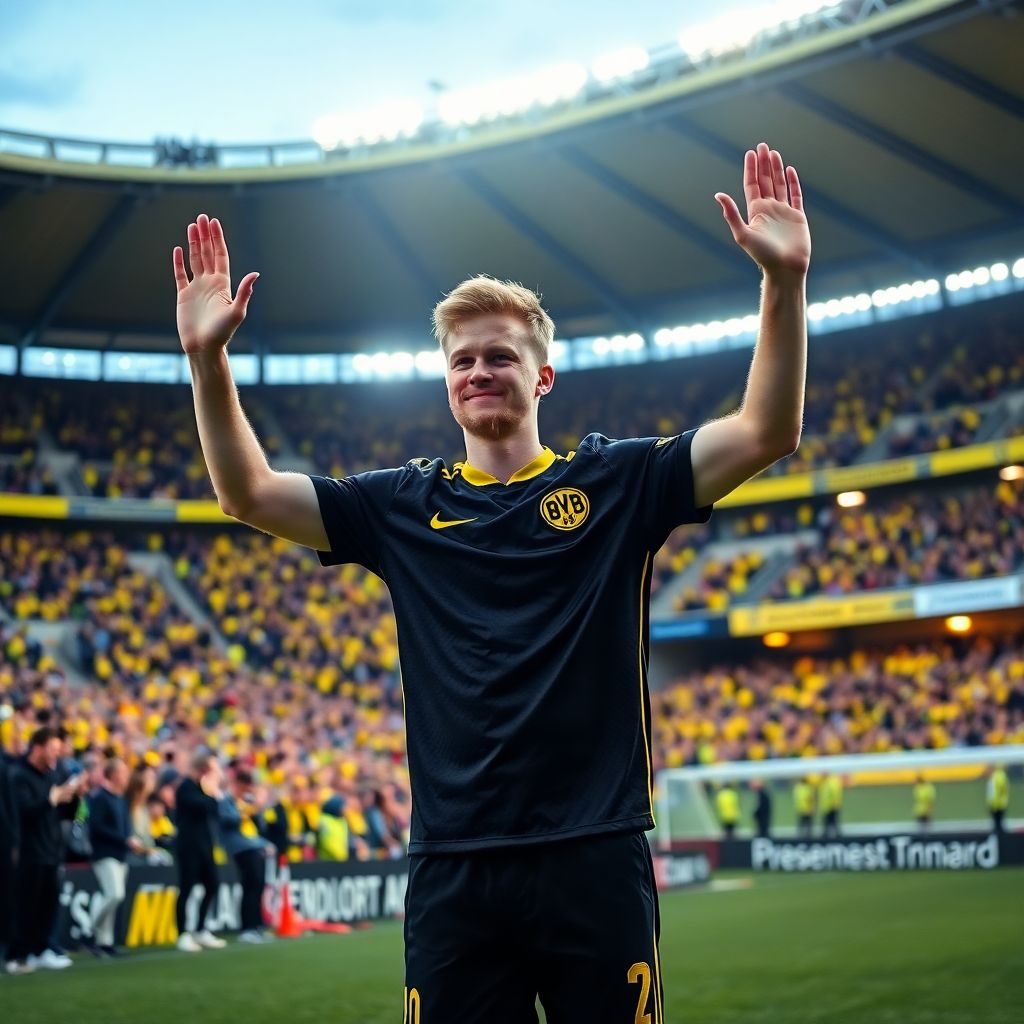
Julian Brandt to leave Borussia Dortmund after seven years at the club
Borussia Dortmund have confirmed that Julian Brandt will part ways with the club at the end of the season, bringing a seven-year spell in black and yellow to a close.
The German midfielder, whose current deal officially runs until 2026, will not see out the remainder of his contract. Dortmund announced that attempts to reach an agreement on a new long‑term arrangement ultimately failed, prompting both sides to decide on a separation this summer.
According to the club’s statement, negotiations over an extension had been ongoing but did not lead to a shared vision for the future. As a result, Brandt will leave on terms described as respectful and mutually understood, despite having two years left on his existing contract.
Sporting CEO Lars Ricken explained that the decision was the outcome of open and honest talks between the parties. He stressed that there was no conflict, only a joint conclusion that continuing the partnership beyond this season was not the right move.
“We held very transparent discussions and, in the end, both sides agreed that the contract would not be extended,” Ricken said. “Julian has played hundreds of matches for Borussia Dortmund and served this club for seven years. All we can do is thank him. We part ways with great mutual respect, and this step can open new opportunities for both him and for us.”
Brandt joined Dortmund in the summer of 2019 from Bayer Leverkusen, arriving as one of the most promising attacking midfielders in Germany. Over his seven seasons at the club, he grew into a key figure in the squad, operating mainly in central and attacking midfield but also filling in wide roles when needed.
In total, the 29‑year‑old has made 298 competitive appearances for Dortmund across all competitions. During that time he established himself as a creative force, known for his vision between the lines, his passing in tight spaces and his ability to link midfield with attack.
Brandt’s spell in Dortmund featured both domestic and European highlights. He was part of the team that lifted the German Cup in 2021, one of the few trophies Dortmund managed to add to their cabinet in recent years. He also featured in the squad that reached the Champions League final in 2024, a run that reaffirmed the club’s status as a serious contender on the European stage.
Beyond the raw numbers, Brandt’s influence has often been measured in the way Dortmund attacked. Under different coaches and varying tactical systems, he frequently served as a creative hub, connecting with forwards and full‑backs, and helping the team break down deep defensive blocks. His versatility allowed managers to reshape the midfield without losing technical quality or game intelligence.
On the international stage, Brandt has long been associated with the German national team. His time at Dortmund helped him maintain a place in the national set‑up, as performances in the Bundesliga and Champions League kept him in contention for international duty. For Germany, as at club level, he was valued for his technique, his ability to find pockets of space and his knack for producing decisive final passes.
The decision not to prolong Brandt’s stay also reflects the broader evolution taking place at Dortmund. The club has regularly refreshed its squad in recent seasons, balancing experienced professionals with younger talents. Allowing a senior figure to depart before the actual end of his contract suggests a strategic choice: to free up room in the wage structure and in the squad hierarchy for a new generation, while still ensuring an orderly, respectful exit for a long‑serving player.
From Brandt’s perspective, leaving now may be about timing and ambition. At 29, he is entering what many consider to be the peak years for a midfielder. A move could give him the chance to embrace a new league, a different tactical environment or a more central leadership role elsewhere. For a player accustomed to Champions League football and high‑pressure matches, the next step is likely to be a club with serious domestic or European aspirations.
For Dortmund, replacing Brandt will not be a simple one‑for‑one process. His departure leaves a gap in creativity and experience, particularly in matches where patience and precise passing are required. The club will need to assess whether that responsibility will shift to existing players – for example, younger midfielders stepping into a larger role – or whether a new signing will be brought in to assume his place in the rotation.
In tactical terms, Brandt’s exit could trigger subtle changes in how Dortmund build their attacks. Coaches may opt for a more direct, vertical style relying on pace and transitions, or look for another playmaker with similar characteristics to maintain the team’s associative play between the lines. How the club chooses to adapt might shape their identity for the coming seasons.
Supporters are likely to look back on Brandt’s time in Dortmund with a sense of appreciation mixed with the feeling that there might have been room for even more success. While the club challenged for the Bundesliga title and made deep European runs, major trophies remained relatively rare. Even so, Brandt’s consistency, availability and technical elegance made him one of the recognizable faces of the team during a period of constant change.
His seven‑year tenure also underlines how unusual it has become for attacking players at top clubs to stay for such a long stretch. In an era of frequent transfers and short cycles, Brandt’s sustained presence provided continuity in the dressing room and on the pitch. Younger teammates often benefited from his experience, and his understanding of the club’s demands helped stabilize the squad through multiple coaching changes.
As the season heads toward its conclusion, Brandt’s final matches in black and yellow will carry added emotional weight. Each appearance offers a last opportunity for him to contribute on the field and for fans to acknowledge his service. The way he signs off – whether with crucial assists, important goals or simply reliable performances – will shape the lasting memory many supporters have of his Dortmund chapter.
Looking ahead, the separation framed as “mutual respect and new opportunities” hints at a relatively smooth transition. Dortmund gain clarity to plan their squad and transfer moves early, while Brandt enters the market with time to evaluate his options rather than facing a late, rushed decision. Both sides appear intent on ensuring that a long relationship ends without controversy or public tension.
In summary, Julian Brandt’s upcoming departure marks the end of a significant era for both player and club. After nearly 300 games, a domestic cup triumph and a run to a Champions League final, his story in Dortmund is approaching its final pages. What comes next – for Brandt in his new destination and for Borussia Dortmund as they reshape their midfield – will be closely watched across Germany and Europe.