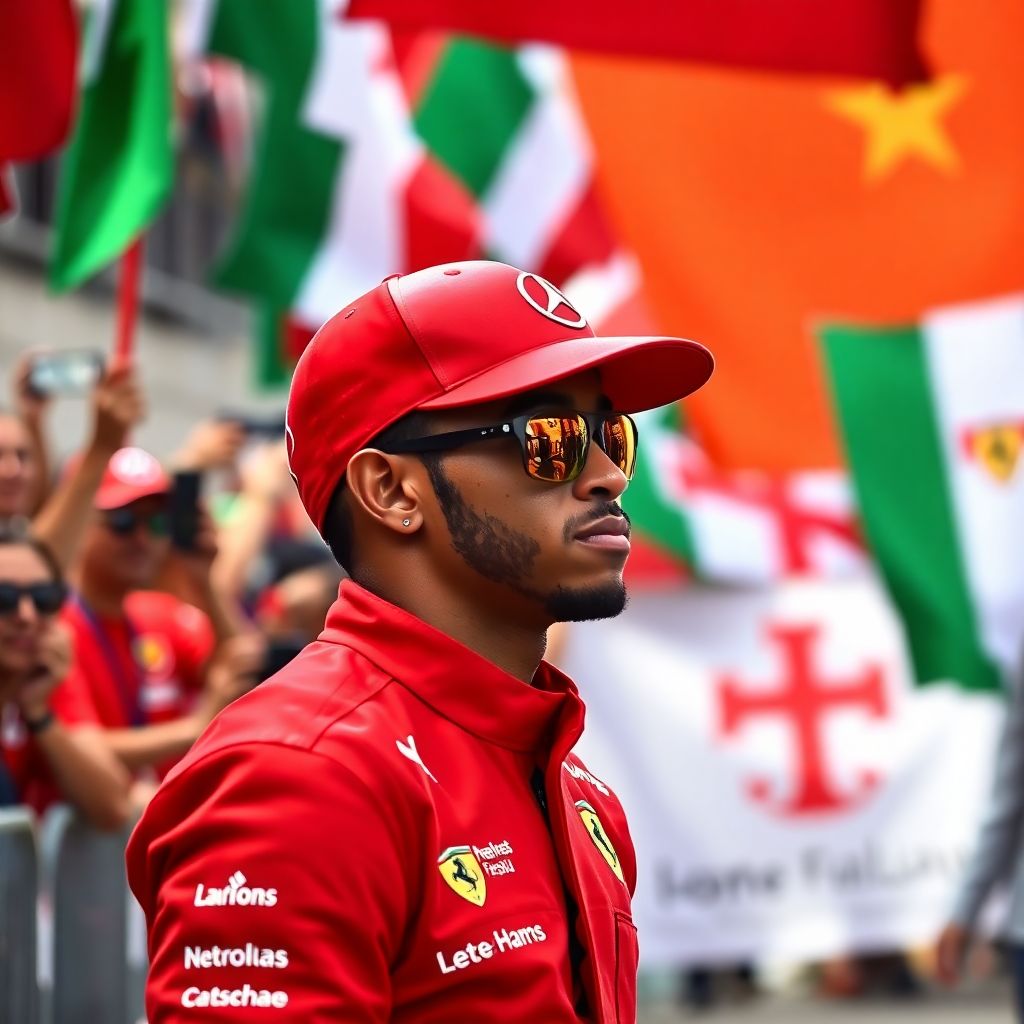
Lewis Hamilton: “In Italy, Ferrari Is Loved Like the Pope”
Lewis Hamilton admits that the disappointing 2025 campaign with Ferrari forced him into an uncomfortable period of self-reflection. Yet as Formula 1 heads into 2026, the seven-time world champion insists his belief in the Scuderia is intact: in his words, the team “has everything it needs to win.”
The British driver’s first full year in red turned into a statistical anomaly. Despite Ferrari’s status and pre-season optimism, Hamilton went an entire season without a single podium finish, becoming the first Ferrari driver in 44 years to endure such a drought over a full campaign. The last time this happened was in 1981 with Didier Pironi – a comparison that underlined just how far below expectations the 2025 season fell.
Even with that painful backdrop, Hamilton, now 41, approaches 2026 with renewed optimism. Pre-season tests again hinted at strong pace, but this time he feels the car – the new SF-26 – reflects him on a deeper level. Describing the machine as carrying more of his own “DNA,” Hamilton explained that he has been immersed in the project for over a year, working closely with engineers and spending countless hours in the simulator.
According to Hamilton, the winter was less about blaming others and more about rigorous personal analysis. He spoke about the importance of stepping back and examining his own performance and mindset: understanding where he stands, setting realistic but ambitious goals, and mapping out how to reach them. Last year his target was crystal clear – to win the world championship with Ferrari – and he fell short. But for Hamilton, failure in one season does not mean a dream is over; it means revising the route, not the destination.
He revealed that he put himself through a series of uncomfortable questions. In his view, any elite competitor must repeatedly look inward and challenge themselves: Am I really doing enough? Could I be better, not only as a driver but as a person? Am I being as kind and constructive as I should be? Which of my methods need to change? That internal dialogue, he says, is essential if you want to grow rather than be paralyzed by disappointment.
Hamilton admitted that the weight of expectation during 2025 sometimes felt overwhelming. Driving for Ferrari is never just about what happens on track; it is about living with an entire nation’s hopes, an iconic brand’s legacy, and a global fanbase that demands success. At points, those responsibilities pressed heavily on him. The challenge, he realized, was to rediscover the simple joy that first brought him into racing. He said that when Ferrari unveiled the new car, he felt a childlike sense of excitement return – a reminder that passion, not pressure, has to be the main fuel.
When asked about the dynamics with his teammate Charles Leclerc in the event of a title fight, Hamilton rejected the idea that internal rivalry could fracture the team. For him, Ferrari represents something bigger than any individual. He stressed that in Italy and in many parts of the world, people follow Ferrari with a devotion that goes beyond ordinary sports fandom – more like a faith. In his vivid comparison, Italians “love Ferrari like they love the Pope.” His aim, he insists, is not to divide supporters or create factions, but to honor that shared passion.
Hamilton underlined that the team’s interest will always come first. Of course, both he and Leclerc are born competitors and both want to be the one standing on the top step. He made no secret of the fact that his personal goal is still to win, to add to his own incredible record. Yet he also acknowledged Leclerc’s status: an “extraordinary driver” who has spent eight years inside the Ferrari system. Hamilton, arriving from a different environment and era, brings his own experience and mindset, but he is clear that any success must be collective.
A key difference between 2025 and 2026, Hamilton explained, is his level of input into the car. When he joined Ferrari, the previous year’s car was largely complete; there was only limited room for him to influence fundamental concepts. With the SF-26 it has been very different. Over the last 14 months, he has been deeply involved in development: countless simulator sessions, long technical briefings with engineers, and a constant feedback loop shaping everything from balance characteristics to how the car behaves over a race stint. That is why he talks about his “DNA” being in the machine – not as a slogan, but as a reflection of his direct imprint on its design.
His belief in Ferrari, he says, is the reason he signed for the team in the first place and also why he remains hopeful despite the early setbacks. In terms of resources, infrastructure, and talent, Hamilton is convinced Ferrari possesses everything necessary to return to the front. What remains is to translate that potential into consistent performance and, ultimately, championships. As he put it, the ingredients are there; now the job is to “finish it off” together with the fans.
Hamilton also recently marked his 20th season in Formula 1 with an emotional message, reflecting on a career that has seen “incredible highs and brutal lows.” Across two decades, he has experienced dominant eras, crushing defeats, controversial moments, and constant scrutiny. He used the anniversary to send a clear signal to those who doubt him or hope he is in decline: there will be “no step back.” Aging, in his eyes, is not a sign to fade quietly, but a reason to lean on experience and resilience.
The Ferrari chapter is arguably the most emotionally charged and risky move of his career. Moving from a team where he had established a legacy of dominance to an outfit still searching for its next great era was a leap of faith. Hamilton is aware that many questioned the timing and logic of that decision, especially after a trophyless 2025. Yet he continues to frame the move as a long-term mission rather than a one-season gamble.
Beyond pure statistics, Hamilton speaks often about legacy and meaning. Winning with Ferrari carries a unique weight in Formula 1. To triumph in red is to join a pantheon that includes some of the sport’s most legendary names. For a British driver who has already broken records with another team, succeeding in Maranello would add a different dimension to his story – one that blends personal redemption with the revival of a global icon.
The cultural shock of Ferrari has also played a role in his adaptation. The atmosphere in Italy, the intense presence of the tifosi, and the symbolism of the red car create an environment unlike anything he had experienced before. He describes how people do not just support Ferrari; they live it. The team’s results can shape the national mood, make headlines across the country, and dominate conversations in everyday life. That is why he compares the adoration for Ferrari to the reverence for the Pope: it is about identity, tradition, and emotion as much as sport.
Inside the factory, Hamilton has tried to blend his championship habits with Ferrari’s own strong culture. He has pushed for clearer communication, more data-driven decisions, and a relentless focus on details, while also embracing the passion and pride that define the Italian squad. The SF-26, in this sense, is the first real test of whether that fusion of styles can produce results.
Looking ahead to 2026, Hamilton knows that pre-season optimism must be treated carefully. He has been in Formula 1 long enough to see fast testing times fade when the real racing begins. However, he believes that this year feels different not only because of the car’s technical step but because of the psychological reset within the team. Engineers, mechanics, and drivers, he says, have turned the frustration of 2025 into motivation rather than defeatism.
For Hamilton personally, the upcoming season is about more than proving critics wrong or chasing another number in the record books. It is about demonstrating that resilience and reinvention are possible even at the top of the sport and at an age when most drivers have already stepped away. Standing on the grid in a red car, with the weight of Ferrari’s history behind him and an Italian public that treats the team like a sacred institution, he enters 2026 with a simple, uncompromising conviction: Ferrari can win again, and he wants to be the driver who makes that belief reality.
Комментарии