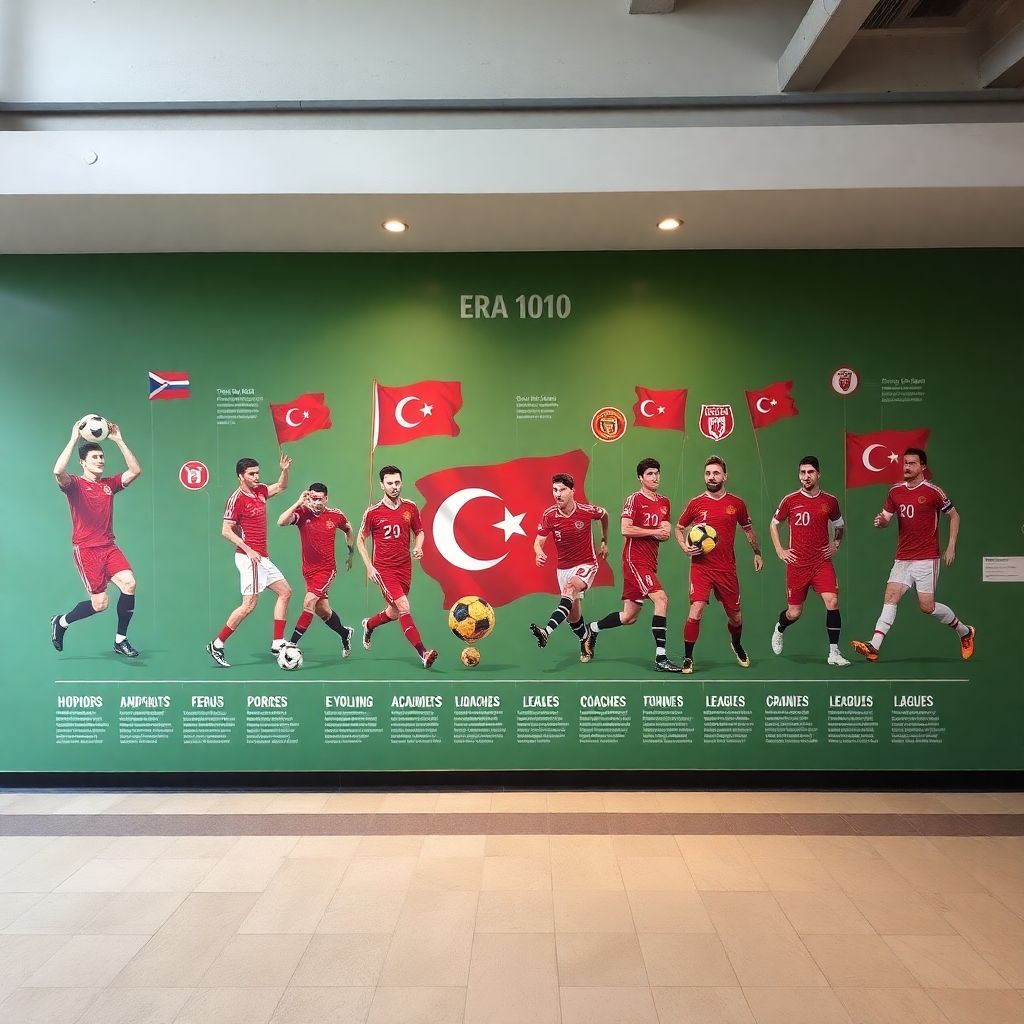
The modern era of the Turkish National Team is best understood through a timeline of defining tournaments and structural changes rather than isolated miracles. From the 2002 World Cup and Euro 2008 runs to coaching cycles, youth academies and league evolution, each phase added strengths but also revealed limitations in depth, planning and sustainability.
Myths that distort Turkey’s modern football narrative
- Myth: The 2002 World Cup came out of nowhere. Reality: It capped a long, uneven build-up in Turkey national football team history, with earlier tactical experiments and a growing diaspora player pool.
- Myth: Euro 2008 proves Turkey is naturally a “tournament team”. Reality: It was a blend of tactical maturity, late goals and contextual luck, not a permanent structural advantage.
- Myth: Fatih Terim alone defines the national team identity. Reality: His influence is huge, but other coaches, federational choices and club trends are equally important in the timeline of modern Turkish national football team.
- Myth: Youth academies in the 2010s solved all talent problems. Reality: They improved output, but transition to senior level still depends on league dynamics, foreign-player rules and coaching bravery.
- Myth: The domestic league’s foreign stars automatically strengthen the national side. Reality: Transfers can raise tactical standards but can also block minutes for local players in key positions.
- Myth: Sociopolitical pressures only harm the team. Reality: They sometimes boost support and motivation, yet they also introduce selection constraints and fragile expectations that limit long-term planning.
2002 World Cup: the seismic underdog breakthrough
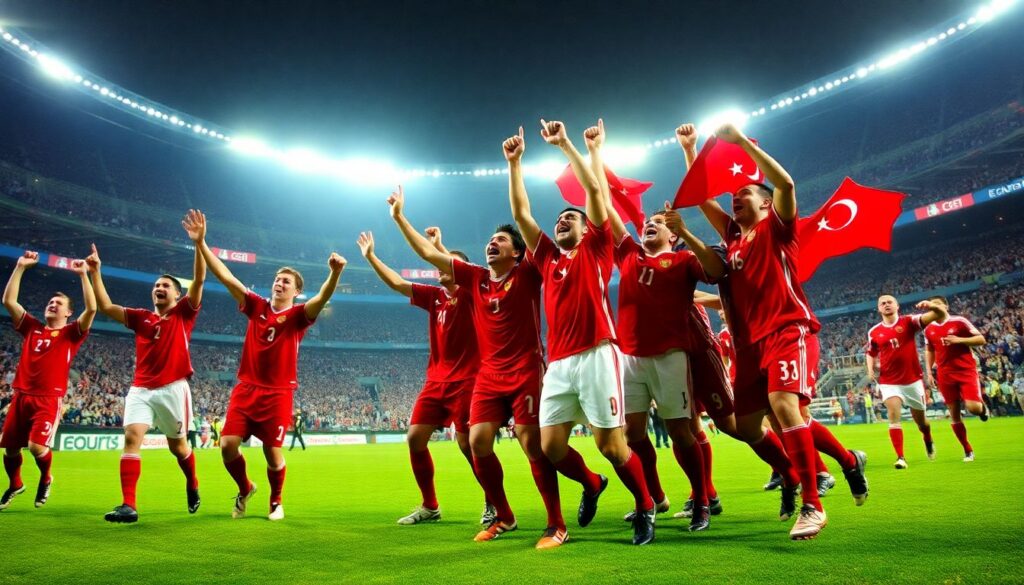
In the timeline of modern Turkish national football team development, the 2002 World Cup is usually treated as the sudden birth of a powerhouse. More precisely, it marks the end of a turbulent build-up phase and the beginning of global recognition. The tournament crystallised patterns that had been forming in qualifying campaigns and club football.
The defining traits were compact defending, rapid counter-attacks and a core group that mixed domestic league stalwarts with Europe-based players. This blend shows up again whenever people list the best moments of Turkish national football team performance: unity, clear roles and a tactical plan that suits the player pool rather than an imported ideology.
Safe conclusions from 2002 include the importance of a stable spine (goalkeeper, centre-backs, central midfield) and continuity between club and national play. The limitation is that such a peak can be misread as a new baseline. Many narratives in Turkey national football team history mistakenly assume that once a semi-final was reached, similar results should follow automatically.
Looking back at 2002 as a definition of the modern era is useful if treated carefully: it highlights what is possible when talent, tactics and mentality align, but it does not guarantee repetition without comparable preparation, depth and adaptation to new tactical trends.
UEFA Euro 2008: tactical maturity and national euphoria
Euro 2008 is often bracketed with 2002 when people talk about Turkey national team World Cup Euro achievements. Yet it represents a different kind of success: a mature tactical framework under extreme emotional pressure. Key mechanisms behind that run included the following elements:
- Flexible in-game adjustments: The coaching staff regularly shifted between back-three and back-four structures, showing a readiness to react to match flow instead of sticking to a single fixed shape.
- Layered pressing instead of wild chasing: Line-of-confrontation decisions (when to start pressing) became more deliberate, allowing the team to conserve energy for late pushes that produced several comebacks.
- Role-specialised midfield: Clear separation between ball-winning, progression and final-third creativity reduced chaos and maximised the strengths of technically gifted midfielders.
- High psychological tolerance for chaos: The team’s capacity to stay functional deep into stoppage time turned several matches into Turkey national football team legendary matches in the public imagination.
- Bench usage and squad trust: Late substitutions were not merely like-for-like; they altered tempo or directness, reflecting the idea that a 23-man squad, not just the XI, defines tournament success.
- Risk management instead of pure heroics: Even dramatic comebacks were usually preceded by humble, safety-first phases of ball circulation that created a platform for final pushes.
The safe takeaway is that Euro 2008 illustrated how tactical discipline and emotional resilience can coexist. The limitation is that this style depends heavily on specific player profiles and fitness levels; it cannot be simply copy-pasted across generations without recalibration.
Coaching identity: Fatih Terim, tactical shifts and continuity
Modern discussions of Turkey national football team history often treat coaching identity as synonymous with Fatih Terim. His cycles do anchor key chapters, but the broader picture is about how different coaches handled similar structural challenges. Typical application scenarios show where identity and continuity truly emerge.
- Tournament reboot phases: Before major competitions, Terim and others often used friendlies as controlled labs, testing aggressive pressing or new formations. Safe practice here is to limit tactical changes to two or three core ideas per cycle; frequent overhauls confuse players and waste preparation time.
- Generational handovers: Coaches must phase out veterans without losing dressing-room authority. Successful periods eased legends out through reduced minutes rather than abrupt exclusion, while parallel integration of younger players kept performance acceptable.
- Balancing diaspora and domestic players: Selection decisions about Europe-based Turkish players shape style and tempo. Overreliance on either group can hurt cohesion; careful mixing tends to produce the best moments of Turkish national football team performance.
- Responding to club-tactical trends: When the Süper Lig emphasised physical transitions, national coaches could either mirror that high tempo or introduce more controlled build-up as a corrective. Identity became a negotiation between domestic habits and international demands.
- Crisis management after failures: Post-qualification disappointments often led to emotionally driven calls for radical change. The safer route has been targeted adjustments (for example, refining set-piece schemes) instead of wholesale abandonment of the existing structure.
Coaching identity, then, is less about a single charismatic figure and more about repeatable principles for selection, communication and tactical adaptation. The limitation is that frequent leadership changes can interrupt this continuity, resetting learning curves just when lessons are starting to take hold.
Youth academies and the 2010s talent pipeline
The 2010s saw youth academies positioned as a long-term answer to inconsistencies in Turkey national team World Cup Euro achievements. Major clubs invested in facilities, scouting and coaching certification, producing technically polished prospects. To understand both the safe benefits and the structural limits, it helps to separate advantages from constraints.
Strengths of the modern youth pipeline
- More standardised training curricula that improve first touch, positional awareness and pressing habits from early ages.
- Better integration between U17, U19 and senior squads, allowing national coaches to track development across the entire Turkey national football team history of youth levels.
- Improved monitoring of dual-nationality players, particularly in European academies, which expands the pool without overextending scouting resources.
- Exposure to international youth tournaments, familiarising prospects with travel routines, refereeing styles and tactical diversity.
Limitations and structural bottlenecks

- Transition from youth to senior football remains uneven; many academy graduates struggle to secure consistent minutes in the Süper Lig.
- Short-term club pressure for results can push coaches to prefer experienced foreign players over local youth, slowing the pipeline.
- Positional imbalances persist, with many creative attackers and few high-level central defenders or defensive midfielders.
- National team selection windows are limited, so integrating large waves of youngsters at once carries performance risks in key qualifiers.
Safe policy steps involve prioritising a smaller group of high-upside talents per age cohort and giving them clear development pathways rather than promising rapid, unrealistic overhauls.
Domestic league evolution: transfers, foreign influence and competitiveness
As the Süper Lig attracted more foreign players, narratives emerged that this automatically elevated national standards. A closer look at errors and myths around league evolution helps clarify what can safely be assumed and where caution is needed.
- Error: equating star signings with tactical education. High-profile transfers can raise visibility but do not guarantee knowledge transfer. Safe benefit arises only when clubs employ staff who can absorb and spread best practices into training and youth structures.
- Myth: more foreigners always block locals. In reality, the impact depends on regulations and club culture. Foreigners in non-priority positions may have little effect on the national pool, while a few imports in key roles can either mentor or marginalise local options.
- Error: ignoring physical and tempo differences. When domestic matches are slower or less intense than elite European games, league form becomes a poor indicator of readiness for Turkey national football team legendary matches at major tournaments.
- Myth: competitive balance alone improves the national team. A tight league race is not enough; what matters is how many clubs regularly compete in European competitions and bring back tactical lessons.
- Error: assuming stylistic homogeneity helps cohesion. If most league clubs play similar football, the national team may lack Plan B options. Some tactical diversity at club level equips coaches with more flexible player types.
The safe view is that the domestic league can be a powerful ally but not a guarantee of national success. Structural alignment and deliberate development policies matter more than headline transfer news.
Sociopolitical forces and their impact on selection and support
Sociopolitical dynamics shape expectations, media narratives and sometimes selection debates. A careful, realistic perspective avoids both romanticising and catastrophising their role.
Consider a simplified mini-case of a qualification cycle:
// Phase 1: Post-tournament euphoria
public_expectation = "repeat 2002 or 2008";
coach_strategy = "minimal change + veteran loyalty";

// Phase 2: Early poor results
media_pressure = "call for young players";
political_discourse = "symbolic representation by regions/clubs";

// Phase 3: Reactive adjustments
if (pressure_level > stability_threshold) {
    selection_policy = "short-term popularity moves";
    long_term_planning = "deprioritised";
}

// Phase 4: Outcome
if (qualification_missed) {
    narrative = "identity crisis" + "search for saviour coach";
} else {
    narrative = "heroic turnaround" + "status quo preserved";
}
Safe steps in this environment include insulating core sporting decisions from day-to-day noise, communicating selection criteria transparently and framing achievements within realistic historical context, not only through the lens of a few iconic tournaments. The main limitation is that no team operates in a vacuum; public mood in Turkey inevitably affects pressure levels and risk appetite around the national side.
Concise clarifications for common reader queries
When does the modern era of the Turkish National Team realistically begin?
Most analysts anchor it around the late 1990s, crystallising with the 2002 World Cup. This period marks sustained qualification attempts, tactical modernisation and a clearer integration between club and national structures.
Are 2002 and Euro 2008 unique peaks or part of a steady rise?
They are peaks built on earlier groundwork but not proof of a smooth upward curve. Between these tournaments, qualifying campaigns and performances fluctuated, showing how fragile high-level consistency can be.
How important is Fatih Terim compared to other coaches in this history?
He is central to Turkey national football team history, especially in defining emotional and tactical identity. Still, other coaches contributed key adjustments in selection, youth integration and match preparation.
Did the 2010s youth focus immediately transform tournament results?
No. It improved technical quality and depth, but translation into senior stability has been gradual. Structural factors like club minutes, league tempo and foreign-player usage continue to shape outcomes.
Why do domestic league improvements not always show at major tournaments?
Because league competitiveness is only one piece. Match intensity, tactical variety, player adaptation to foreign environments and coherent national-team planning all influence whether domestic gains convert into tournament performances.
Can sociopolitical pressures ever be fully separated from football decisions?
In practice, no. The realistic goal is not isolation but mitigation: setting clear sporting criteria, communicating them consistently and resisting reactive changes based solely on short-term public mood.
What is the safest way to judge the national team’s progress over time?
Combine results in key tournaments with underlying indicators: player development, tactical sophistication, squad depth and stability in coaching philosophy. Isolated heroic runs should be seen as signals, not definitive proof of permanent status.