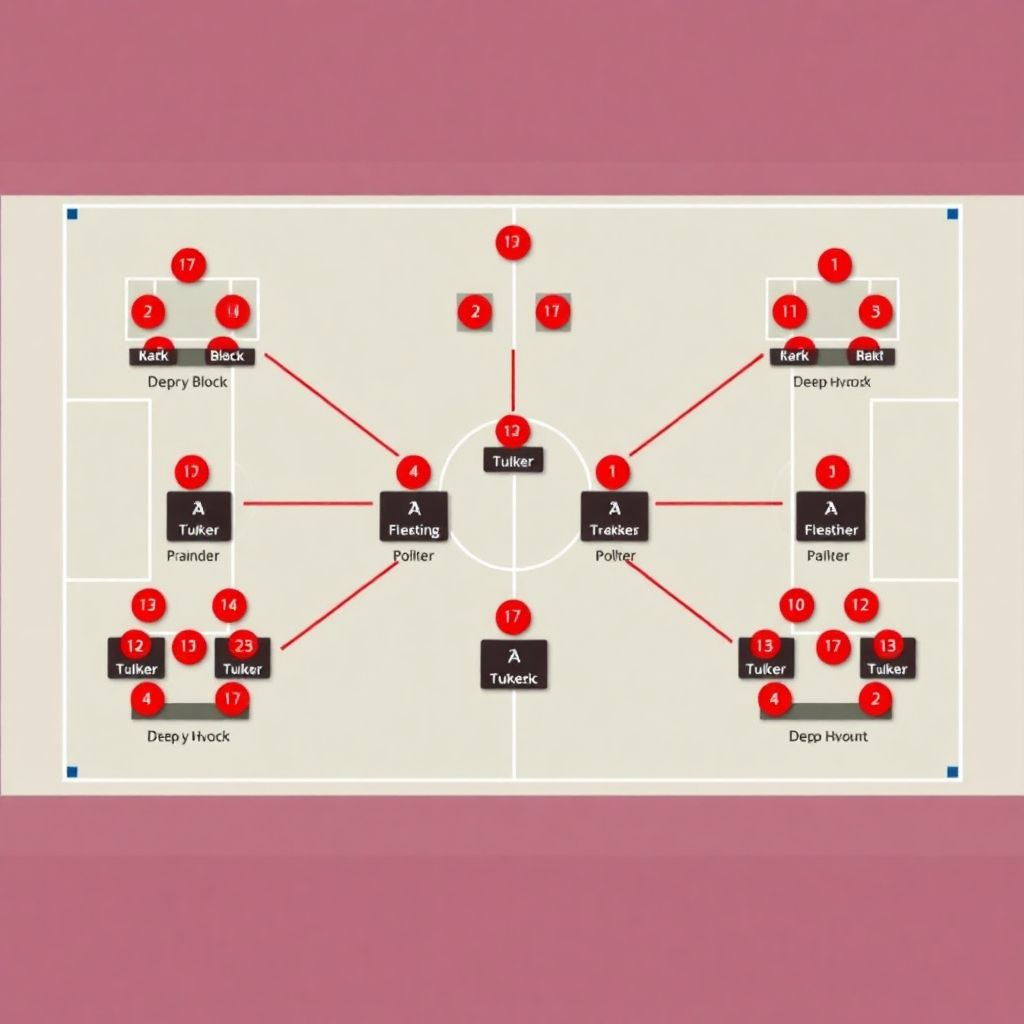
The tactical evolution of the Turkish National Team across the last three World Cup cycles is a gradual shift from reactive, medium-block defending and direct breaks toward more flexible, ball‑dominant structures with hybrid lines. It includes improved pressing triggers, more choreographed wide rotations, smarter set pieces, and better use of limited analytical resources.
Concise tactical briefing
- Turkey moved from rigid 4-2-3-1 / 4-1-4-1 shapes to hybrid lines that morph between back four and back five depending on phase and opponent.
- Pressing evolved from passive mid-blocks to more deliberate, opponent- and zone-specific pressure, especially against short build-up teams.
- Wide players shifted from pure wingers to multi-role outlets: touchline width, half-space creators, and primary counter-attacking targets.
- Set-piece work increased in variety and planning, though execution and second-ball coverage remain inconsistent across cycles.
- Club trends in Turkey and academy habits strongly shape national tactics, often creating tension between high-press, high-tempo styles and more conservative tournament setups.
- For environments without tracking data or big staffs, focusing on 2-3 clear defensive triggers and simple wide rotations can replicate many benefits of elite Turkey national team tactical analysis.
Debunking myths: Was Turkey tactically stagnant
Discussion of the recent three World Cup cycles often treats Turkey as tactically frozen: same 4-2-3-1, same deep block, same reliance on individual talent. This view misunderstands how the team adapted its structures, especially between qualifiers and tournament play, and how coaching changes redefined roles within similar base formations.
First, shape continuity does not equal stagnation. Even when the graphic showed a 4-2-3-1, the spacing, pressing height, and build-up patterns changed from cycle to cycle. For example, the distance between the double pivot and the front line, the aggression of full-backs, and the positioning of the “10” in the half-space were recalibrated to opponent profiles and available personnel.
Second, Turkey football team World Cup history is often used selectively. The 2002 run is romanticised as pure passion and chaos, while more recent cycles are dismissed as overly cautious. In reality, the recent period shows a steady effort to balance traditional strengths (transitions, emotional momentum, strong central defenders) with modern requirements like structured pressing and positional play.
Third, the idea that there is no learning loop is misleading. While the national environment lacks the massive analytical infrastructure of top-five leagues, staff still draw from Turkey national football team statistics and data, club match experiences, and informal networks. The challenge is not absence of evolution, but the friction between different tactical “languages” spoken by players coming from very different club systems.
Formation evolution: from fixed banks to hybrid lines
Across three cycles you can trace an evolution from fixed, clearly separated lines towards more fluid, phase-dependent structures that bend without fully breaking the identity of the side.
- Cycle 1 – classic double pivot and deep full-backs: A nominal 4-2-3-1 with a conservative double pivot, wide players mostly hugging the touchline, and full-backs rarely overlapping together. The back four behaved as a rigid line, prioritising protection over width in possession.
- Cycle 2 – asymmetry appears: One full-back began to advance more aggressively while the opposite side stayed deeper, forming an asymmetrical back three in build-up. The “10” drifted into one half-space, effectively creating a lopsided 4-3-3 with a triangle on the strong side.
- Cycle 3 – hybrid line logic: The back line increasingly behaved like a situational back five. Against strong opponents, a wide midfielder or full-back dropped to form 5-4-1 in the low block; in possession, the same player moved up to create a 2-3-5 or 3-2-5 structure, supporting controlled progression instead of pure long balls.
- Pivot roles diversified: Instead of two flat holding midfielders, one pivot often stepped ahead of the other, screening between lines and enabling aggressive pressing after losses. This transformed the previous “screen & stand” approach into “screen & jump” behaviour.
- Forward line flexibility: The centre-forward alternated between pinning the last line and dropping as a link player, with wide forwards attacking the gaps. This change helped Turkey use central overloads more intelligently while still keeping access to fast counters.
- Limited-resource alternative: For coaches without detailed Turkey national football team statistics and data, this evolution can be mirrored by a simple rule-set: one full-back attacks, the other stays; one pivot sits, the other presses forward; one winger tucks in, the other stays wide. This keeps structure simple but adaptable.
Pressing and defensive organization: patterns and triggers
The defensive game moved from generic mid-blocks into more clearly coded behaviours tied to opponents’ build-up habits. Instead of pressing randomly, Turkey increasingly applied triggers: moments that told the nearest players to jump.
- Mid-block as baseline: Across all three World Cup cycles, a compact mid-block remained the default. The front line screened central access, the pivots protected the space in front of centre-backs, and the team allowed opposition centre-backs to have the ball as long as passes stayed predictable.
- Goal-kick and back-pass triggers: Later cycles introduced more assertive starts. On opposition goal kicks played short, the nine and one winger pressed centre-backs on the outside shoulder, while the “10” locked the pivot. A back-pass to the goalkeeper or a poor first touch were triggers for a collective squeeze forward.
- Wing-trap mechanisms: Turkey increasingly used the touchline as an extra defender. The nearest winger curved the run to cut the full-back’s inside lane, the striker blocked the return pass to the centre-back, and the team shifted across in a 4-4-2 shell to isolate the ball-carrier.
- Pressing height variation: Against stronger build-up teams, pressing height dropped, but triggers sharpened: a flat pass into a full-back facing his own goal or a vertical pass into a back-to-goal pivot were cues for an aggressive jump from the nearest midfielder.
- Counter-pressing improvement: The biggest advancement came after ball loss. Instead of automatically retreating, the nearest 3-4 players closed the ball, cut central lanes, and delayed counter-attacks. Even in resource-limited environments without GPS or video overlays, coaches can copy this by training three-second “hunt the ball” reactions immediately after losing possession.
Possession, progression and the role of wide players
In possession, the story of these cycles is the gradual move away from “give it to the winger and hope” towards more layered wide play. Wingers and full-backs learned to share width, stretch lines, and create interior lanes for midfielders and the “10”.
Benefits of the newer approach in possession
- Better spacing in the final third: One wide player holds the touchline while the other moves inside, preventing three players from ending up on the same vertical channel.
- Higher quality crosses and cutbacks: Overlaps and underlaps allow wide players to arrive on the ball with time and momentum instead of receiving in static, crowded positions.
- Safer rest defence: With an inverted full-back or tucked-in winger, Turkey can keep at least two players behind the ball to defend counters, instead of over-committing both full-backs.
- More routes for progression: Rather than forcing early crosses, the team can circulate through the pivot, half-space, or underlapping full-back, choosing the least crowded path forward.
- Alignment with club habits: Many key players experience similar wide rotations at their clubs, easing the transfer of patterns to the national side and reducing confusion in short camps.
Limitations, trade-offs and constraints
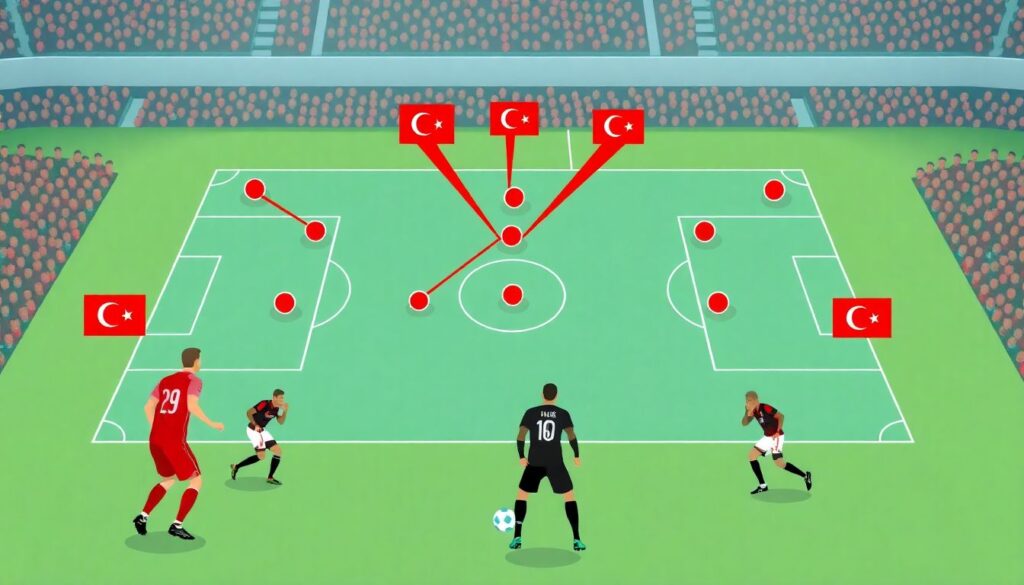
- Execution level varies: Short national-team windows mean wide players sometimes mis-time overlaps or arrive in the same space, breaking the intended structure.
- Dependence on individual quality: When the wide players lack 1v1 threat, opponents can stay narrow, making Turkey’s possession look sterile despite good shapes.
- Risk of isolation on the weak side: Strong-side overloads occasionally leave the weak-side winger disconnected, with long diagonal switches hard to complete under pressure.
- Time-limited coaching: Compared to a club environment or a Turkish national team coaching tactics course, national staff have fewer training sessions to automate rotations and positional rules.
- Resource-light adaptation: In setups without sophisticated video analysis or a Turkey national team match analysis subscription, coaches can still teach a simple three-role model: touchline winger, underlapping runner, and stabilising pivot. Whiteboard and small-sided games are often enough to embed these patterns.
Set-piece strategy and counter-transition design
Set pieces and transitions often decide qualification campaigns. Turkey’s evolution here features more variety and some persistent misunderstandings about risk, structure, and how much planning is realistically possible in short international breaks.
- Myth: more attacking on corners always helps
When extra players commit into the box without a clear rest-defence structure, the counter-attack risk explodes. Later cycles improved by keeping at least two players at the edge of the box and one covering the far side to slow counters. - Myth: zonal marking is “passive”
Switching to more zonal or mixed schemes on defensive corners did not mean accepting free headers. It meant assigning players to dangerous spaces while still tracking key targets. The real issue was timing of jumps, not the idea of zonal coverage itself. - Error: poor second-ball coverage
Early in the period, Turkey often won first contacts but lost second balls at the edge of the box, extending pressure. Gradually, one more midfielder stayed just outside the area to clean up loose balls and launch counters. - Error: uncoordinated counter-attacks
Counters were sometimes treated as chaos events: whoever got the ball ran forward. Later cycles specified lanes: one player sprinting wide to stretch, one central runner, one trailing option. Even without complex analytics, setting these lanes on the training pitch makes transitions far more repeatable. - Myth: small staffs cannot plan complex routines
Coaches with limited resources can still build 2-3 rehearsed set-piece patterns that mirror what Turkey attempts internationally: a near-post flick, a far-post screen, and a late edge-of-box runner. No advanced tech is required, only repetition and simple cues.
Coaches, academies and club influences on national tactics
The tactical identity of the national team is the product of many interacting environments: national coaches, club managers, academy methods, and even informal education like a Turkish national team coaching tactics course or online clinics. These layers explain why certain behaviours change quickly and others persist across cycles.
Clubs in Turkey traditionally lean towards emotional, momentum-driven football: intense pressing phases, rapid vertical attacks, and heavy reliance on individual talent in wide areas. National coaches, responsible for entire Turkey football team World Cup history narratives, often try to add more control, reducing chaos without losing aggression. This creates a push-pull dynamic between “club instincts” and “national structure”.
Consider a simplified mini-case from a recent cycle. Many key attackers arrived from clubs that pressed high in 4-2-3-1 but defended deeper in Europe. The national coach wanted a flexible mid-press that could jump high on triggers. The solution looked like this in functional “pseudocode”:
IF ball is with opposition CB AND body orientation is towards touchline THEN

  Winger presses outside-in;

  Striker blocks pass to far CB;

  10 jumps to pivot;

  Near-side pivot steps forward, far-side pivot shifts central.

ELSE

  Back into compact 4-4-2 block, protect half-spaces.

END IF
This simple rule-set aligned with players’ club habits while formalising when to jump and when to sit. For coaches without extensive staff or access to a Turkey national team match analysis subscription, the same logic applies: encode 3-5 clear “IF-THEN” behaviours for pressing, build-up, and set pieces. Even modest structures, consistently applied, can echo the tactical evolution seen in the Turkey national team tactical analysis of recent World Cup cycles.
Common tactical doubts addressed
Why does the Turkish National Team often look different between qualifiers and tournaments?
Qualifiers allow more time between big games and a wider range of opponents, so Turkey can experiment with pressing heights and shapes. Tournaments compress schedules and increase opponent quality, encouraging more conservative, risk-managed versions of the same tactical ideas.
Is Turkey naturally a counter-attacking team, or can it dominate the ball?
Recent cycles show Turkey can do both. The squad retains strong counter-attacking instincts, but coaches have increasingly used controlled possession phases, especially against weaker or equal-strength sides, using structured build-up and wide rotations.
How much do domestic club tactics influence the national team setup?
Club styles strongly influence players’ habits in pressing, wide play, and build-up. National coaches rarely fight these instincts; they usually build frameworks that channel familiar behaviours into a coherent plan, adjusting only what is essential at international level.
Can a team evolve tactically without advanced data and large analysis staffs?
Yes. While high-level data helps, most of Turkey’s visible tactical evolution comes from clear principles, targeted video work, and rehearsal of specific scenarios. Smaller teams can imitate this by defining a few simple rules for pressing, build-up, and set pieces, then drilling them consistently.
Why does Turkey sometimes struggle to break down low blocks despite good possession?
Possession structure has improved, but final-third decision-making and individual 1v1 quality vary by cycle. When wide players lack creativity or timing of runs is off, the team can circulate the ball well without creating enough high-quality chances.
What can grassroots coaches in Turkey copy from the national team’s tactical evolution?
They can adopt basic hybrid-line ideas (one full-back high, one low), clear pressing triggers, and simple wide rotations. These concepts require more clarity than technology and can be trained using small-sided games and whiteboard explanations.
Is sticking to similar base formations across cycles a weakness?
Not necessarily. Repeating familiar base shapes can help players from different clubs coordinate faster. The key is how roles, pressing cues, and positional details change within that shape, not how the team is listed on paper.