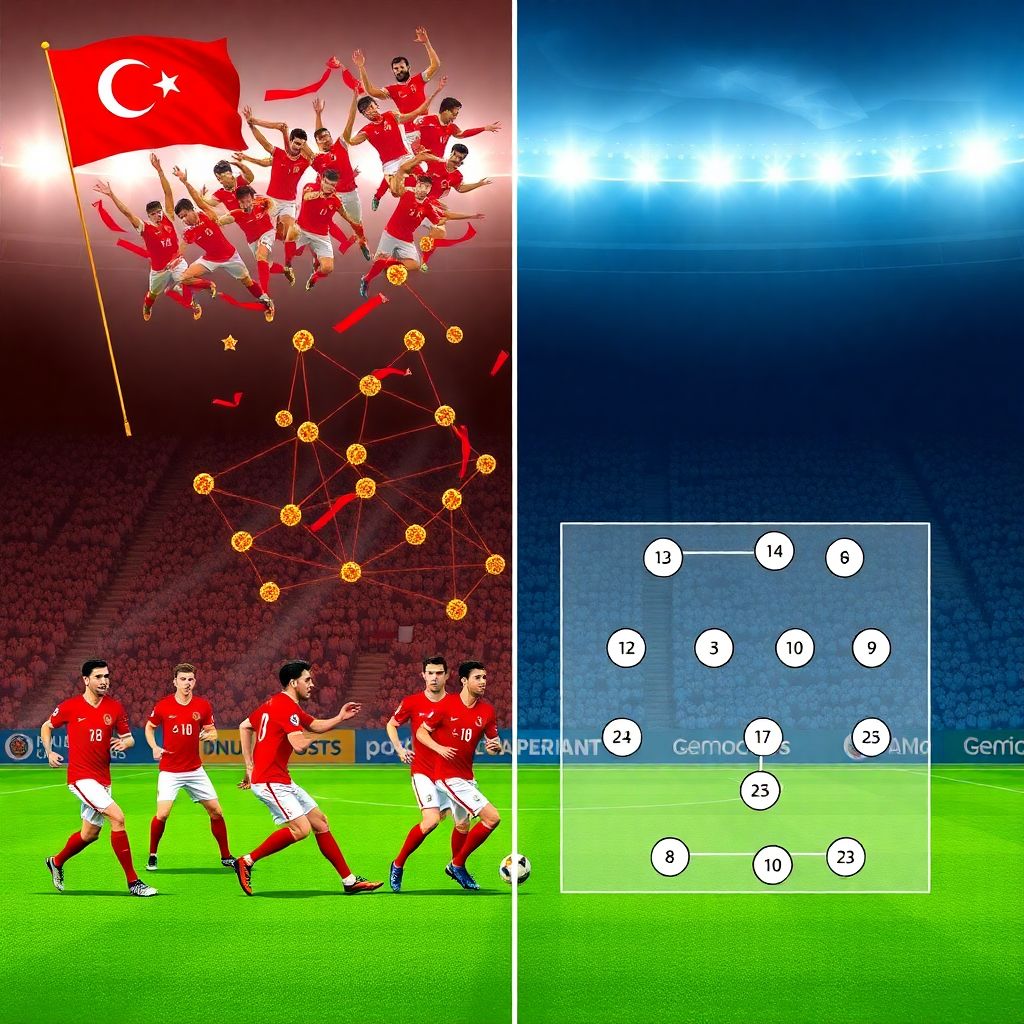
The tactical evolution of the Turkish national team runs from Fatih Terim’s aggressive, pressing 4-3-3/4-2-3-1 with wide attacks to today’s more flexible, data-informed structures. If you study this shift through roles, pressing height and spacing between lines, then you can understand why Turkey now looks less chaotic and more controlled.
Defining Tactical Shifts: Core Concepts
- If you compare turkey national football team tactics analysis by era, then focus on pressing height, distances between lines and the freedom given to attackers.
- If fatih terim turkey national team coaching style is your reference point, then treat it as an identity built on emotion plus high pressing, not just on a formation.
- If you study turkey national team history and evolution, then separate phases by coach profiles: motivators, system-builders, and pragmatists.
- If you contrast turkey national football team under fatih terim vs today, then look at ball circulation patterns and how frequently full-backs overlap.
- If you want the best books on turkish national football team tactics, then prioritise works that explain context (coaches, players, federation culture) alongside chalkboard diagrams.
Fatih Terim Era: Aggression, Pressing and Wide Attacks
Fatih Terim’s era is defined by high emotional intensity supported by aggressive pressing and boldly wide attacks. If you picture a 4-3-3 or 4-2-3-1 with full-backs flying forward and wingers attacking diagonally inside, then you have the basic framework of his national-team sides.
If the ball was lost, then the nearest three or four players pressed immediately, trusting the back line to defend big spaces. This led to matches that swung in momentum but always felt alive. Terim’s Turkey would rather win 3-2 than protect a 1-0 lead early.
In possession, the first idea was often vertical: if there was space behind the defence, then the pass went forward quickly; if rivals blocked the centre, then the ball was circulated wide for 1v1s or aggressive overlaps. Structure existed, but improvisation and individual bravery were strongly encouraged.
- If you want to replicate Terim-style pressing, then push your front three high and instruct midfielders to jump aggressively toward the ball, accepting some risk behind them.
- If your wingers have strong 1v1 skills, then isolate them wide and ask full-backs to underlap or overlap only once the winger has drawn a second defender.
- If your team feeds off emotion, then allow more freedom in the final third while keeping at least one holding midfielder purely for protection in transition.
Adapting to Modern Defences: Formation and Role Changes Post-Terim
Later coaches inherited Terim’s attacking DNA but had to cope with more organised, compact defences in international football. If opponents sat deeper and blocked the half-spaces, then Turkey needed more varied positional play and patience in possession.
Formations moved more often between 4-2-3-1, 4-1-4-1 and occasionally 3-4-3. If the midfield struggled to progress the ball, then a single pivot with two advanced interiors replaced the Terim-style double pivot; if the back line needed help in buildup, then a full-back stayed deeper to create a back three in possession.
- If your team faces low blocks frequently, then use a 4-2-3-1 with at least one midfielder who can receive between the lines instead of relying only on crosses.
- If your full-backs are strong passers but not fast, then invert one of them into midfield in buildup to create a 3-2 structure instead of forcing wide sprints.
- If your centre-backs are uncomfortable under pressure, then keep a true double pivot close to them and ask the goalkeeper to act as an extra passing option.
- If your number 10 is easily marked, then rotate him with a winger into the half-space to disrupt strict man-marking schemes.
- If opponents counter too easily, then shorten the distance between your defensive and midfield lines and delay counter-pressing instead of chasing every lost ball.
- If you want to modernise a Terim-like 4-3-3, then start by redefining one full-back as more conservative and one winger as a permanent half-space threat.
- If your team struggles to break deep blocks, then introduce rehearsed rotations between number 8s and wingers rather than just switching the ball aimlessly.
- If you concede on counters, then anchor at least one midfielder in front of the centre-backs whenever both full-backs advance.
Managerial Imprints: How Successive Coaches Rewrote Principles
Each new coach layered his own principles on top of Terim’s emotional legacy. If the coach valued control, then Turkey focused more on compact defensive shape and structured buildup; if he valued individuality, then the team leaned back toward open games and player freedom.
Some coaches reduced pressing height and switched to mid-blocks, especially away from home. If the opponent’s build-up was strong, then Turkey dropped to protect the central lane and forced play wide. Others reintroduced selective high presses in specific match phases, preferring targeted triggers rather than constant chaos.
There were also changes in risk tolerance. If a qualification campaign started poorly, then a new coach often chose safer lineups and more conservative full-backs; if results stabilised, then more expressive players were reintroduced. Over time, this produced a hybrid identity: still emotional, but tactically more varied.
- If you coach a national team with short preparation windows, then define 2-3 simple tactical non‑negotiables (pressing height, full-back roles, rest defence) and repeat them consistently.
- If you replace a charismatic, attack-minded coach, then keep one or two of his principles (e.g. high pressing after goal kicks) so players feel continuity.
- If your squad spans generations, then balance veterans who understand previous systems with younger players suited to your positional ideas.
- If results decline under a complex system, then simplify: reduce the number of pressing triggers and build around your most reliable ball-progressor.
- If you change head coach mid-cycle, then adjust only one phase at a time (e.g. pressing or buildup), not the entire game model.
- If fans demand attacking football, then communicate clearly how your defensive structure will protect that ambition, using simple language players and media can repeat.
- If you want to judge a coach’s imprint, then analyse five consecutive competitive matches for recurring patterns instead of reacting to a single result.
Player Evolution: From Traditional Wingers to Versatile Forwards
Turkey’s player pool has also shifted. Classic touchline wingers gave way to versatile forwards who can play wide, inside, and as second strikers. If your wide players like to receive between the lines, then you cannot simply ask them to hug the touchline and cross like old-style wingers.
Modern Turkish attackers often come through European academies shaped by positional play. If they are used to attacking half-spaces and combining centrally, then national-team tactics must create those zones rather than relying purely on old patterns of overlap and cross.
Advantages of the new forward profiles
- If your wide forwards can play inside, then you can overload the central channels and create more short passing triangles around the box.
- If forwards are comfortable pressing, then your first defensive line becomes more coordinated and dangerous in transition.
- If strikers can drop to link play, then midfielders can run beyond them, adding unpredictability to attacks.
Constraints and trade-offs to manage
- If all your forwards naturally drift inside, then you must design width through adventurous full-backs or risk crowding the middle.
- If your versatile forwards lack aerial strength, then relying heavily on high crosses becomes inefficient.
- If your best attackers need the ball to feet, then you must include at least one runner in behind to stretch the defensive line.
- If your squad has many hybrid forwards, then define clear zones (left half-space, central lane, right half-space) so they do not all occupy the same pocket.
- If you lose natural wingers, then rehearse underlaps and third‑man runs from midfield as alternative wide threats.
- If your full-backs are your only natural width, then manage their load with rotation and stricter rest-defence behind them.
Set-Piece and Transition Patterns: Practical Tactical Adjustments
Set-pieces and transitions are where emotional teams either win big or suffer. Over the years, Turkey’s staff have tried to add more structure to these phases. If you rely purely on spirit on corners and counters, then international opponents will punish small details.
Several myths often appear in discussions of Turkish tactics. Understanding them helps clarify practical adjustments that have actually occurred.
- If you assume Turkey always defends set-pieces zonally, then you will misread recent matches, where mixed marking (zonal plus man-to-man) is increasingly common.
- If you think fast counter-attacks must always go straight through the centre, then you ignore how often the first pass now goes wide to find safer 2v1s.
- If you believe more attackers in the box automatically mean more goals from crosses, then you overlook the importance of timing and blocking defenders’ runs.
- If you expect the team to counter-press with Terim-era intensity every time, then you will miss the selective, match‑situation-based pressing used today.
- If your team concedes from second balls on corners, then keep one extra player on the edge of the box assigned only to clear rebounds.
- If your players rush counters and lose the ball quickly, then demand a two-pass rule: secure the first pass, then attack space on the second.
- If opponents dominate aerially, then design low driven corners and short routines instead of floating high balls into crowded areas.
Current Blueprint: Data-Driven Tendencies and Match Examples
The current Turkish blueprint blends emotional heritage with data-informed decisions. If analysis shows weaknesses in defending certain zones, then the game plan shifts to protect those spaces rather than sticking blindly to tradition. Staff now use match statistics to refine pressing triggers, rest-defence and set-piece routines.
In recent competitive matches, Turkey often started in a 4-2-3-1 that morphed into a 2-3-5 in attack. If the opponent built short, then the front four pressed man‑to‑man with one midfielder stepping up; if the rival went long, then the block dropped and focused on winning second balls.
Think of the plan almost like pseudo-code: if build-up is under control, then push full-backs high and send one midfielder beyond the striker; if possession is unstable, then keep at least three players behind the ball line and delay vertical passes. This conditional thinking marks the main tactical difference from the more instinctive Terim years.
- If your analysis shows your team struggles once it loses compactness, then prioritise shorter distances between lines over constant forward runs.
- If data reveals most conceded chances come from one flank, then adjust that full-back’s positioning before changing the whole formation.
- If your best attackers perform better with quick combinations, then design patterns that bring them together centrally instead of isolating them wide.
- If you evaluate Turkey’s tactical evolution, then always anchor your analysis in specific eras, coaches and player profiles instead of vague labels.
- If you compare systems, then track pressing height, width creation, and rest-defence as your three core indicators.
- If you apply these principles to your own team, then build simple if-then rules for each phase of play and repeat them until they become automatic.
- If you study match footage, then focus on what changes after goals, substitutions and red cards, not only on the starting formation.
Practical Answers to Tactical Questions
How did Fatih Terim’s Turkey differ most from today’s team?
If you compare eras, then Terim’s sides were more willing to accept defensive chaos for attacking gain, with higher pressing and more direct wide play. Today’s team usually shows more controlled buildup, selective pressing and greater attention to rest-defence.
Why has the formation shifted so often after Terim?
If you see frequent formation changes, then it reflects attempts to balance Turkey’s attacking tradition with modern defensive stability. Coaches have experimented with 4-2-3-1, 4-1-4-1 and back‑three shapes to fit evolving player profiles and tougher international opponents.
How important are versatile forwards in the current setup?
If forwards can play wide, inside and as link players, then the coach gains flexibility to overload key zones without constant substitutions. This suits Turkey’s current squad, but it also demands clearer structure for providing width and deep runs.
Should Turkey always press high like in the Terim era?
If the opponent is weak in buildup, then high pressing still makes sense and fits national identity. If the rival is strong under pressure or Turkey is protecting a lead, then a more compact mid-block is safer and now more commonly used.
How can a coach at local level learn from Turkey’s evolution?
If you coach in Turkey or follow the national team, then translate the evolution into simple rules: choose your pressing height, define how you create width, and decide how many players stay behind the ball. Then repeat these choices consistently.
Is a back three the future for the Turkish national team?
If the player pool offers ball‑playing centre-backs and energetic wing-backs, then a back three can balance Turkey’s attacking instincts with stability. If those profiles are missing, then flexible back‑four systems with asymmetric full-backs remain more realistic.
Where should I start if I want to study Turkish national team tactics deeper?
If you want depth, then combine match replays with long-form analyses, coaching interviews and historical overviews. Avoid relying only on highlight clips; full matches and thoughtful writing reveal the real tactical evolution.