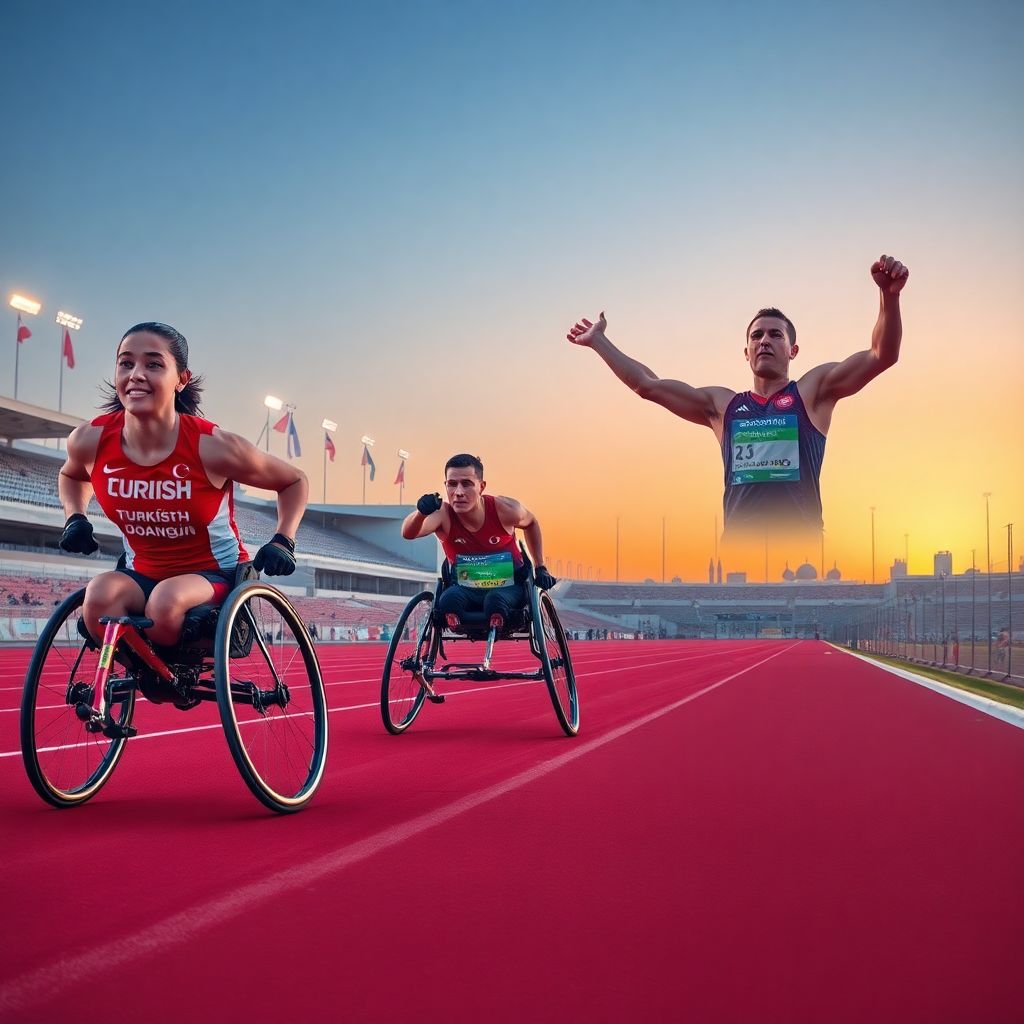
National para athletes shine in Dubai with five-medal haul
Turkey’s Para Athletics National Team delivered a standout performance at the 17th Dubai World Para Athletics Grand Prix, held between 10–13 February 2026 in the United Arab Emirates, returning home with a total of five medals. Despite competing with only three athletes at this prestigious international meeting, the team managed to secure 3 gold, 1 silver and 1 bronze medal, turning the event into a historic success for Turkish para athletics.
The competition, one of the key stops on the international para athletics calendar, brought together many of the world’s leading para athletes. In this challenging field, the Turkish squad not only climbed the podium multiple times but also ensured that the Turkish national anthem echoed over Dubai, underlining the country’s growing status in the sport.
One of the leading figures of this success was Hamide Doğangün. The experienced sprinter and middle-distance specialist once again proved her class on the track. In the 400 metres, Doğangün delivered a commanding performance, leaving her rivals behind and claiming the gold medal. Her race management, acceleration in the final stretch and tactical maturity positioned her as one of the key names to watch in the upcoming season.
Doğangün did not limit her impact to just one event. In the 100 metres, she lined up against a strong international field and fought until the very last metre. This time she finished second, winning the silver medal for Turkey. Taking gold and silver in two different distances at a season-opening competition confirmed her consistency and versatility, and offered a promising preview of her form ahead of the Olympic quota period.
Another star of the Grand Prix for Turkey was Hamid Haydari, who competed in the throwing events. Haydari left his mark on the competition with an impressive double victory. In javelin throw, he produced a series of strong attempts, demonstrating both power and technical precision, and secured the gold medal. His performance showed that he is capable not only of competing with the best in the world, but also of dominating in high-pressure situations.
Haydari then stepped into the shot put circle and produced another outstanding display. Once again outperforming his opponents, he captured a second gold medal. Achieving two golds in two different throwing disciplines at the same Grand Prix is a rare accomplishment and highlighted the depth of his talent and his readiness to challenge for major honours in upcoming international tournaments.
The third member of the Turkish team, sprinter Zübeyde Süpürgeci, also added her name to the medal list. Competing in the 100 metres, Süpürgeci showcased a determined and resilient run. Despite stiff competition, she managed to secure the bronze medal, adding another podium finish to Turkey’s tally. Her performance confirmed that she remains firmly among the competitive names in her classification and that she can push for even higher results as the season progresses.
In total, the trio’s performance — 3 golds, 1 silver and 1 bronze — far exceeded expectations for a small delegation and underscored the effectiveness of the preparation period undertaken by the national team and coaching staff. For Turkish para athletics, the outcome in Dubai is being interpreted not just as an isolated success, but as a sign of a broader upward trend.
President of the Athletics Federation, Ahmet Karadağ, expressed his satisfaction with both the medal count and the attitude shown by the athletes. He underlined that this Grand Prix was the first major international competition for the team after the World Championships and highlighted the significance of opening the new season on such a high note. According to Karadağ, the athletes’ determination and fighting spirit were as important as the medals themselves.
Karadağ pointed out that performances at the beginning of the season are usually seen as an early indicator rather than a final measure of an athlete’s potential. He noted that, although the athletes are still in a development phase physically and technically, winning five medals at this stage demonstrates that the national team is moving in the right direction. For the federation, this outcome confirms the value of long-term planning, structured training programmes and investment in support staff and facilities.
The federation chief also drew attention to the upcoming Olympic qualification process, stressing that the primary goal is not only to collect medals but also to secure quotas and improve personal and seasonal bests. He expressed full confidence in the athletes’ potential, stating that he believes they will achieve even stronger results in the next competitions and continue to make the public proud with their performances on the international stage.
Beyond the numbers, this success story from Dubai carries symbolic importance. Para athletes often have to overcome not only their rivals, but also structural challenges, limited resources and social barriers. Each medal won in such a context becomes a powerful message about resilience, equality of opportunity and the transformative impact of sport. The triumphs of Doğangün, Haydari and Süpürgeci serve as inspiration for many young people with disabilities who are considering taking up sport.
The Grand Prix result is also expected to have a positive impact on the development of para athletics domestically. Strong international performances tend to increase media interest, attract sponsors and encourage greater institutional support. This, in turn, helps federations and clubs to improve training conditions, provide better equipment, expand talent identification programmes and organise more national-level competitions, thereby feeding a virtuous cycle of progress.
From a technical perspective, starting the season with such performances allows coaches and analysts to gather valuable data. Split times in sprint events, throwing distances, reaction times and competition behaviour are all carefully evaluated. Adjustments to training loads, technique refinement and mental preparation strategies can then be made based on actual competition output rather than theoretical planning alone. Dubai, in this sense, has functioned as both a testing ground and a confidence booster.
The athletes themselves will benefit psychologically from this momentum. Winning medals early in the season builds self-belief and reduces pressure in subsequent events. Instead of entering the qualification period with uncertainty, they now have concrete evidence that their training is working. This mental edge can be decisive in tight races, clutch throws or finals where the outcome is often determined by who can handle nerves and expectations better.
Looking ahead, the focus for the national team will be on maintaining this upward trajectory. The coaching staff will aim to carefully manage the balance between pushing for higher performance and avoiding overtraining or injury. Periodisation of training, strategic participation in selected international meetings and continuous medical and psychological support will be crucial to keep the athletes at peak condition when it matters most — during major championships and Olympic qualification events.
At a broader level, the Dubai Grand Prix achievements highlight the importance of long-term investment in para sport. The success of just three athletes in an elite competition shows how targeted support, professional coaching and structured programmes can translate into tangible results on the world stage. As awareness around para athletics grows, it becomes increasingly important for institutions, media and society to recognise these athletes not only for their inspiring stories, but also for their high-performance achievements.
In summary, Turkey’s participation in the 17th Dubai World Para Athletics Grand Prix turned into a milestone for the national team. With three gold, one silver and one bronze medal secured by only three competitors, the delegation maximised its potential and sent a strong signal ahead of the Olympic quota process. The performances of Hamide Doğangün, Hamid Haydari and Zübeyde Süpürgeci have strengthened the belief that Turkish para athletics is on a solid and promising path — one that aims not just for participation, but for consistently standing on the podium at the highest level of international sport.