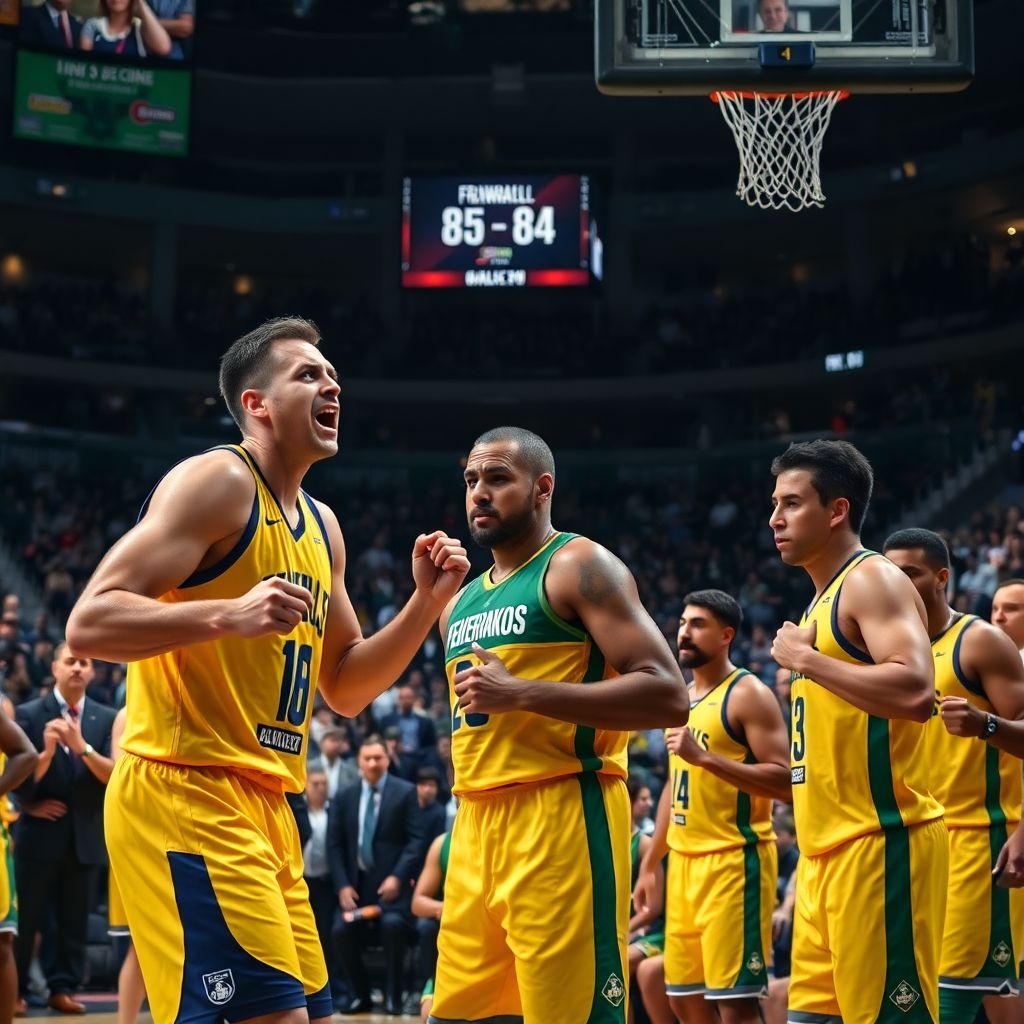
“Fans and We Will Never Forget This”: Cedi Osman Slams Wade Baldwin After Dramatic Finish
Fenerbahçe Beko’s EuroLeague clash with Panathinaikos Aktor ended in high drama and even higher tension, both on and off the court. In a fiercely contested game in Athens, Fenerbahçe edged out Panathinaikos 85–83 thanks to a last-second basket from Wade Baldwin. Yet the biggest talking point after the final buzzer was not the shot itself, but what followed.
Turkish international Cedi Osman, wearing the Panathinaikos jersey this season, delivered remarkably sharp comments in the post-game mixed zone. According to Osman, Baldwin’s behavior in the aftermath of his game-winning play crossed a line and failed to meet professional standards.
Osman did not mince words when asked about his view of the decisive moments and Baldwin’s celebration. He stated that what the Fenerbahçe guard did was “not professional” and openly criticized what he saw as a lack of respect toward Panathinaikos as a club.
“We will never forget this”
Reflecting on the closing seconds, Osman made it clear that the issue for him was not the defeat itself, but how Baldwin chose to celebrate it.
“Wade Baldwin’s behavior was not professional,” Osman said. “The fact that he did not show respect to our club is unacceptable. You win the game, of course you can celebrate, but not like that. The fans and we will never forget this. Panathinaikos is a much bigger club than Baldwin thinks.”
His words underlined two key points: respect for the institution he represents and the emotional bond between players and supporters. For Osman, Baldwin’s gestures and attitude appeared to cross from passionate celebration into what he considered disrespect.
A night of tension on the court
The game itself was already charged with emotion. Fenerbahçe Beko, one of the heavyweights of the EuroLeague, traveled to face a Panathinaikos side led by head coach Ergin Ataman, a name that always adds spice to any matchup, especially against Turkish opposition.
Throughout the four quarters, both sides traded runs and physical plays, with neither able to build a decisive lead. Every possession in the closing minutes felt like a mini-final. The tension in the arena grew as the clock wound down and both teams fought for every loose ball and every defensive stop.
In the final seconds, with the score tied, the ball ended up in the hands of Wade Baldwin. The Fenerbahçe guard attacked, created separation, and sank the decisive shot, sealing an 85–83 victory for the visitors. The basket was a textbook example of a clutch play in elite European basketball, but it was followed by a celebration that angered the Panathinaikos camp.
Celebration vs. provocation: where is the line?
In high-stakes games, emotional celebrations are almost inevitable. Players, coaches, and fans live through weeks of preparation, pressure, and expectation, all released in a few seconds of victory or disappointment. Osman himself acknowledged that winning players have every right to celebrate.
Yet his central complaint was about “how” you celebrate. For him, there is a boundary between expressing joy with your own team and provoking the opponent’s bench or crowd. When that boundary is crossed, it becomes, in his words, “unacceptable.”
Osman’s reaction highlights a broader debate in modern sports: what counts as passion, and what becomes disrespect? In the heat of competition, this line can blur, but veterans like Osman insist that top-level professionals have a responsibility to remain aware of it, particularly in arenas with intense fan cultures like Athens or Istanbul.
Panathinaikos’ identity and pride
By emphasizing that “Panathinaikos is a much bigger club than Baldwin thinks,” Osman wasn’t just defending his own feelings — he was invoking the weight of the club’s history. Panathinaikos is one of the most decorated institutions in European basketball, with multiple continental titles and a fan base known for its loyalty and ferocity.
Osman’s statement suggests that, in his view, any action perceived as mocking or belittling such a club touches on more than a single game. It feels, for players and supporters alike, like a challenge to identity and pride. That is why he stressed that neither the fans nor the team will forget what happened.
This type of rhetoric often fuels future encounters. When a player says an incident “will never be forgotten,” it usually means that subsequent games between the same sides carry additional emotional weight. The next time Panathinaikos meets Fenerbahçe, every gesture, foul, and basket involving Baldwin will likely be under even sharper scrutiny from the stands and the players.
The role of fans in escalating or easing tension
Osman’s explicit reference to the fans — “The fans and we will never forget this” — shows how strongly he connects the locker room with the stands. For him, it is not just about his teammates’ feelings, but also about defending supporters who invest time, money, and emotion into the club.
In basketball environments where the crowd is a decisive factor, such as Athens or Istanbul, players often feel a responsibility to mirror the fans’ passion and stand up for them publicly. Osman’s comments can therefore be read as both a personal reaction and a message of solidarity with the Panathinaikos faithful, who likely interpreted Baldwin’s celebration in a similarly negative way.
At the same time, these statements can also intensify an already heated rivalry. Fans on both sides may use such incidents to stoke future chants, banners, and reactions. In this sense, a few post-game sentences can help shape the narrative for an entire season of clashes between two powerhouses.
Respect in defeat, humility in victory
Osman’s remarks also touch on an unwritten code that many athletes refer to: respect in defeat and humility in victory. While not every player interprets this code the same way, it typically implies that winners should avoid unnecessary taunting and losers should accept the result without resorting to excuses.
From Osman’s perspective, Baldwin’s actions broke that unwritten agreement. His focus was not on the referees or tactics, but on what he perceived as an avoidable display of disrespect. By centering his criticism on behavior rather than the scoreboard, he indirectly accepted the loss while contesting the manner of the opponent’s triumph.
For young athletes and fans watching, episodes like this can serve as a real-life example of how thin — and important — the line is between healthy competitiveness and provocation.
Implications for the EuroLeague season
Beyond the emotional charge of the moment, this episode could have tactical and psychological consequences for the rest of the EuroLeague campaign. Games between Fenerbahçe and Panathinaikos already carry a special intensity due to their status, ambitions, and the presence of high-profile coaches and players.
After Osman’s comments, future matchups may become even more physical and mentally demanding. Panathinaikos players might use the controversy as additional motivation, framing Baldwin’s celebration as something that must be answered on the court. Conversely, Fenerbahçe could rally around their guard, portraying him as a competitor unfairly targeted for his passion.
Such narratives can shape locker-room dynamics, coaching strategies, and even game plans, particularly if the two teams cross paths in crucial late-season or playoff games where every psychological advantage matters.
The coach factor: Ergin Ataman vs. Turkish rivals
An added layer of intrigue in this story is the presence of Ergin Ataman on the Panathinaikos bench. Ataman, long associated with Turkish basketball and known for his outspoken personality, has a history of emotionally charged duels with rival clubs and players.
Matches involving Ataman against Turkish teams often come with extra narrative baggage. His teams generally play with intensity and are unafraid of confrontation, whether tactical or psychological. Osman’s comments fit into that broader frame: Panathinaikos is not just another opponent for Fenerbahçe, and Fenerbahçe is not just another visitor in Athens.
This background likely contributed to both the pressure on the players and the way the post-game comments were expressed and interpreted.
Will there be a response from Baldwin?
As of now, Osman’s statements stand as a clear public criticism of Baldwin’s demeanor. It remains to be seen whether Baldwin will respond directly, tone things down with an explanation, or simply let his game speak in future encounters.
In professional basketball, players sometimes later clarify that intense celebrations are driven by adrenaline, not by deliberate disrespect. Others double down, embracing the “villain” role in hostile arenas. How Baldwin chooses to react — or whether he reacts at all — could either calm the situation or add more fuel to an already burning rivalry.
What remains clear is that this dramatic ending and the emotional fallout have transformed a regular-season EuroLeague game into a reference point for the relationship between these two clubs and these particular players.
A night that will linger in memory
In purely sporting terms, Fenerbahçe Beko walks away with a valuable 85–83 road victory, anchored by Wade Baldwin’s decisive shot at the buzzer. But the impact of the night goes far beyond the standings.
For Cedi Osman and Panathinaikos fans, the bitter aftertaste is not only the narrow defeat, but a sense that their club’s dignity was challenged. Osman’s strong language — emphasizing that neither the supporters nor the team will forget what happened — suggests that this moment will linger in collective memory.
In a competition where rivalries are built over years through iconic games, controversial moments, and unforgettable plays, this match has earned its place. The next time Fenerbahçe and Panathinaikos share the floor, every eye will be on Wade Baldwin, Cedi Osman, and how both sides choose to write the next chapter of this unfolding story.