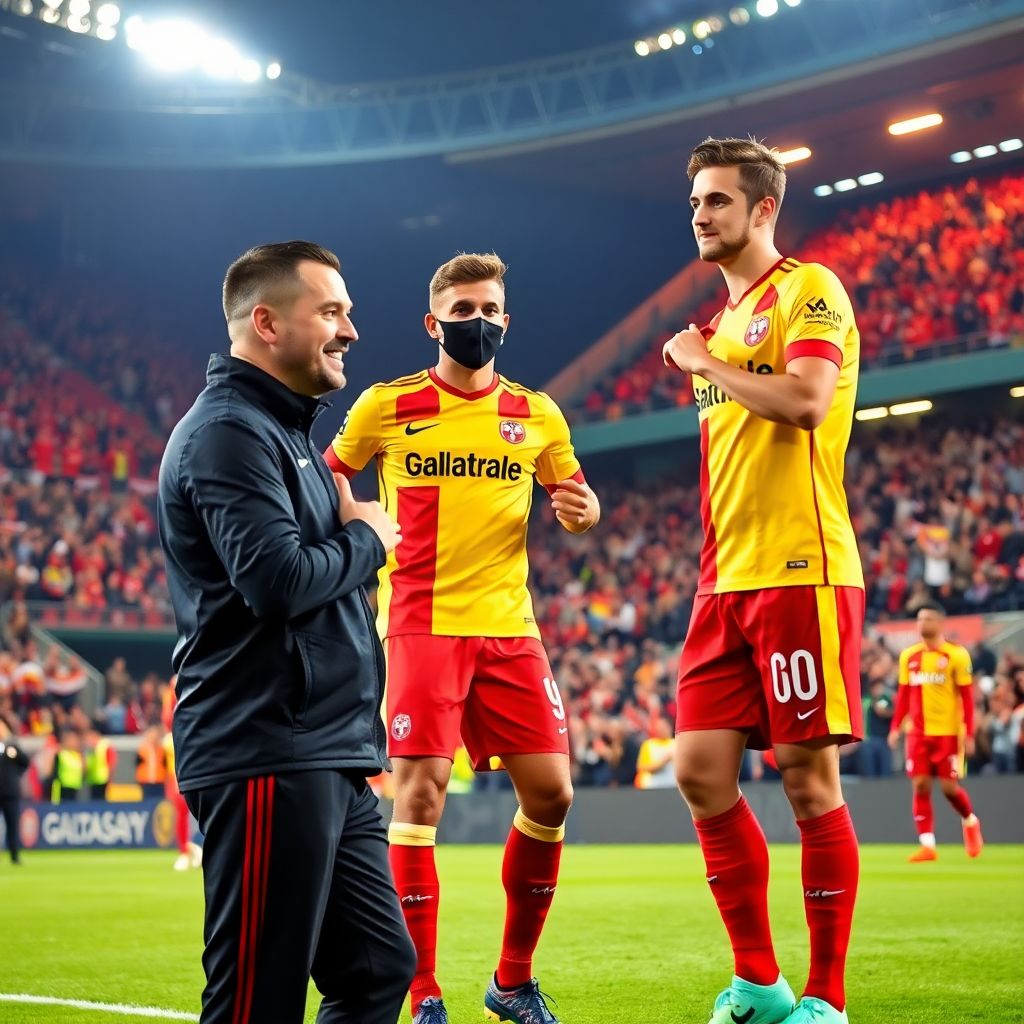
Okan Buruk pleased with Nhaga’s debut as Galatasaray cruise past Eyüpspor
Galatasaray head coach Okan Buruk underlined that his team’s recent high‑scoring victories in the Trendyol Süper Lig have strengthened both their playing philosophy and dressing-room morale. Speaking after the 5–1 win over Eyüpspor in the 22nd week at RAMS Park, Buruk highlighted individual performances, tactical choices and especially the promising display of winter signing Renato Nhaga.
Buruk began by reminding that, despite their poor run in the league, Eyüpspor remain a difficult opponent. “In recent games their squad has changed, but they are still a team that pushes their rivals,” he noted. “They beat Alanyaspor away, drew at home with Beşiktaş, they try to play good football and are not a side you can underestimate in any way.”
The match, however, shifted decisively after Eyüpspor were reduced to ten men. “Once they went down to 10 players and we made it 2–0, the character of the game changed completely,” Buruk explained. “In my opinion, it turned into a very positive night for us ahead of the Juventus match. Beyond the scoreline, it was a fixture where players who hadn’t featured for a long time got minutes, we rotated the squad and managed to rest some key names.”
He paid special tribute to Mauro Icardi and Victor Osimhen, who started together up front. “Icardi’s goals were very important,” Buruk said. “He and Osimhen played as a pair, and the two assists from Osimhen were extremely valuable. Icardi has had a long injury period, but from November to February there is a huge difference in his condition. His training and match performances have both gone up. Physically, he is in a much better phase now.”
The coach underlined that the decision to play with two strikers was not only about the individuals but also a response to Eyüpspor’s game model. “We had to consider their rising performances, but we also planned with the opponent’s structure in mind,” he explained. “It was a home match for us, and judging by their formation, we preferred to press with two forwards. Eyüpspor are good at building from the back. They make a lot of passing errors, but they insist on playing that way. We thought that if we applied strong high pressure while they were circulating the ball in their own half, we would win it in dangerous zones. That’s exactly what happened: we created chances and forced the red card. So the decision for a twin‑striker setup was not only about Icardi and Osimhen, but also about exploiting their style.”
A night of rotation and returns
Buruk described the encounter as ideal for managing his squad ahead of a crucial Champions League clash. Reminded that he has a deep, alternative-rich squad and asked why he did not use Roland Sallai, the coach was clear. “On Tuesday we will play a very important match in the Champions League,” he said. “We chose not to use some of our players with that in mind. Sallai was one of them.”
It was also a night for long‑awaited comebacks. “Sacha Boey had been out for a long time and needed minutes; we were able to see his condition,” Buruk stated. “Singo played 45 minutes after a long break. Nhaga stepped in front of our supporters for the first time. Overall it was a positive, morale‑boosting evening. Making our fans happy, especially those who came here today, makes us leave the stadium satisfied. These recent matches with lots of goals are helping us push our footballing philosophy to a higher level and increasing our happiness.”
Defensive options multiplying
Another key takeaway for Buruk was the situation in central defence. With several players returning from injury, the coach now feels he has genuine competition for places at the back. He revealed that the half-time substitution of Davinson Sánchez for Wilfried Singo had been decided in advance.
“I had planned the change before the match,” he said. “My initial idea was that Davinson and Singo would each play 45 minutes. I even considered starting with Singo and bringing Davinson on later, but in the end I thought it would be better to judge Singo according to how the game developed. His return as an option at centre-back is very important for us. He is a player we can use alongside both Abdülkerim and Davinson. Those two have played a lot of games recently.”
Buruk reminded that, during the injury crisis, he had been forced to improvise. “At times we used Lemina there,” he recalled. “In the Manchester City match I even played Ismail Jakobs as a left-sided centre-back. We also have Arda Ünyay in the squad. So now our alternatives at centre-back have increased significantly.”
Singo’s versatility goes beyond centre-back
The coach was keen to correct the perception that Singo is now limited to playing only in central defence. “It’s wrong to think Singo can only play as a centre-back,” Buruk insisted. “His injury has largely healed. Today he once again reached high speeds. He is in a condition to play almost anywhere on the pitch. He can also play at right-back. The main thing today was to give him those 45 minutes, and he came through them very well. Hopefully from now on he will continue by getting more and more minutes.”
By emphasizing Singo’s versatility, Buruk also hinted at tactical flexibility for the rest of the season. With the team fighting on multiple fronts, being able to shift between a back four and a back three, or adjust the pressing scheme depending on the opponent, will be vital. Players like Singo who can cover several positions give the coach more freedom both during preparation and in‑game.
“I liked Nhaga’s performance”
One of the most talked‑about aspects of the match was the first real appearance of new signing Renato Nhaga in front of the Galatasaray fans. Buruk made it clear that he sees serious potential in the young midfielder. “Nhaga is a very young player,” he said. “You could clearly see his desire during the game. That made us and our supporters happy.”
At the same time, Buruk maintained a balanced view of the context in which Nhaga played. “We have to remember he came on when it was 11 against 10,” he pointed out. “But in general, I liked his performance. He pressed in the right areas, he was very calm on the ball, and at no point did he look out of place. The fans gave him huge support. We will keep working with him on his positioning in midfield. He is a player who needs to develop, but he has shown his potential. He left the impression that he will become a very good player in the future.”
Despite this praise, Nhaga was not included in the club’s Champions League squad. Buruk explained this decision as a matter of experience and priorities. “The Champions League is a very tough competition,” he stressed. “Having experience there is crucial. That is the only reason we didn’t register Renato. After Sacha Boey returned, we preferred players who are more ready at this level. The minutes he gets in other matches and the opportunities we give him will be very important for his growth.”
Why Nhaga was left out of the Champions League list
Expanding on the Champions League decision, Buruk pointed out that the squad list forces coaches into difficult choices. “We are entering a very demanding period,” he said. “Fortunately, our squad is very deep. We have players returning from injuries and new signings who have added serious depth and competition to the team. This is great for the club, but it also means I will face tough decisions as a coach.”
According to Buruk, leaving Nhaga out should not be interpreted as a lack of trust. Instead, it is part of a phased plan for his development. “For a young player, it is not always ideal to be thrown straight into the toughest competition,” he argued. “First he must gain rhythm, understand our tactical demands fully and build confidence in league and cup games. Once he has that base, the step up to the Champions League becomes much more natural.”
Tactical profile of Renato Nhaga
While Buruk did not go into exhaustive tactical detail, his comments allow a picture of Nhaga’s profile to emerge. The coach particularly appreciated the way the youngster handled pressure and contributed to the team’s pressing. “He went into the right pressing lanes and looked very relaxed on the ball,” Buruk noted. “These are important qualities for a midfielder in our system. He did not hide, he always wanted to be involved.”
Galatasaray’s game model demands that central midfielders combine courage on the ball with discipline off it. The mention of “position taking in midfield” suggests that one of the main areas of focus in training will be Nhaga’s sense of spacing, when to move forward and when to provide cover. If he continues to absorb these tactical details, he could evolve into a reliable rotation option in matches of higher intensity.
Managing a deep and competitive squad
Buruk’s remarks throughout the press conference repeatedly returned to one theme: squad depth. With key players back from injury and several reinforcements added, internal competition has intensified. “The transfers we made and the players returning from the treatment room have given the team serious depth and competition,” he said. “From my perspective, I am entering a difficult period because I will constantly have to make choices between very good options.”
This competition, however, is something the coach views as essential for maintaining a high level across three fronts: league, domestic cup and Europe. Players know that any drop in performance can quickly cost them their starting spot, while strong training displays can open doors. Youngsters like Nhaga benefit from this environment by training daily alongside experienced internationals, accelerating their learning curve.
High‑scoring wins and the team’s identity
Buruk placed strong emphasis on how recent big wins have helped to reinforce Galatasaray’s footballing identity. “These last matches with lots of goals allow us to elevate our playing philosophy,” he commented. “They make us happier and more confident.” The combination of an aggressive high press, quick transitions and clinical finishing is gradually becoming the hallmark of his team.
In this context, the roles of Icardi and Osimhen are central. Playing them together sends a clear message: Galatasaray intend to attack proactively, especially at home. Their complementary skill sets – Icardi’s penalty-box instincts and Osimhen’s mobility and physical presence – stretch defences and free space for midfielders arriving from deep. The coach’s willingness to adapt structures based on the opponent’s build‑up patterns also shows a more flexible, modern approach.
Looking ahead: what this game means for Galatasaray
The 5–1 victory over Eyüpspor was more than just three points. It provided a platform to fine‑tune the team before a critical Champions League test, offered minutes to players returning from layoffs, and allowed a promising youngster like Renato Nhaga to take his first real steps in front of the home crowd.
For Buruk, the task now is to convert this positive momentum into consistency at a higher level. Maintaining balance between rotation and continuity, nurturing talents such as Nhaga without exposing them too early, and sustaining a competitive but harmonious atmosphere in a deep squad will define Galatasaray’s season.
If Nhaga continues to respond as he did in this match – showing desire, composure and tactical discipline – he is likely to move from being a promising option for the future to a genuine contributor in the present. For now, his coach’s verdict is clear and encouraging: Okan Buruk liked what he saw, and he believes there is much more to come.