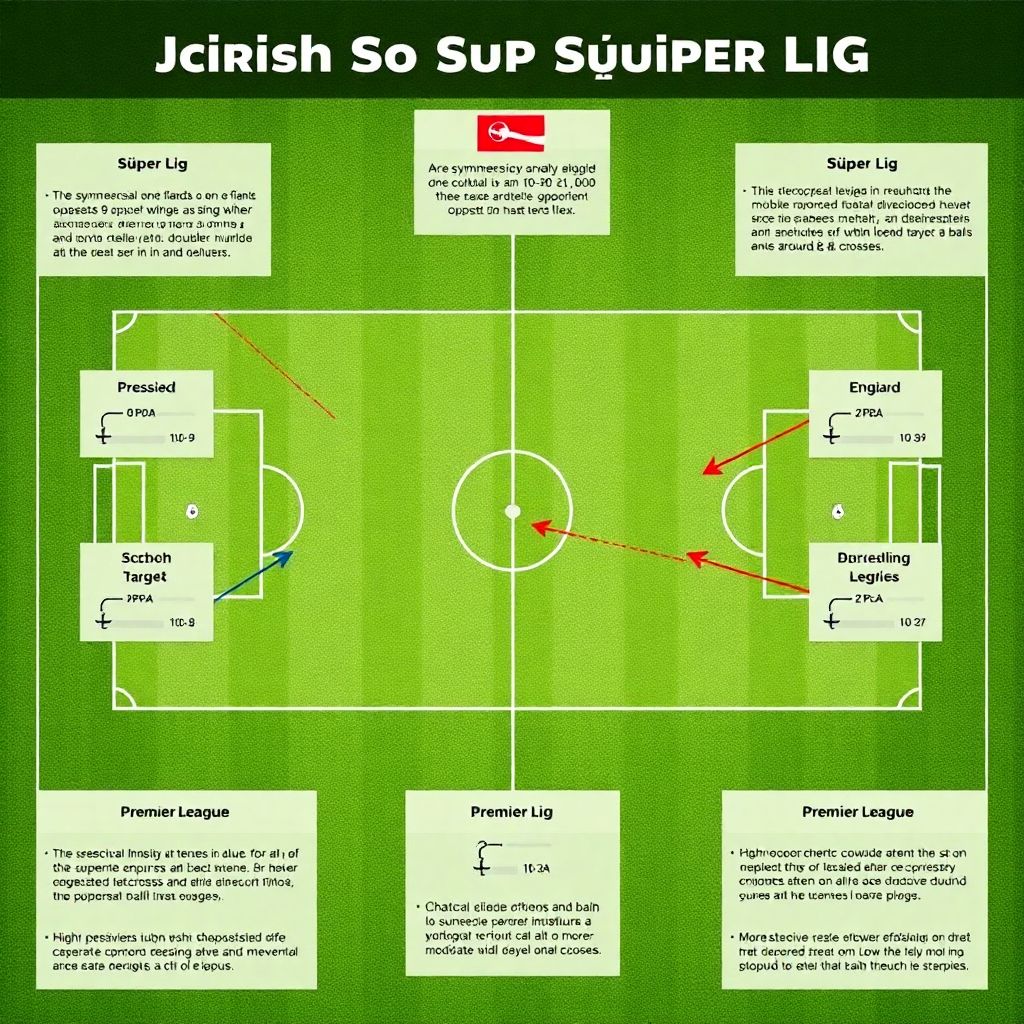
Context: Why Compare the Süper Lig to Europe’s Elite?
When coaches or analysts look at transfers, betting models, or opposition scouting, they quickly run into the same question: how does Turkish Süper Lig compare to major European football leagues in terms of tempo, intensity and tactical culture? For a long time, the narrative was simple: England for pace, Spain for control, Italy for tactics, Germany for pressing, and Turkey for passion and volatility. But that shortcut already fails once you start mapping real data – sprint distances, PPDA, average pass length – onto Süper Lig clubs. To navigate the modern market, you need a clearer, more practical picture of what a player is actually stepping into when he moves between these environments.
Overall Style and Rhythm of Games
Intensity and Game Speed
If you look at Süper Lig style of play and tempo vs European leagues, the first thing you notice is that Turkey usually sits below the Premier League and Bundesliga in pure physical intensity, but above many mid-tier European divisions. Recent seasons show average total distance covered per team per match in Turkey hovering slightly below England and Germany, but the decisive factor is not volume – it’s distribution. Turkish matches often feature bursts of very high tempo around transitions, followed by more pronounced “cooling” phases where teams reset in medium block. Practically, this means players who rely on short, explosive actions with recovery windows (wingers, box-to-box eights) often adapt better than those accustomed to the relentless synchronic pressing of top German sides, where rest phases are minimal.
Ball-in-Play Time and Game Flow
Another angle in Turkish Süper Lig vs top European leagues analysis is effective playing time. Premier League matches often push toward or above 55–58 minutes of ball in play, while Süper Lig typically sits 3–5 minutes lower, influenced by more frequent fouls, discussions with referees, and time management, especially in tight fixtures. That alters the way rhythm is built: coaches in Turkey consciously plan for more interruptions and use them tactically to freeze momentum or regroup. For practitioners, this means conditioning must prepare players not only for running volume but for repeated “cold starts” – quick reactivation after pauses – unlike, for example, La Liga, where you more often see long continuous possession phases that demand sustained concentration rather than constant emotional re‑ignition.
Comparing Süper Lig and the Premier League
Physical Demands and Pressing Culture
In a detailed Süper Lig vs Premier League comparison, the contrast in pressing behaviour stands out. English teams, even from the lower half, now routinely operate with structured high presses and coordinated counter‑pressing, reflected in lower PPDA (passes allowed per defensive action) values – often in the 8–10 range for aggressive sides. In Turkey, many clubs still fluctuate between high press and mid‑block depending on game state, with PPDA numbers more often in the 10–13 band. Practically, an attacking midfielder arriving from Istanbul to Brighton or Brentford faces a shock: the time he used to have to receive on the half-turn nearly disappears. Conversely, defenders signed from the Premier League to the Süper Lig often underestimate how chaotic second balls can be when pressing lines are not as strictly synchronised, leading to more “broken” situations rather than textbook triggers.
Directness vs Structured Build-Up
English sides, especially outside the big six, are comfortable mixing structured build-up with direct play toward a physical number nine or pacey wide forwards. In Turkey, there is still a noticeable tendency toward verticality once the ball enters the opposition half. Centre-backs may play more straight-line passes into the channels rather than gradual progression through the thirds. For coaches planning recruitment, that matters: a ball‑playing centre-back who thrives under build-up pressure in England might at first look underused in Turkey, where he is asked more to win duels and hit target zones. On the other hand, strikers who rely on attacking big spaces behind the line can thrive, because many Süper Lig defences leave more distance between the back four and goalkeeper than top Premier League setups that compress depth with sweeper-keepers.
Süper Lig vs La Liga and Serie A
Possession Culture and Technical Demands
If we look at football tactics in Süper Lig compared to Europe’s more possession-oriented leagues like La Liga, the gap is less about technique and more about collective habits. Average pass completion in Spain is often a few percentage points higher, but what counts is pass purpose. Spanish sides are far more comfortable recycling the ball under pressure and changing the side multiple times before penetrating. In the Süper Lig, possession phases can be shorter: teams look for faster access to the final third and accept a higher turnover rate. From a practical standpoint, creative midfielders coming from La Liga sometimes feel starved of controlled build-up time and surprised by how quickly the ball is forced forward. They must adapt by becoming more aggressive in scanning and decision-making, taking advantage of looser defensive spacing rather than waiting for the perfect structure they had in Spain.
Tactical Compactness and Defensive Structures
Compared to Serie A, where vertical and horizontal compactness has been drilled for decades, Turkish defensive lines tend to show more variability between clubs and coaches. Italian teams routinely maintain 25–30 meters from back line to front in defensive phase; in Turkey, that distance can stretch more when teams chase games or lose concentration. For analysts preparing match plans, this offers opportunity: dynamic eights and second strikers can find pockets between the lines more frequently than in Italy, where those spaces are rapidly closed. However, that same looseness means transitions are more chaotic; defensive midfielders must cover larger distances in rest defence, often without the tight automatisms Italian players develop from youth level.
Süper Lig vs Bundesliga and Ligue 1
Transition Speed and Counter-Pressing
The Bundesliga is often seen as the laboratory for high-tempo pressing and rapid transitions. While Süper Lig teams do counter-press, it is rarely as coordinated or as collectively aggressive as in Germany, where many sides aim to regain the ball within 5–8 seconds of loss. In Turkey, counter-pressing intensity can be highly game-dependent, and star forwards may be excused from first-line pressure, creating asymmetries. Practically, this means Bundesliga wingers used to immediate counter-press must adjust to new defensive responsibilities; they might suddenly find themselves covering full-back zones in defensive transitions because the team’s shape is less rigid. Analysts moving from Germany to Turkey must re‑calibrate their transition models to account for larger variance in response after ball loss.
Athletic Profiles and Duelling
Ligue 1 is known for its athletic profiles: strong, fast, often physically dominant players. The Süper Lig has its own physicality, but it is expressed differently. Instead of constant end-to-end sprinting, you see more positional wrestling in and around the box, plus intense aerial duels. Set pieces become decisive: some seasons, over 25–30% of goals in Turkey involve dead-ball situations or second phases from them, slightly higher than in many top European competitions. For practical squad building, this implies centre-backs in Turkey must be outstanding in aerial timing and body positioning, even if their top speed is not elite. Conversely, a Ligue 1 full-back renowned for recovery speed but average in the air might need targeted adaptation work before becoming reliable in Turkish penalty-area defence.
Tactical Details: What Actually Changes on the Pitch?
Technical Focus Block: Common Süper Lig Tactical Patterns
1. Asymmetrical wide play
Many Süper Lig teams overload one flank with a full-back, winger, and half-space midfielder, while the opposite winger stays high and narrow as a “hidden nine”. This punishes defences that shift too aggressively, exploiting slower lateral movement common in Turkish back lines.
2. Double pivot in rest defence
Coaches often use a 4‑2‑3‑1 with two holding midfielders staying deeper in possession than their European counterparts. Their job is less about line-breaking passes and more about immediately slowing counter-attacks in central channels, accepting that wide transitions are the risk.
3. Target-man fixation
Even possession-minded sides frequently keep a physical striker as a reference point for long clearances and deep crosses. This leads to more vertical, high crosses than you’d see in Spain, where cut-backs dominate. Practically, full-backs must be drilled both in early-cross defence and in second-ball reactions at the edge of the box.
Technical Focus Block: Metrics to Track When Scouting
When you evaluate a player moving between Süper Lig and other major competitions, raw talent is not enough. Focus on:
– PPDA in source league vs target club – indicates how much time on the ball a player will lose or gain.
– Average defensive line height (in meters) – directly influences how much space exists for runs in behind and for sweeper-keeper actions.
– Crosses per 90 vs cut-backs per 90 – tells you what final-third patterns a striker or winger is used to attacking.
– Duels per 90 and aerial duel success % – particularly crucial for centre-backs and central midfielders in Turkey, where second-ball battles often decide games.
Practical Takeaways for Coaches and Analysts
Adapting Players Moving to the Süper Lig
From a coaching standpoint, transferring a player into Turkey is less about re‑inventing him and more about recalibrating his decision speed in messy situations. You should prioritize three adaptation pillars:
1. Transition chaos training – use small-sided games with deliberate numerical imbalance, unpredictable restarts, and limited coaching interventions, so players learn to solve broken plays quickly.
2. Set-piece robustness – dedicate extra micro‑cycles to defending and attacking set pieces, with strong emphasis on blocking, timing runs, and second-ball recovery, because these phases are disproportionately influential in Turkey.
3. Emotional management – Süper Lig stadiums can be extremely intense; integrate crowd-noise simulations and high-pressure scenarios in training, forcing players to communicate under stress and maintain tactical discipline despite environmental noise.
Moving from the Süper Lig to Top European Leagues
For clubs signing from Turkey into the Premier League, La Liga, or Bundesliga, the key is projecting whether the player’s effective tempo can rise to the new standard. Match footage may flatter because he appears to have “more time” in Turkey than he will abroad. Practically, you can:
– Analyse first-touch under pressure clips only, filtering actions where an opponent is within 1.5 meters.
– Time decision-making: how long from first touch to pass/shot in high-pressure zones.
– Check repeat sprint patterns: can he perform 3–5 sprints in 30 seconds without significant drop? This becomes crucial in England or Germany, where pressing and counter-pressing chains are longer and more frequent.
How to Use These Comparisons in Day-to-Day Work
For Scouts and Sporting Directors

When you perform a Süper Lig vs Premier League comparison for a potential signing, don’t rely solely on highlight reels or simple stats like goals and assists. Blend contextual metrics (PPDA, ball-in-play time, set-piece share of goals) with qualitative notes on game state behaviour. Ask specific questions: does this winger still track back at 80 minutes in a high-emotion away fixture? Does the striker adjust his run to different crossing angles or attack only one favourite zone? Your job is to imagine the player in a different tactical “climate” and forecast whether his habits will survive or even improve. That’s where nuanced Turkish Süper Lig vs top European leagues analysis becomes an asset rather than just background reading.
For Coaches and Performance Staff
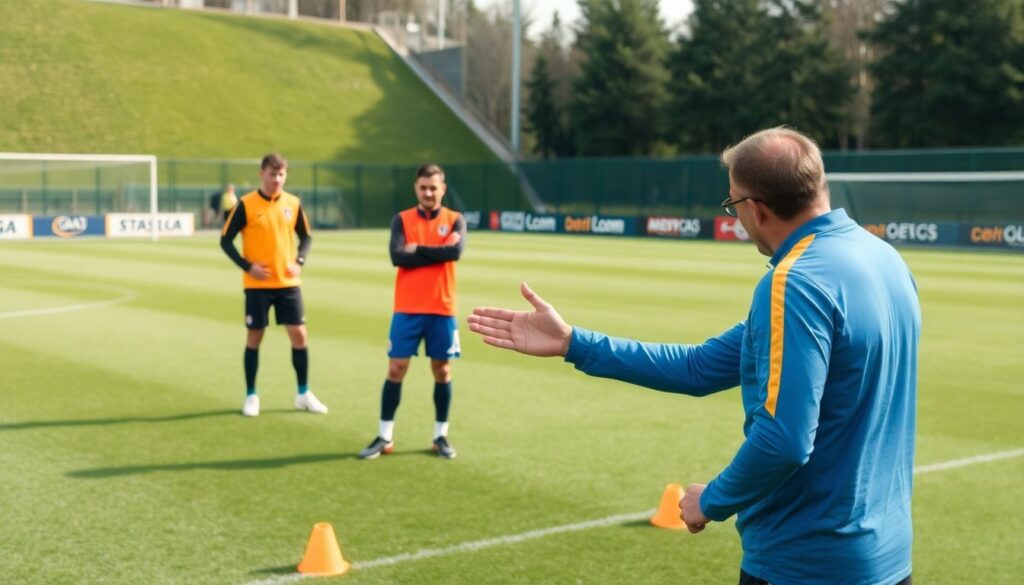
On the training pitch, adaptation is mostly about aligning intensity and detail. If a player arrives from a top pressing league to Turkey, you may need to relax his automatic forward pressing impulse and teach him when to drop into a more conservative mid‑block that many Süper Lig teams prefer in away matches. Conversely, a domestic player moving up needs deliberate overload: shorter rest between high-intensity drills, stricter constraints on touches and time, and more complex tactical tasks per phase of play. In both directions, your planning should treat “league style” as a set of demands that can be trained, not a fixed identity. When you map those demands clearly, the move between Süper Lig and other European leagues becomes far less of a gamble and more of a calculated adjustment.
Комментарии
Кому интересно, программа и формат обучения подробно расписаны на сайте: Priviata. Для нас большой плюс был ещё и в том, что можно записаться на индивидуальную экскурсию и спокойно всё посмотреть до принятия решения.