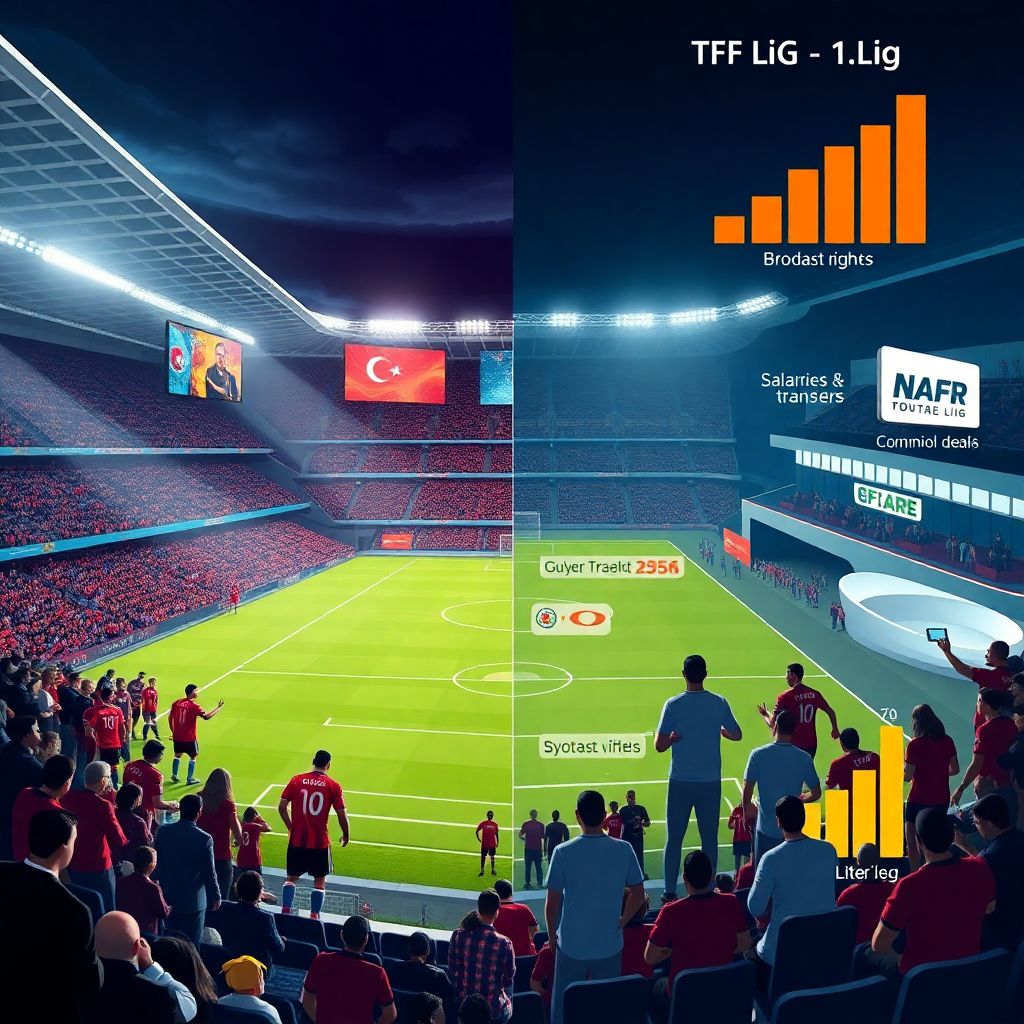
The money gap between Turkey’s top two divisions is bigger than the scoreboard ever shows. When you zoom in on how cash really flows in the Süper Lig and TFF 1. Lig, you start to understand why some clubs chase Europe while others just try to pay the electricity bill on time.
Below is a breakdown of what the numbers actually say, how the picture is changing by 2026, and what it all means for the future of Turkish football.
—
The basic money story: two leagues, two different planets
Revenue scale and league position
If you compare the average budgets, the Süper Lig lives in one economic universe and TFF 1. Lig in another.
In broad terms, top-flight clubs typically work with budgets several times higher than second-tier sides. Even the poorer Süper Lig clubs usually outspend most promotion contenders from TFF 1. Lig. That gap shows up in:
– Squad wages
– Quality of foreign players
– Infrastructure (training grounds, academies, analytics staff)
By 2026, the divide hasn’t shrunk; if anything it has become more structured. Promotion to the top tier is now less a sporting achievement and more a financial lottery ticket. Clubs are planning seasons not just around tactics but around broadcast contracts, exchange rates and debt schedules.
Short version: move up a division, and your world changes overnight. Stay down too long, and it gets harder every year to catch up.
—
Broadcasting money: the main oxygen supply
Süper Lig TV rights revenue vs TFF 1. Lig
Let’s start with the most obvious pipeline of cash: TV rights.
Süper Lig domestic rights bring in the largest shared pot in Turkish football. Even with renegotiated contracts, currency fluctuations and occasional payment disputes, the top tier still captures the lion’s share of the total broadcast value. TFF 1. Lig gets a fraction of that, both in absolute and per-club terms.
When people talk about “Süper Lig TV rights revenue vs TFF 1. Lig”, they’re basically talking about the difference between running a mid-size business and running a small local company. For many Süper Lig clubs, TV money is still their single biggest predictable income stream. For TFF 1. Lig sides, it’s helpful, but it rarely covers core costs like wages and facilities on its own.
Turkish football broadcasting rights market analysis
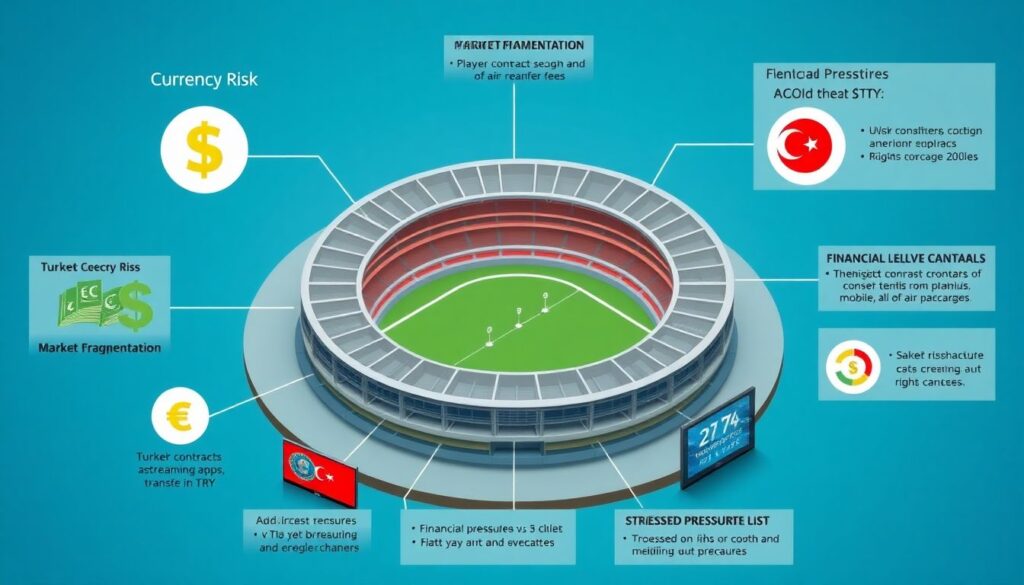
A proper Turkish football broadcasting rights market analysis shows three structural pressures that shape both leagues:
– Currency risk: Rights are often negotiated in local currency, but many club costs (foreign salaries, bonuses, transfers) are effectively pegged to euros or dollars.
– Fragmentation of viewers: OTT platforms, illegal streams and shifting fan behaviour make it harder to raise domestic fees to the levels of Western Europe.
– International appetite: Outside Turkey and diaspora communities, global demand is modest. That caps how big the export piece of the rights puzzle can become.
By 2026, rights deals are still essential, but nobody counts on them growing fast enough to save badly run clubs. Broadcasters have become tougher negotiators, and performance clauses, viewership metrics and digital rights packaging play a bigger role than five or ten years ago.
—
Salaries, transfers and financial pressure
Turkish Süper Lig club finances and salaries
The Süper Lig has long punched above its economic weight on wages. Mid-table clubs sometimes offer salaries that would be surprising given their actual revenues. The traditional recipe:
– Generous contracts to attract experienced foreigners
– Short-term performance pressure to reach Europe
– Loans and advances against future income to pay for it all
This model looks increasingly fragile in 2026. UEFA financial regulations, stricter domestic oversight and simple market reality have forced many clubs to:
– Move from high fixed salaries to more performance-based contracts
– Shorten contract lengths for older players
– Bet more on resale value and younger signings
TFF 1. Lig operates on a different scale. Wages are lower, and payment delays are more common. For many players, the financial dream is straightforward: get promoted or get transferred to the top tier, because that’s where life-changing money is.
—
Sponsorships and commercial deals
Süper Lig sponsorship deals compared to TFF 1. Lig
Sponsorship is the second big financial pillar after media. And once again, the gap is huge.
When you compare Süper Lig sponsorship deals compared to TFF 1. Lig, a few things stand out:
– Big-city Süper Lig clubs attract national and international brands. Shirt fronts, sleeve deals, training kit, stadium naming rights – it all adds up.
– Regional Süper Lig teams have smaller deals, but still operate at a level most TFF 1. Lig clubs can’t match.
– Second-tier sides rely heavily on local businesses, municipal links and occasionally politically connected sponsors.
For sponsors, exposure matters. Live broadcasts, social media reach, European competition appearances – all of that is far more likely in the top league. That’s why a mid-table Süper Lig side can earn multiple times the sponsorship income of a promotion-chasing second-tier club.
—
Financial statistics: what the numbers tend to show
Revenue composition and club behaviour
If you strip away club names and just look at percentages, a typical Süper Lig club’s revenue mix often looks roughly like this (varying from club to club):
– A large chunk from domestic and international broadcasting
– A meaningful share from sponsorships and commercial deals
– Matchday income that heavily depends on stadium size and fan base
– Transfer income that can swing numbers wildly from year to year
For TFF 1. Lig, the pie chart is different:
– Smaller broadcast piece, often not enough to be decisive
– Sponsorships more limited, heavily local
– Matchday income modest, with attendance fluctuating sharply based on promotion hopes
– Transfers mostly about selling promising players to the Süper Lig or abroad
The underlying statistical pattern is simple: the higher you go, the more diversified and scalable your revenue. The lower you go, the more fragile and seasonal it becomes.
—
Investment and ownership: risk and reward
investment opportunities in Turkish football clubs
By 2026, people talk a lot more about investment opportunities in Turkish football clubs than they did a decade ago. Several drivers are behind that:
– Undervalued assets: Compared to Western Europe, club valuations can look “cheap” relative to fan base size and sporting potential.
– Player trading: Turkey has become a visible shop window for players heading to the top five European leagues. Smart recruitment can mean real upside.
– Stadium infrastructure: Many modernised stadiums give a better base for matchday and event revenues.
But this is not a simple bargain-hunter’s paradise. Investors still face:
– Heavy legacy debts at big clubs
– Political and regulatory unpredictability
– Volatile exchange rates impacting foreign financing and costs
In TFF 1. Lig, investment is usually more niche and strategic: academies, local talent pipelines, and attempts to build a promotion project that can then be flipped or stabilised in the Süper Lig.
—
Economic aspects: beyond club balance sheets
Local economies, jobs and public money
Football in Turkey isn’t just about clubs’ own finances; it’s tied into local economies and sometimes public budgets.
Longer-term trends:
– Municipalities often still support clubs, directly or indirectly. That can mean rent deals, infrastructure, or business networks tied to local government.
– Matchdays generate revenue for small businesses – cafés, transport, merchandising stalls – especially in cities where the club is the main local brand.
– New or renovated stadiums have been built with public involvement, making the political and economic stakes higher when a club is relegated.
The economic footprint of a Süper Lig team in a city is substantially larger than that of a TFF 1. Lig side. Relegation doesn’t just hurt fans emotionally; it can reduce local spending and visibility in a very practical way.
—
Development forecasts to 2030
Where the money side is likely heading
Looking ahead from 2026, several financial trends seem quite likely, based on current patterns:
– More disciplined wage structures
Clubs are slowly moving away from unsustainable wage-to-revenue ratios. Expect:
– Greater emphasis on academy graduates and domestic talent
– Performance and resale value becoming central metrics for sporting directors
– Fewer “big name, short-term impact” signings on massive contracts
– Digital-first commercial strategies
Growth is more likely to come from digital content, international fan engagement and data-driven marketing than from old-school sponsorship alone.
– Selective foreign investment
Rather than a wave of random takeovers, expect focused investors targeting clubs with clear brands, stadium control and realistic European prospects.
For TFF 1. Lig specifically, the forecast is a struggle for sustainability:
– Clubs will be pushed to professionalise back-office operations.
– Youth development and player sales will become core business models.
– Financial regulation and licensing could force some consolidation or restructuring among chronically loss-making teams.
—
Impact on the wider Turkish football industry
Talent, competitiveness and league identity
The financial realities of Süper Lig vs TFF 1. Lig shape everything from style of play to career paths.
A few industry-level effects:
– Talent funnel: Second-tier clubs increasingly act as stepping stones for both domestic youngsters and underrated foreign players who hope to reach the Süper Lig quickly.
– Competitive balance: The top of the Süper Lig remains dominated by historically large clubs, but smart mid-range teams with solid finances can now challenge more regularly.
– Brand of the league: The Süper Lig’s reputation as a high-intensity, emotionally charged league with strong crowds is still intact, but the financial narrative is shifting toward “can they finally become sustainably run?”
For Turkish football as an industry, the big question isn’t just whether more money can be brought in. It’s whether that money is used to:
– Stabilise club finances
– Build real scouting and analytics departments
– Invest in academies and women’s football
– Upgrade fan experience and safety
If those boxes are ticked, both the Süper Lig and TFF 1. Lig can evolve into healthier competitions that still keep their edge and local flavour.
—
Conclusion: what the numbers really reveal
When you strip away the emotion, the numbers tell a clear story.
The Süper Lig sits at the centre of Turkish football’s economic universe, pulling in most of the broadcast, sponsorship and investment attention. TFF 1. Lig, meanwhile, survives in its orbit, vital for talent development but exposed to financial shocks and dependent on local networks.
The future up to 2030 will be defined less by who scores the goals and more by who learns to manage cash flows, control debts and build sustainable models. Those clubs – in both divisions – will not only win more often; they’ll shape what Turkish football looks like for the next generation.