Why Compare Turkish and European Youth Development Models at All?
When practitioners talk about youth work, they often jump straight to inspirational stories or flashy project photos. But if we zoom out, we see two partly overlapping ecosystems: youth development programs in Turkey and Europe. Both aim to help young people build skills, find their place in society, and participate democratically, yet they are built on different histories, policies and funding logics. Comparing them is not an academic game; it is a practical way to spot blind spots in your own practice, borrow what works elsewhere, and avoid wasting money on well‑meant but clumsy projects. In this article we will unpack definitions, sketch simple “text diagrams”, compare Turkish and European youth policy models, highlight what can realistically be adapted, and, importantly, walk through typical mistakes that beginners make when they first enter this field or try to “import” foreign approaches without real adaptation.
Key Definitions: Getting the Language Straight
Before looking at specific systems, it helps to agree on what we are comparing. “Youth development” is a broad term, and if you put ten youth workers in a room, you might get twelve different descriptions. For the purposes of this article, we will treat youth development as a mix of three components: (1) personal growth (skills, confidence, life competencies), (2) social inclusion (avoiding marginalisation, discrimination, or radicalisation), and (3) civic engagement (participation in communities, NGOs, sometimes politics). Youth work, more narrowly, is the set of non‑formal and informal educational practices aimed at young people, usually outside formal schooling. When we talk about youth development programs in Turkey and Europe, we mean structured interventions—projects, centres, networks, policies—designed to improve these three components for people roughly aged 15–29, although legal age brackets differ by country. Keeping these definitions clear helps avoid the classic beginner’s error of confusing any activity “with young people present” with genuine youth development that has intentional outcomes and coherent methods.
A Simple Diagram of Youth Development Systems
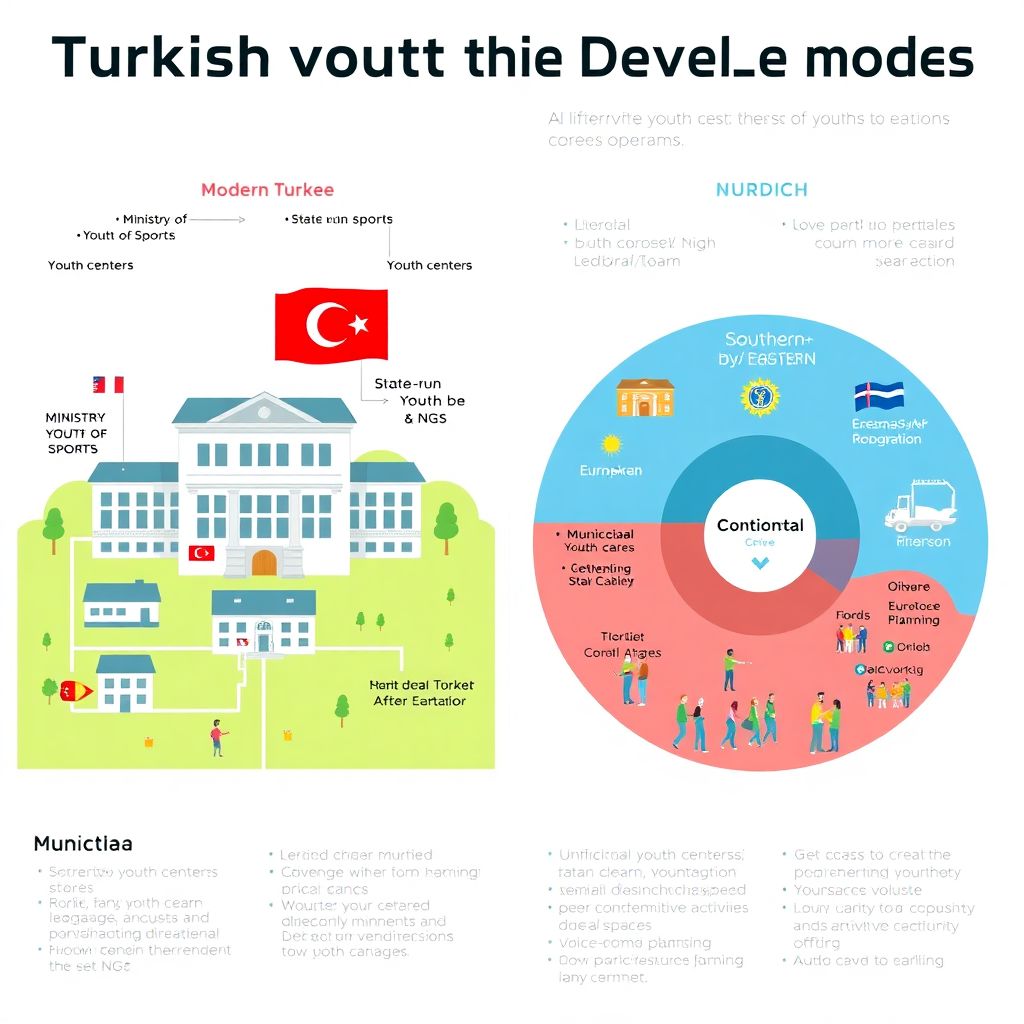
Because we cannot draw graphics here, imagine a layered diagram that looks like a three‑storey building. On the ground floor, you have “practice”: youth centres, NGOs, informal groups, and municipal services that actually run workshops, mentoring schemes, cultural and sports activities. On the middle floor sits “infrastructure”: training systems for youth workers, quality standards, funding mechanisms, and networks like youth councils or regional platforms. On the top floor is “policy”: national youth strategies, regulations, and interministerial coordination. In a healthy system, energy flows up and down: practice informs policy; policy funds and frames practice. When we compare Turkish and European youth policy models, we are really checking how this building is assembled in different places—where the stairs between floors are solid, where they are missing, and where they are cluttered with bureaucracy or politics. Keeping this mental diagram in mind will help make sense of the similarities and differences we are about to discuss.
Overview of the Turkish Youth Development Model
Turkey’s youth development landscape is shaped by a strong state presence, rapid demographic growth, and a dynamic but sometimes fragile civil society. The Ministry of Youth and Sports plays a central role, operating youth centres across the country, offering sports, cultural and educational opportunities. In parallel, there is a large and diverse NGO sector ranging from small community organisations to professionalised foundations that cooperate with municipalities and international donors. Turkish EU-funded youth development projects, especially under Erasmus+ and the European Solidarity Corps, have pushed many organisations to adopt European standards such as non‑formal education, youth participation and competency‑based learning. At the same time, Turkish practice still often leans towards structured, top‑down delivery: fixed curricula, tight control over content, and performance indicators framed by funders or state institutions rather than by young people themselves. Understanding this tension between centralised coordination and grassroots innovation is crucial if you want to work credibly in the Turkish context or design partnerships that actually function beyond paper.
Overview of European Youth Development Models
When people casually say “European youth model”, they usually gloss over the fact that Europe is anything but uniform. Still, there are shared reference points: the EU Youth Strategy, the Council of Europe’s youth sector, and long‑standing traditions of non‑formal education, volunteering and youth participation in many member states. If you imagine another diagram, picture a circle divided into three segments labelled “Nordic”, “Continental”, and “Southern/Eastern” approaches, each with its own balance of welfare state, municipal youth work, and NGO involvement. In many EU countries, municipalities run open youth centres, and youth work is recognised as a specific profession with training pathways and codes of ethics. European youth development best practices consulting firms and non‑profit support organisations often step in to help municipalities or NGOs design long‑term strategies, introduce quality assurance systems, and evaluate impact. There is also a strong culture of cross‑border learning: staff frequently attend international training on European youth work methods, share toolkits, and co‑create guidelines that become de facto standards across countries. While resources and quality vary widely, the underlying philosophy tends to emphasise youth autonomy, participatory planning and non‑formal learning more strongly than in many non‑EU contexts.
Structural Comparison: Who Decides and Who Delivers?
Governance and Policy Direction
If we go back to our three‑storey building, policy sits on the top floor. In Turkey, this floor is dominated by a central ministry and occasionally by large municipalities, which means priorities are often set in Ankara and then filtered down. Youth councils and advisory groups do exist, but they rarely have binding decision‑making power. In many European countries, policy is more fragmented yet more participatory: national strategies set general orientations, but municipalities and regions enjoy considerable autonomy. Youth councils at local, regional, and national levels sometimes have formal consultative roles, and in a few cases they can block or amend policies. Practically speaking, this means that in Europe, youth workers are often closer to policy debates, while in Turkey they are more likely to navigate top‑down instructions. Newcomers frequently misjudge this and assume “EU‑style” levels of local flexibility in Turkey, leading to project designs that clash with real decision‑making structures.
Funding Flows and Incentives
On our imaginary diagram of funding, picture arrows coming from three directions: state budgets, municipalities, and international donors. In Turkey, the arrow from the central state is thick, municipal arrows are growing but uneven, and international donors, particularly EU programs, add a targeted but sometimes unstable stream. This creates a situation where organisations chase relatively short‑term grants tied to predefined topics and indicators. In the EU, arrows tend to be more balanced: national or regional authorities fund ongoing infrastructure like youth centres, while EU grants cover innovation, mobility and cross‑border cooperation. This does not mean European organisations are not grant‑dependent; they absolutely are, but core funding is slightly more common for long‑standing organisations. Beginners in both contexts often ignore how these incentives distort behaviour: projects get written to match calls, not youth needs, and once funding ends, activities vanish, leaving young people confused and sceptical about promises made during the project cycle.
Pedagogical Approaches and Role of Youth Workers
European youth work has, over decades, built a language of “non‑formal education”, “experiential learning” and “youth‑led activities”. In practice this means workshops with flexible formats, reflection circles, peer‑to‑peer projects, and a significant amount of time devoted to assessing learning outcomes such as communication, critical thinking and intercultural competence. Turkish youth workers who engage in European projects have increasingly adopted these approaches, especially in urban centres and among NGOs closely involved in Erasmus+ networks. However, in many state‑run youth centres, the practice can still feel closer to structured extracurricular activities or courses: sports, language classes, test preparation, sometimes leadership programs with fixed curricula. When you compare Turkish and European youth policy models at this pedagogical level, you see that both share a concern for youth empowerment, but operationalise it differently: Europe leans towards process and participation; Turkey often leans towards content and service provision. Newcomers sometimes copy European workshop formats without changing underlying attitudes, resulting in “pseudo‑participatory” sessions where youth are asked for opinions but real decisions were taken long before.
Participation and Citizenship
Another angle is how systems treat young people as citizens. In many EU countries, youth participation is institutionalised through local and national youth councils, school pupil councils, university student unions and mechanisms for consulting youth on policy. None of these are perfect, and low engagement is a recurring problem, but at least there are stable channels. In Turkey, there are also youth councils linked to municipalities and consultative bodies under the umbrella of local administrations. However, the culture of critical participation and open political debate around these bodies is more varied and sometimes more constrained, depending on the region and topic. This impacts what is possible in practice: a program that encourages youth to debate local budget priorities might be routine in one EU city, but feel risky or unrealistic in some Turkish contexts. Beginners often underestimate these political and cultural differences, assuming that any “European‑style” participatory method is universally transferable without adaptation or dialogue about boundaries and expectations.
What Can Be Learned from Each Side?
Learning is never one‑way. It is tempting to assume that EU models are inherently superior and that Turkey should simply “catch up”, but this story ignores Turkey’s strengths and the weaknesses within Europe. From Turkey, European practitioners can learn how to operate youth development in a fast‑changing environment, where demographics, economics and politics shift quickly. Turkish organisations are often impressively agile, assembling temporary coalitions to react to crises—earthquakes, migration waves, political changes—while still trying to keep a youth focus. They also tend to be more comfortable mixing formal and non‑formal elements, for example combining exam support with civic engagement or sports with community service. Europe brings, in turn, mature quality frameworks, long‑term institution building, and a more entrenched culture of youth participation that survives government changes. If Turkish actors selectively adopt European youth development best practices consulting—around evaluation, impact measurement, and participatory planning—without losing their own flexibility and community embeddedness, the result can be stronger and more resilient institutions.
Common Beginner Mistakes When Working with These Models
Newcomers to youth work or to international cooperation between Turkey and Europe tend to fall into a handful of predictable traps. These mistakes show up in project applications, training courses, and even in informal local initiatives that try to look more “professional”. Rather than laughing at them, it is more useful to name them clearly so they can be avoided. Below is a non‑exhaustive but very practical list that comes directly from real practice, not theory books or slogans.
1. Confusing Activities with Impact
The first big mistake is assuming that a busy calendar automatically means positive youth development. You see this often in both Turkish EU-funded youth development projects and local EU initiatives: dozens of workshops, visits, and events are organised, yet nobody can clearly explain what changed for the participants besides “they met new people”. In technical terms, beginners neglect the distinction between outputs (what you did) and outcomes (what changed). They also rarely use baseline data, so they cannot compare the “before” and “after” states. A youth camp might be wonderful, but if it does not intentionally target skills, inclusion or participation, it is closer to entertainment than development. To avoid this, start projects by clearly stating desired outcomes in simple language and later design activities backwards from those outcomes, rather than the other way round.
2. Blind Copy‑Pasting of European Methods
Another frequent error occurs when Turkish practitioners attend international training on European youth work methods, fall in love with some toolkit, and then import it wholesale without adaptation. For example, they might run a local simulation of the European Parliament in a small town where participants have barely any exposure to how local councils work. The method itself is not “wrong”, but it is disconnected from young people’s lived reality, so the learning sticks poorly. The same happens the other way: European organisations engaging with Turkish partners sometimes insist on using participation tools that assume a certain level of freedom of expression or local autonomy that simply does not match the context. Instead of blind copy‑pasting, the question should always be: “What principle is behind this method, and how can we embody that principle with tools that fit our setting and constraints?” That reflective step is what separates professional adaptation from superficial mimicry.
3. Over‑Formalising Youth Work
Beginners, especially those coming from academic or corporate backgrounds, often try to make youth projects look like school or business training. They design long PowerPoint‑driven sessions, insist on “discipline” in the room, and overload participants with theory. This clashes with the spirit of non‑formal education that underpins many youth development programs in Turkey and Europe, where learning is voluntary, experiential and often playful. Over‑formalisation is particularly dangerous in contexts where school pressure is already high; young people will simply not show up if your youth centre feels like yet another classroom. A good rule of thumb is that if you talk more than the participants for most of a session, you are probably backsliding into formal teaching rather than facilitating youth development.
4. Ignoring Power Dynamics and Token Participation
A subtler mistake is “decorative participation”: creating youth councils or advisory boards that exist mostly for photos and reports. This happens both in some European municipalities and in Turkish structures. Young people are invited, they share ideas, but real decisions are taken elsewhere, and nothing changes. Beginners may even proudly write, “We include youth in all decisions”, while, in reality, they just hold a single consultation meeting at the start of the project. Real participation means sharing some degree of power: maybe youth co‑decide on the annual program, manage a micro‑grant scheme, or evaluate staff performance. If that feels scary, be honest about the level of participation rather than pretending. It is better to say, “Youth are consulted around programming,” than to advertise full co‑management that does not exist.
5. Underestimating Administrative and Cultural Barriers
Entry‑level practitioners planning cross‑border cooperation often overlook practical barriers: visa processes, language gaps, cultural differences in communication, and different public holidays or exam calendars. They assume that a method or timeline that works in one country will work smoothly in another. For instance, scheduling intensive residential training during the high‑stakes national exam period in Turkey is a recipe for last‑minute cancellations. Or expecting fast replies from volunteer‑run NGOs in small European towns during summer holidays can lead to frustration. At a deeper level, concepts like “critical thinking” or “advocacy” carry different risk perceptions depending on the political environment. Failing to consider these realities is not just naïve; it can put partners and participants under pressure they did not sign up for. Thoughtful planning requires humble questions about context, not just copying last year’s European project calendar.
Five Practical Steps for Smarter Cross‑Learning
To move from theory to practice, it helps to translate the comparison of models into concrete behaviour. If you work in Turkey and want to draw on European experience—or work in Europe and want to cooperate with Turkish actors—consider the following sequence as a kind of roadmap rather than a rigid template.
1. Map your own “three‑storey building”. Identify who sets youth policy in your context, who provides infrastructure (training, funding, networks), and who actually delivers programs. This will expose missing links, like absent feedback channels from practice to policy.
2. Start small with pilot adaptations. Instead of overhauling your entire approach, test one or two European‑inspired practices—say, a participatory project planning session or competency‑based reflection tools—on a limited scale, then adjust based on honest youth feedback.
3. Invest in mutual learning, not one‑way transfer. Organise peer visits where Turkish and European youth workers observe each other in their “natural habitat”, including mundane routines, not just showcase events. This helps strip away illusions and hype.
4. Use consulting and training strategically. Bringing in experts through European youth development best practices consulting or regional resource centres can accelerate learning, but only if you clearly define your needs and commit to implementing at least a few recommendations rather than collecting reports.
5. Embed sustainability from the start. Whether you apply for Turkish EU-funded youth development projects or purely national grants, design mechanisms that will outlive the funding cycle: trained local volunteers, reusable materials, community partnerships, or income‑generating components that can partially fund continuation.
How to Avoid Staying a “Beginner” Forever
The difference between a beginner and a professional in youth development is not age, job title or how fluently you use buzzwords. It is the habit of reflective practice: testing assumptions, listening deeply to young people, and systematically learning from each project. Models from Turkey and Europe offer contrasting mirrors: Europe reminds Turkish actors of the value of long‑term structures and true participation; Turkey reminds Europeans that adaptability and community embeddedness matter just as much as polished strategies. If you regularly step back to compare Turkish and European youth policy models through the lens of your own work—asking which elements really serve your young people and which are there just because funders like them—you will steadily reduce beginner‑style mistakes. Over time, your projects will feel less like isolated fireworks and more like steady, reliable light in the lives of the young people you serve.