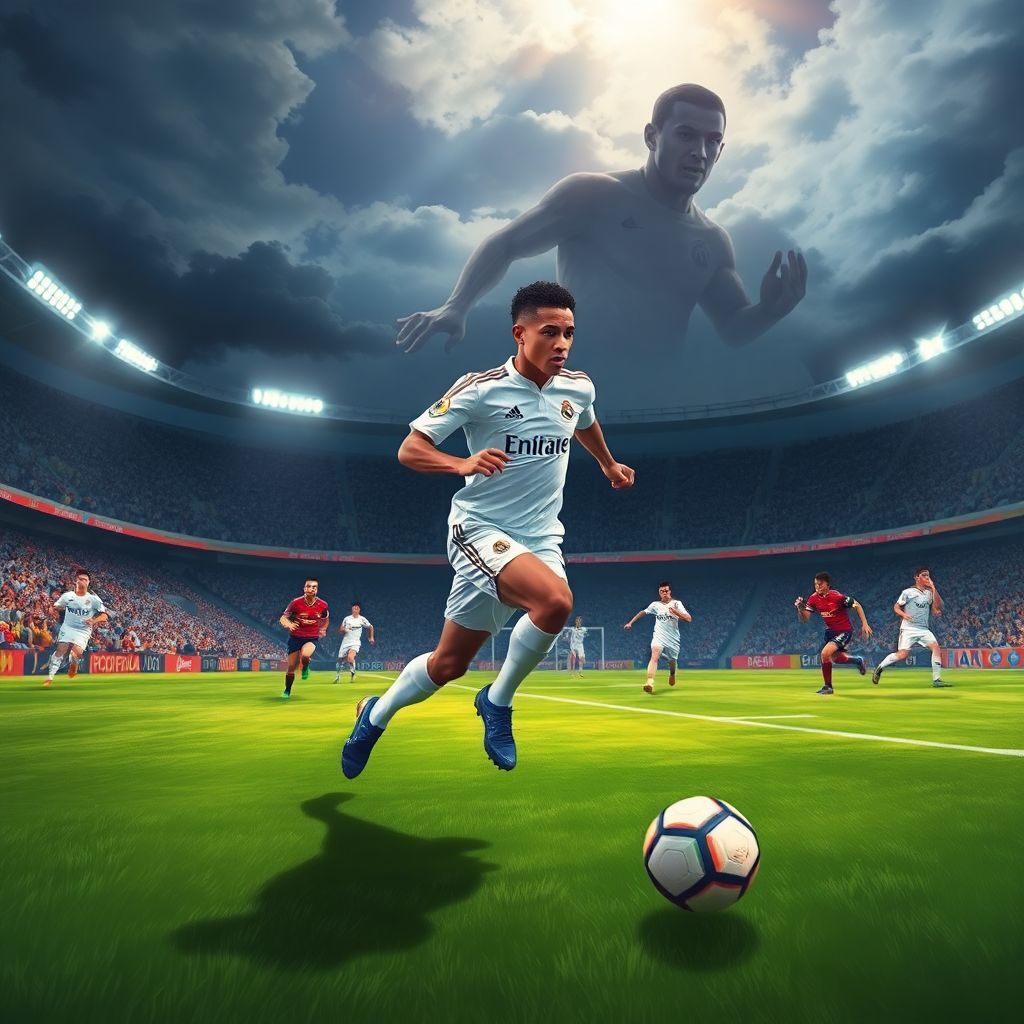
Arbeloa: Mbappé Is Following the Path Once Walked by Cristiano Ronaldo
After Real Madrid’s hard‑fought victory away to Valencia at Mestalla, head coach Álvaro Arbeloa delivered a statement that instantly set the tone of post‑match debates: in his eyes, Kylian Mbappé is walking the same road once dominated by Cristiano Ronaldo.
The young coach, visibly satisfied with his star forward’s impact, did not hesitate to draw a direct parallel between the Frenchman and the Portuguese icon. Speaking to the club’s television channel with a smile, Arbeloa admitted that words are no longer enough to describe Mbappé’s level and mentality.
He explained that for years there was a widespread belief that football would never again witness a phenomenon like Cristiano Ronaldo. Yet, watching Mbappé’s evolution in a Real Madrid shirt, Arbeloa is convinced that such scepticism may have been premature. According to him, the French star is steadily closing the gap on a player many considered unique and unrepeatable.
In his media appearance, Arbeloa underlined that Mbappé is still far from his ultimate ceiling. The coach stressed that the forward’s current performances, as impressive as they are, represent only a stage in a much larger journey. The suggestion was clear: Mbappé has both the time and the tools to aim even higher than Ronaldo’s legendary records.
Arbeloa went a step further and openly questioned why Mbappé should not surpass Cristiano one day. If there is a footballer capable of breaking the limits set by the Portuguese legend, he believes it is Kylian. This comment not only highlights the trust the coach places in his player, but also shows how high the bar has been set within the Real Madrid dressing room.
Beyond Mbappé, the match in Valencia also showcased the progress of another young talent: Álvaro Carreras. Arbeloa devoted special praise to the defender, particularly for his goal, which he described as a clear demonstration of Carreras’ attacking quality. Against a tough Valencia side, the youngster delivered a strike of real class, underlining how Madrid’s new generation is learning to decide big games.
Returning to Mbappé, Arbeloa’s words were unwavering. He recalled how Ronaldo’s peak years at Madrid seemed almost supernatural, as if he were playing a different sport to everyone else. Now, he sees in Mbappé a player with the physical, technical and mental attributes required to attempt a similar domination of the game over a long period.
The coach stressed that the road ahead of Mbappé is still long and full of challenges, but insisted that the Frenchman possesses everything necessary to travel it: elite speed, killer instinct in front of goal, leadership, and the capacity to handle extreme pressure. For Arbeloa, these are the ingredients that turn a top player into a footballing reference point for an entire era.
Mbappé’s influence on the pitch has already become decisive for Real Madrid. In matches like the one at Mestalla—traditionally one of the most complicated away grounds in Spain—his presence changes the way opponents prepare and defend. Defenders drop deeper, midfields compact around him, and entire defensive structures are reorganised just to try to limit his impact. That gravitational pull around a single player is exactly what Madrid once experienced with Cristiano.
From a tactical perspective, Mbappé offers Arbeloa options Cristiano also provided in his prime years: the ability to attack from the left, cut inside to finish as a central striker, or stretch the back line with runs in behind. This flexibility creates constant mismatches and opens spaces for teammates, especially for late runners from midfield or overlapping full‑backs like Carreras.
Mentally, the comparison with Ronaldo is not limited to goals or statistics. Arbeloa is particularly impressed by Mbappé’s hunger. Much like Cristiano, the French forward appears unsatisfied even after scoring or winning; he continuously seeks improvement, staying longer in training, working on finishing, movements off the ball, and combinations with teammates. That relentless drive is what convinces his coach that the conversation about “the next Ronaldo” is not just hype.
Arbeloa also knows the weight of the number and legacy Mbappé has inherited in Madrid. The Bernabéu is a stadium unforgiving with stars who cannot handle expectation, yet it often serves as a springboard to greatness for those with strong character. Mbappé’s response so far has been to embrace the pressure, treat criticism as fuel, and take responsibility in decisive moments. That attitude is another element that reminds Arbeloa of Cristiano’s years in white.
The coach’s remarks also reflect a wider shift in world football. For more than a decade, Ronaldo and his eternal rival Lionel Messi set standards many thought unreachable. Now, a new generation led by Mbappé is being asked, fairly or not, to match or surpass those heights. Arbeloa is not simply making a flattering comparison; he is publicly stating that Real Madrid expects its franchise player to be at that historic level.
At the same time, the Spaniard recognises that football has evolved. Defences are more compact, physical demands are higher, and calendars are more congested. To catch or surpass Cristiano in such conditions requires not only talent, but also exceptional professionalism and long‑term discipline. In his view, Mbappé has already demonstrated that he is prepared to live according to these standards, from his physical conditioning to his game intelligence.
The performance against Valencia offered a microcosm of why this comparison persists. Mbappé was constantly involved, dropping to receive the ball, initiating transitions, and stretching the defence with diagonal runs. Even when he was not the direct protagonist of a move, his presence created lanes for others—like Carreras—to exploit. That ability to influence a match beyond goals is another trait he shares with Ronaldo at his best.
For the younger players in the squad, Mbappé is gradually becoming what Cristiano once was: a living example of what it means to be an elite professional at Real Madrid. Arbeloa hinted that many in the dressing room look at his routines, his diet, his recovery work, and his focus before games as a model to follow. The Frenchman’s standards, therefore, can raise the overall level of the team, just as Ronaldo’s did for a decade.
Of course, any comparison between generations must be approached with caution. Statistics, trophies, and historical context will ultimately determine whether Mbappé reaches or surpasses Ronaldo’s status. Arbeloa is fully aware of this, yet he insists that the conversation has merit not because of fan sentiment, but because of what he sees daily on the training ground and in high‑pressure matches.
From a psychological standpoint, this kind of public backing from the coach is also significant. By stating so firmly that Mbappé is on Cristiano’s path, Arbeloa is both trusting and challenging his star. He is saying: the club believes you can be that decisive, that historic—but you must confirm it season after season, title after title, night after night in stadiums like Mestalla.
In the coming years, every Champions League night, every Clásico, every title race in LaLiga will feed into this narrative. Mbappé will be measured not only against his own output, but also against the ghost of Cristiano’s numbers and moments: unforgettable goals, comebacks, and decisive performances in the biggest stages. Arbeloa’s comments, therefore, are not an end point, but the beginning of a long comparison that will follow Mbappé throughout his Madrid career.
For now, one thing is clear: in the eyes of his coach, Kylian Mbappé has already done enough to jump from the category of “great talent” to that of “potential legend.” Arbeloa’s message is simple but powerful: football might indeed witness a player capable of stepping into Cristiano Ronaldo’s territory—and that player may already be wearing the white shirt of Real Madrid.