
Why the Ballon d’Or Question Matters for Turkey
Can Turkey really produce a Ballon d’Or contender, not just a solid Champions League player? The raw ingredients are there: a football‑obsessed society, a huge diaspora, and a track record of technically gifted playmakers from Hakan Şükür and Emre Belözoğlu to today’s Arda Güler. Yet, when voting comes around, Turkish names are either absent or buried deep in the list. To understand why, it’s not enough to blame “mentality” or “infrastructure”. We need to look at the whole pipeline: the tools available, the step‑by‑step pathway a kid must follow, and where that pathway keeps breaking down right before true elite level.
“Necessary Tools”: What a Turkish Ballon d’Or Track Actually Needs
If we think in practical terms, a Ballon d’Or track is a set of tools around a player, not just talent. At grassroots level, a modern turkish football talent development academy needs data‑driven training, specialist coaches, and clear individual development plans. Above that, you need clubs ready to give minutes to teenagers, not just recycle 30‑year‑olds. Then come sports science, nutrition, psychology, and language education to prepare players for early moves abroad. Finally, you need agents, analysts, and legal support who understand top‑five‑league dynamics and protect the player from being stuck as a rotation option on a mid‑table team for years.
Real‑World Case: Arda Güler as a Prototype
Arda Güler is the closest thing Turkey currently has to a Ballon d’Or‑style project. At Fenerbahçe, he was handled almost like a startup: individual fitness plans, a clear media strategy, and carefully controlled playing time to build highlight‑reel moments. His move to Real Madrid showed that the toolset was partially in place: good early coaching, strong branding, timely transfer. Yet his injuries and adaptation period underline a key issue: Turkey can help create brilliant potential, but the support system after the big move—medical, tactical, and psychological—still depends heavily on the foreign club, not on a Turkish ecosystem following him into Europe and defending his interests long‑term.
Step‑by‑Step Pathway from Local Pitch to Ballon d’Or Conversation
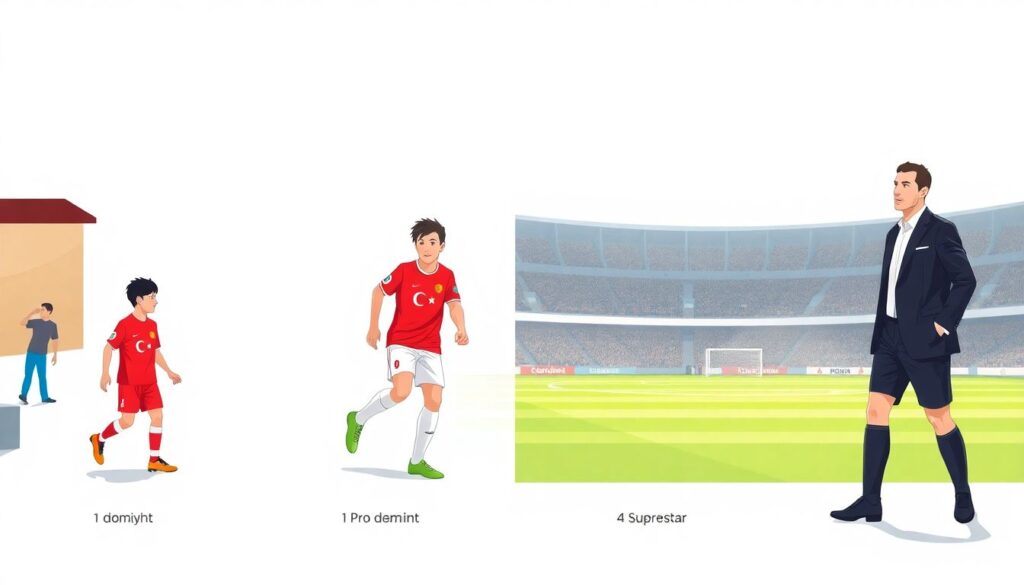
Let’s break the journey into stages. A kid in Ankara, Berlin, or Amsterdam with Turkish roots doesn’t jump from U14 to Ballon d’Or shortlists. There’s a sequence: local dominance, pro debut, European relevance, then superstar status. Each step has its specific requirements and typical failure modes. The question isn’t whether Turkey has talent; it’s whether the system consistently lets a player pass each gate without stalling. That’s where turkey youth football academies scouting, club policies, and smart career planning either combine into a clear pathway—or clash and cancel each other out.
Stage 1: Local Dominance and Academy Formation

At the first stage, the player must be clearly superior among peers and then refined, not flattened, by coaching. Many Turkey‑based clubs still overload young players with results‑driven training. A good turkish football talent development academy should instead focus on ball mastery, decision‑making under pressure, and positional versatility. In practice, this means fewer random youth tournaments and more structured internal competition, plus tracking physical and cognitive benchmarks. The diaspora story also matters: some of the best young turkish footballers 2025 are likely to come from German or Dutch systems, where early tactical education is stronger, and then choose between representing Turkey or their birth country.
Key success ingredients at Stage 1
– Coaches rewarded for producing pros, not just winning youth leagues
– Daily contact with the ball, small‑sided games, and fun, not fear‑based training
– Early detection of special traits (vision, 1v1 talent, leadership) and nurturing them
Stage 2: Professional Minutes and Smart Early Moves
The second step is brutal: getting real minutes in a competitive league before 20. Here Turkey’s “big three” often hesitate. Fans demand instant titles; coaches fear errors from teenagers. So many gifted players end up on endless loans. Contrast this with how Salzburg, Porto, or Ajax systematically push young stars into the starting XI. A practical pathway would see Turkish clubs adopting clear policies: if an academy player is elite in his cohort, he must either get minutes in the first team or be loaned to a club with a defined development role, not just “see what happens”.
Case Study: Merih Demiral and the Early Leap
Merih Demiral left Turkey very early for Portugal’s lower tiers before climbing to Sporting, Sassuolo, then Juventus. This path shows one workaround for domestic bottlenecks: leaving early to get tactical polishing and exposure in a system that trusts youth. But it’s also risky; without robust support, players can vanish in foreign B‑teams. Ideally, Turkey should build internal platforms that mimic the Portuguese or Dutch stepping‑stone model, so defenders and midfielders don’t have to gamble their career on being noticed far from home just to receive proper tactical schooling and elite‑level intensity.
Stage 3: From “Good Pro” to Global Headliner
Most Turkish stars stop at “Champions League level” rather than turning into global headliners. To break this ceiling, a player needs to join a top‑tier European club by 21–22, play a decisive offensive role, and deliver in knockout games. That’s where transfer news top turkish players Europe often reveals the problem: many moves are lateral or slightly upward, not transformative. Players join mid‑table sides or clubs with unstable coaching situations. A Ballon d’Or candidate needs ruthless career curation—shorter contracts, exit clauses, and a focus on teams that dominate the ball and create high‑visibility moments in big competitions.
“Troubleshooting”: Where the Turkish Pathway Breaks Down
Even with talent and early success, things go wrong. The “troubleshooting” mindset means asking, for each stage, what typically derails a potential superstar and how to correct it. Common issues include overplaying at 16–18 and burning out, choosing clubs based on salary not role, poor language skills leading to isolation, and inconsistent physical preparation. Another structural problem is the weak interface between club and national team development; playing three different tactical roles for club, U‑21, and senior national team can confuse young players and slow their growth at the moment when clarity is critical.
Common Failure Points and Fixes
– Injury cycles: Overloaded schedules, poor pitch quality, and limited individual conditioning lead to chronic issues; fix with monitored workloads and personal trainers.
– Mental overload: Sudden media hype creates unrealistic expectations; fix with in‑house psychologists and controlled exposure.
– Agent‑driven missteps: Chasing signing bonuses over fit; fix by educating families and creating trusted advisory panels around elite prospects.
Role of Agents, Media and the Diaspora
The layer around the player—agents, family, press—is often decisive. football agents for Turkish players in Europe tend to be split between those with deep networks and those chasing fast commissions. The difference is visible: well‑represented players land at tactically suitable clubs, with clauses protecting their development time; poorly advised ones disappear on benches. Media hype can also be double‑edged: in Turkey, one good month can trigger “new Messi” headlines that distort self‑perception. Meanwhile, diaspora stars like İlkay Gündoğan or Mesut Özil (who chose Germany) highlight both the richness of talent and the cost when Turkish structures fail to convince or properly integrate top dual‑nationals.
What Needs to Change to See a Turkish Ballon d’Or Contender
Realistically, Turkey can produce a Ballon d’Or contender in the next 10–15 years if it treats elite talent as long‑term projects rather than quick assets. That means aligning turkey youth football academies scouting with first‑team strategies so promotion is predictable, not random; building domestic clubs with a clear identity attractive to top prospects; and creating pathways from U‑14 to Champions League knockout rounds that don’t rely purely on individual luck. If multiple clubs replicate the best practices behind players like Arda Güler or Merih Demiral—and avoid repeating the stalled careers of many others—Turkey won’t just ask whether it can produce a Ballon d’Or candidate; it will be arguing about which of its stars gets there first.