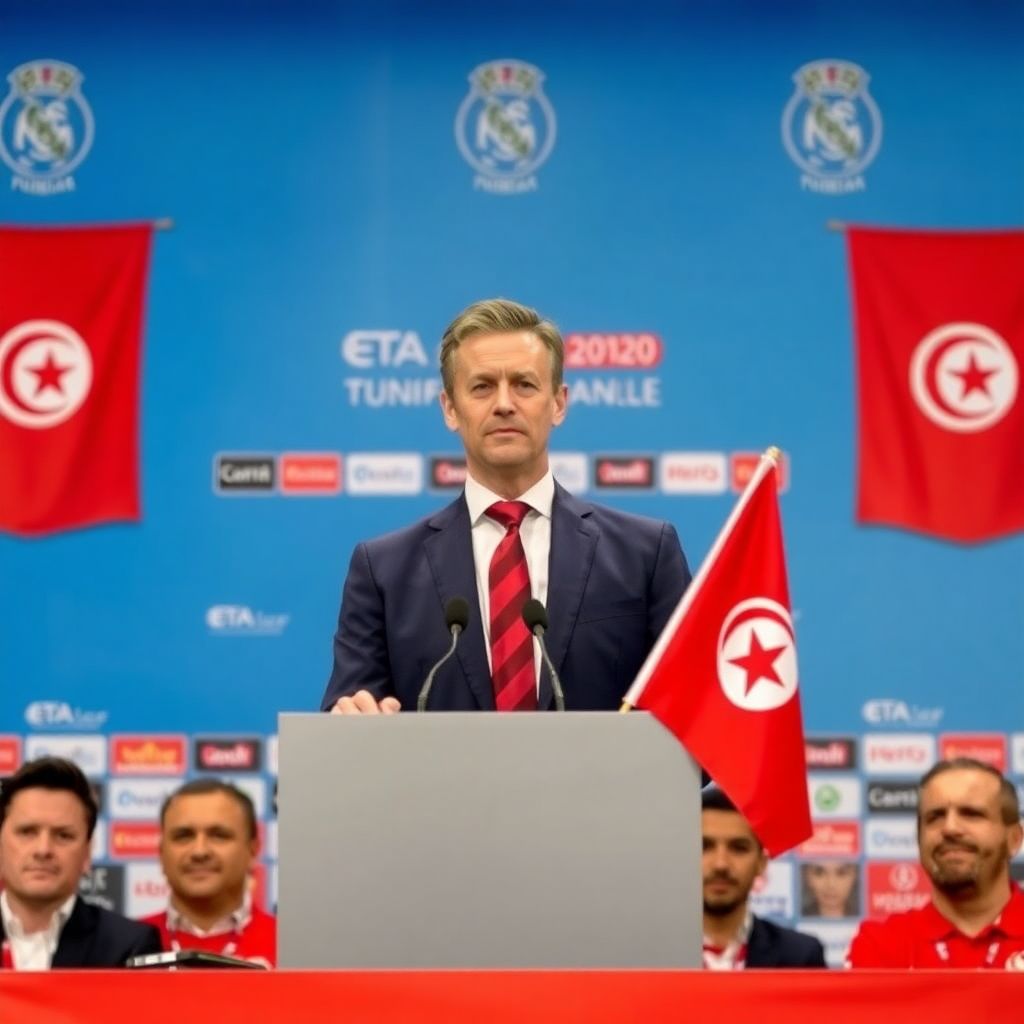
Renard takes charge of Tunisia national team
The Tunisian Football Federation has officially ushered in a new era by appointing French coach Hervé Renard as head coach of the national team, filling the vacancy left by Sabri Lamouchi. Federation president Moez Nasri confirmed on state television that an agreement has been reached and that Renard will lead Tunisia through the remainder of the 2026 World Cup campaign.
Tunisia, competing in Group F of the 2026 World Cup, turned to Renard after a disastrous start to the tournament. In their opening match, the team suffered a heavy 5-1 defeat against Sweden, a result that triggered the end of Lamouchi’s tenure. With two group-stage fixtures still to play, against Japan and the Netherlands, the federation chose to act quickly in the hope of salvaging their chances and reshaping the team’s trajectory.
Renard’s arrival is seen as a bold but logical decision. Known for his meticulous preparation and his ability to inspire underdog teams, the Frenchman has built a reputation as a specialist in international football. Tunisia’s management clearly believes his experience in tournament football and his familiarity with African teams can give the “Eagles of Carthage” a new identity and renewed belief on the world stage.
A coach forged in international football
Hervé Renard’s first experience as a national team coach came in 2008, when he took charge of Zambia. That job laid the foundation for a career closely tied to international football. After his initial spell with Zambia, Renard managed Angola before returning to Zambia, then moved to club side USM Alger. His success at national team level soon brought him back to the international stage with Ivory Coast, followed by stints at Sochaux, Lille, Morocco, Saudi Arabia and the France women’s national team.
Most recently, Renard had been in charge of Saudi Arabia, a position he held from 2024 until his departure on 17 April. During his earlier spell with the Saudis, he oversaw one of the most memorable upsets in modern World Cup history: a 2-1 victory over Argentina in the opening match of the 2022 tournament. Despite that sensational win, Saudi Arabia later lost to Poland and Mexico and ultimately finished fourth in Group C, exiting at the group stage. That campaign, however, reinforced Renard’s reputation as a coach capable of crafting game plans that unsettle even the strongest opponents.
Why Tunisia turned to Renard
The choice of Renard is not accidental. Tunisia, a regular participant at World Cups and Africa Cup of Nations tournaments, has often been viewed as a solid but rarely spectacular side. The federation’s decision suggests a desire to break that pattern and to embrace a more ambitious project. Renard’s track record in Africa is a major part of the appeal: he has already won the Africa Cup of Nations with both Zambia and Ivory Coast and is familiar with the mentality, pressure and logistical challenges facing African national teams.
Moez Nasri openly hinted that the federation was looking for a coach with proven international know-how and the authority to make tough decisions quickly. Renard fits that profile. He arrives with a clear identity: intense pressing when possible, compact defensive blocks when necessary, and a focus on transitions that maximize the strengths of quick, technically gifted attackers. For a Tunisian squad that often boasts speed and creativity in wide areas, this could be a natural fit.
Rebuilding after a heavy defeat
The 5-1 loss to Sweden was more than just a bad result; it raised doubts about Tunisia’s defensive organization, mental resilience and tactical clarity. Under Lamouchi, the team struggled to maintain structure after conceding the first goal, and the match quickly slipped out of control. Bringing in Renard mid-tournament is a high-risk, high-reward move: there is very little time to implement a new system, but his reputation for quickly imposing discipline made the federation believe the gamble is worthwhile.
Renard’s first tasks will be straightforward but demanding: stabilize the defense, simplify the tactical instructions, and rebuild confidence in the dressing room. He is known for strong man-management and for creating a sense of collective responsibility. Players who felt lost after the Sweden defeat will now be challenged to prove themselves under a coach who has little tolerance for complacency but plenty of trust in hard-working squads.
Key matches ahead: Japan and the Netherlands
Tunisia’s remaining group games against Japan and the Netherlands will define whether Renard’s tenure begins with a miraculous turnaround or a rebuilding process for the future. Japan typically offers a high-tempo, disciplined style with excellent off-the-ball movement, while the Netherlands bring attacking flair, physical presence and a deep tactical culture. Both opponents pose different problems, forcing Renard to adapt his approach in a very short time.
It is likely that against Japan, Tunisia will focus on compactness between the lines and rapid counters, exploiting any gaps left when the Japanese full-backs push forward. Against the Netherlands, Renard may prioritize limiting space between the center-backs and defensive midfielders, aiming to neutralize Dutch playmakers and break quickly through the flanks. In both matches, set pieces could become a crucial weapon for Tunisia, particularly if they struggle to create chances from open play.
What Renard brings to the dressing room
Beyond tactics, Renard is recognized for his psychological impact on teams. His motivational speeches are often cited by players who describe him as demanding but deeply committed. At Zambia and Ivory Coast, many footballers later spoke about how he instilled belief that they could compete with the continent’s giants. That mindset is exactly what Tunisia needs after a demoralizing start to their World Cup campaign.
He is also known for making bold selection calls. Established names do not automatically keep their places if they fail to meet his standards in training or matches. This could open the door for younger Tunisian players, especially those performing strongly at club level but previously overlooked. The new regime might therefore accelerate a generational shift, blending experienced leaders with hungry newcomers eager to define a new chapter for the national team.
Tactical evolution of Tunisia under Renard
Historically, Tunisia has often preferred a balanced, pragmatic approach: cautious defending, structured buildup and selective risk-taking. Under Renard, this is likely to evolve into a more aggressive and modern style, even if he remains pragmatic when facing stronger sides. Fans may see more emphasis on pressing in midfield, coordinated movements to win second balls and direct, vertical transitions once possession is regained.
Renard’s teams usually rely on clearly defined roles. Full-backs are expected to contribute in attack but must be disciplined in their positioning; central midfielders are tasked with both shielding the defense and initiating quick counters; forwards must press intensively and maintain constant movement. For players, this clarity can be liberating: everyone knows what is expected, and performance is judged against transparent criteria.
Long-term implications for Tunisian football
Regardless of how the current World Cup campaign ends, the appointment of Renard could shape Tunisian football beyond a single tournament. If he remains in charge for a full cycle, he will likely influence youth development strategies, scouting structures and the integration of diaspora players based in European leagues. His experience in different football cultures – from Africa to Europe, the Middle East and women’s international football – gives him a broad perspective on building competitive squads.
For the federation, this is also an opportunity to modernize certain aspects of the national team environment: sports science, data analysis, training methodologies and opponent scouting. Renard has worked in setups where these tools are deeply embedded and may push for similar standards with Tunisia. Over time, that can reduce the gap with the world’s leading national teams.
Expectations from fans and media
Public reactions to Renard’s appointment are likely to be a mixture of hope and caution. On one hand, his resume commands respect and fuels optimism that Tunisia can punch above its weight. On the other hand, the timing of the change – in the middle of a World Cup group stage – leaves very little margin for error. Supporters will demand immediate signs of improvement: better organization, visible fighting spirit, and a sense that the team has a clear plan on the pitch.
Media scrutiny will also intensify. Every lineup decision, substitution and tactical tweak will be dissected, especially if results do not change quickly. Renard is accustomed to this pressure from his previous posts, yet managing expectations will be crucial. He has to balance short-term results with building a foundation that endures beyond the current tournament.
A new chapter for the “Eagles of Carthage”
The beginning of the Hervé Renard era marks a turning point for Tunisia’s national team. The heavy defeat to Sweden exposed systemic weaknesses, but it also accelerated a decision that could redefine the squad’s identity. With a coach who has already proven he can compete with the best and shock football’s established powers, Tunisia enters an uncertain but intriguing phase.
Renard now has to transform theory into practice: restore confidence, instill discipline, and adapt his ideas to the specific qualities of Tunisian players in a matter of days. Whether this leads to an immediate World Cup revival or instead lays the groundwork for future success, the appointment signals a clear message from the federation: Tunisia does not want to be just a participant in major tournaments; it wants to be a genuine competitor.