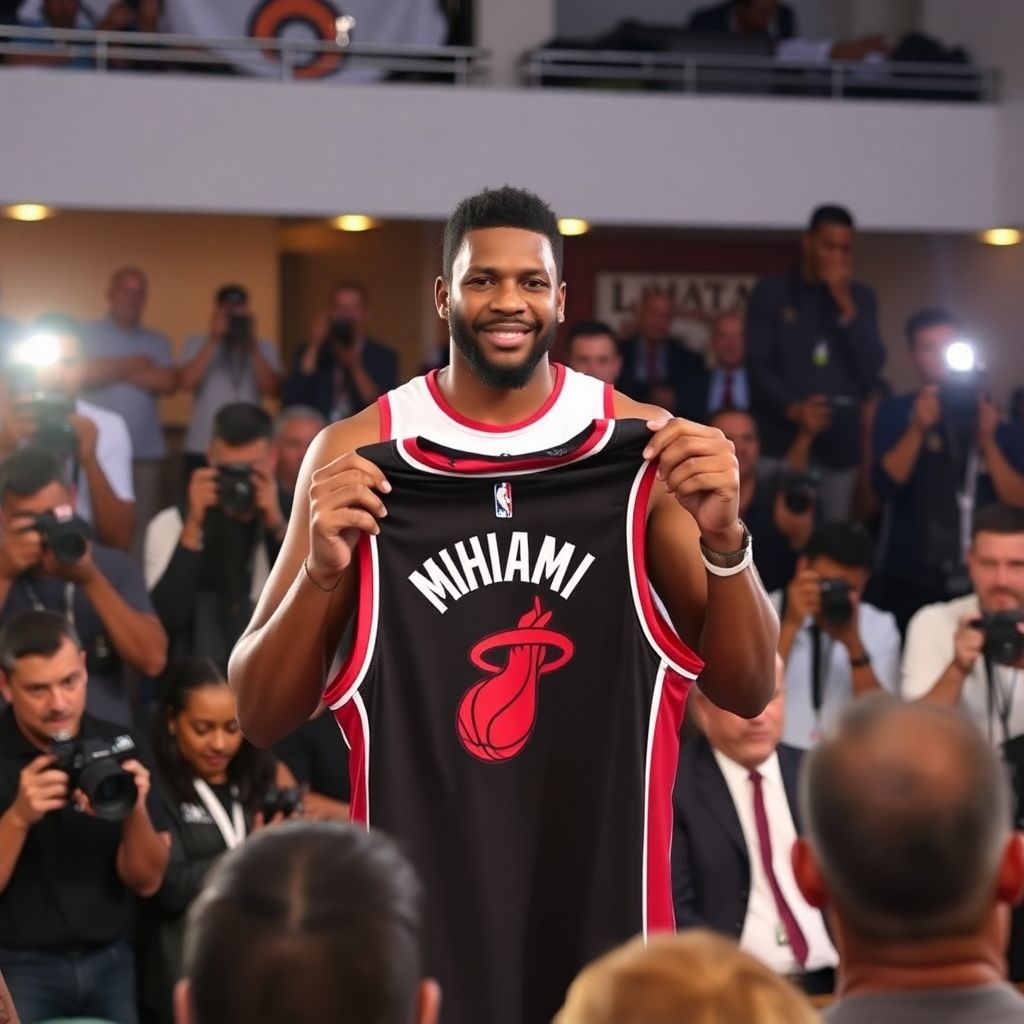
Giannis Antetokounmpo is heading to South Beach.
The Greek superstar has been traded from the Milwaukee Bucks to the Miami Heat, giving the Florida franchise one of the most dominant two-way forces of this era and instantly reshaping the balance of power in the Eastern Conference.
According to the reported framework of the deal, Miami acquires Giannis Antetokounmpo and veteran forward Bobby Portis, while sending a massive haul of players and draft capital to Milwaukee. The Bucks receive Tyler Herro as the centerpiece of the package, along with Kel’el Ware, Jaime Jaquez Jr., Kasparas Jakucionis, a 2026 first-round pick, additional first-rounders in 2031 and 2033, a second-round pick in 2033, and one future draft pick swap.
For Miami, this is an all‑in move. Herro, long considered a foundational piece of the Heat’s future, headlines the outgoing group. Jaquez Jr. had emerged as one of the more promising young wings in the league, while Ware and Jakucionis represent long-term upside. On top of that, surrendering multiple first-rounders and a pick swap significantly limits the Heat’s flexibility in future drafts. In return, they get a generational talent in Giannis and the rugged, championship-tested Portis to reinforce the frontcourt.
Portis’s inclusion is far from a minor detail. Known for his energy, toughness, and reliable outside shooting for a big man, he fits perfectly into Miami’s culture of physicality and defensive intensity. His experience as a key role player on a championship team should help ease the transition for Giannis and give the Heat an immediate boost in frontcourt depth.
Antetokounmpo’s journey to this point has been remarkable. Drafted 13th overall in 2013 by the Bucks, he entered the league as a raw, lanky prospect with intriguing potential. Over the years, he methodically added strength, skill, and confidence, transforming into one of the most complete players in the NBA. His relentless work ethic and constant year‑to‑year improvement turned him from a project into the face of a franchise and, ultimately, the face of the league.
The accolades tell the story. Giannis led Milwaukee to the NBA championship in 2021, claiming Finals MVP honors with an all‑time performance on both ends of the floor. He captured back-to-back regular-season MVP awards in 2019 and 2020, underlining his dominance as an offensive force and transition nightmare. In 2020, he also secured the Defensive Player of the Year award, a rare combination that placed him in the company of the game’s true legends. Ten All-Star selections by the age of 31 further underscore his sustained excellence.
Now, that résumé arrives in Miami, a franchise that prides itself on competing at the highest level. The Heat have long been associated with a strict conditioning culture, defensive accountability, and playoff toughness-all traits that align seamlessly with Giannis’s mentality. His ability to control games in the open floor, collapse defenses, and guard multiple positions makes him a natural fit in a system that thrives on intensity and adaptability.
From a basketball standpoint, Antetokounmpo adds a dimension Miami has not had since its previous superstar eras. He gives the Heat a dominant downhill threat who can initiate offense, pressure the rim on virtually every possession, and still be the anchor of the defense. Surrounded by capable shooters and disciplined role players, his driving lanes should remain open, and his playmaking opportunities should increase as opposing defenses are forced to collapse.
The expected frontcourt pairing of Giannis with a rugged supporting cast could make Miami one of the most feared defensive units in the league. Portis’s size and rebounding, combined with Antetokounmpo’s length, shot-blocking, and weak-side help, creates a wall at the rim. Miami’s perimeter defenders-known for their grit and willingness to take on tough assignments-now have the confidence of an elite backline behind them.
Offensively, the Heat can lean into a more versatile identity. Giannis thrives in pick‑and‑roll actions, post‑ups against smaller defenders, and transition opportunities off steals and rebounds. Miami’s coaching staff is known for creativity and in‑game adjustments; integrating Giannis into their sets opens up possibilities for inverted pick‑and‑rolls, five‑out lineups that leverage his slashing, and small‑ball configurations where he acts as both primary creator and finishing big.
For Milwaukee, the trade marks the end of an era. The franchise built its modern identity around Antetokounmpo, reaching the summit in 2021 and consistently contending in the East. By moving their franchise cornerstone, the Bucks pivot toward a long-term retool built on youth and draft assets. Tyler Herro brings shot creation and perimeter scoring, while Jaquez Jr., Ware, and Jakucionis give Milwaukee a mix of immediate rotation potential and developmental projects.
The treasure trove of draft picks is crucial for the Bucks’ next chapter. Multiple first-round selections and a pick swap extend well into the next decade, giving the team avenues to either draft new talent or flip those assets in future trades. It signals a willingness to step back from the very top of the standings in the short term to gain more flexibility and optionality over the long term.
This move will inevitably reshape the Eastern Conference hierarchy. With Giannis in Miami, the Heat immediately enter or return to the inner circle of championship favorites. Their combination of top-end star power, playoff-tested veterans, and a proven coaching staff positions them as a genuine title threat. Meanwhile, Milwaukee must redefine its identity without the player who elevated the franchise back to relevance and delivered its first championship in decades.
The pressure, however, now shifts firmly onto Miami’s shoulders. By assembling such a high‑stakes roster and sacrificing so many future assets, the franchise is signaling that anything less than deep playoff runs and a realistic push for a championship will be a disappointment. The margin for error narrows; injuries, chemistry issues, or tactical missteps become more costly when a team lacks future draft control and high‑end prospects.
From a locker-room perspective, Giannis’s leadership style will play a key role in how quickly this new‑look Heat group comes together. He is known for his competitiveness, humility, and team‑first approach, qualities that should resonate strongly within an organization that values accountability and hard work. The blend of his personality with Miami’s existing core and coaching philosophy has the potential to create a cohesive, driven group with aligned goals.
There is also the question of how opponents will adjust. Teams in the East have long game‑planned to contain Giannis in a Milwaukee uniform; now they must rework those strategies for a Heat squad that has historically excelled at exploiting mismatches and punishing defensive mistakes. The combination of Antetokounmpo’s physical dominance and Miami’s tactical discipline will force rivals to rethink their personnel and schemes.
On a broader level, this trade is another example of how quickly the landscape can shift in the modern NBA. A single blockbuster move can redefine trajectories for years, altering the futures of entire franchises, fan bases, and player legacies. For Giannis, this is a new chapter in an already storied career: a chance to chase another title in a different city, under a different banner, while carrying the same expectations that come with being one of the game’s defining stars.
As the dust settles, one thing is clear: the arrival of Giannis Antetokounmpo and Bobby Portis in Miami marks one of the most significant moves of recent seasons. The Heat are betting their future on the idea that a generational talent, placed in a culture known for maximizing competitiveness, can lead them back to the top of the basketball world. Whether that bet pays off will shape the NBA’s narrative for years to come.