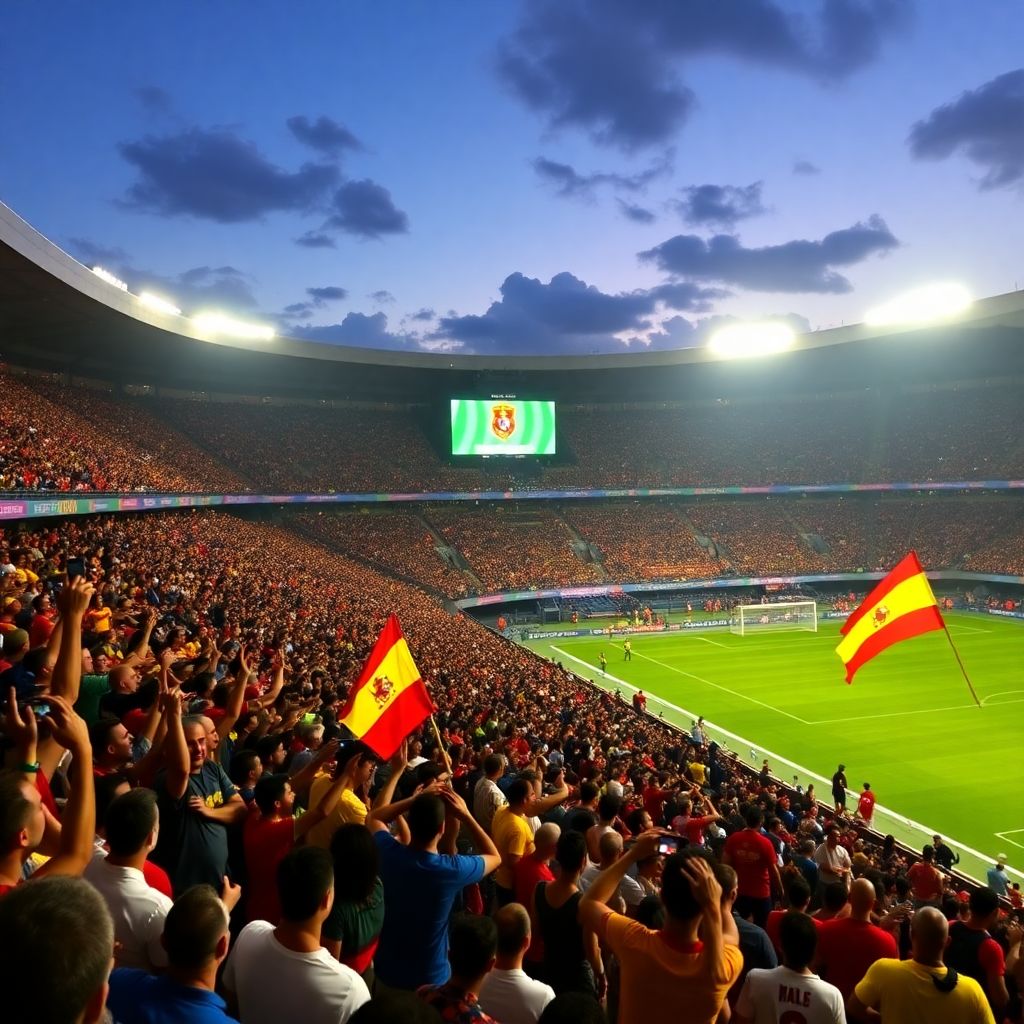
Spain steps onto the World Cup stage in the United States with a historic matchup: a group-stage clash against Cape Verde, a nation preparing for its first-ever appearance at football’s biggest tournament. The two sides will face each other in Group H of the 2026 FIFA World Cup, with kick-off scheduled for 19:00 (TSI) at Atlanta Stadium. For Spain it is a chance to launch another title run; for Cape Verde it is a moment of pure history.
Cape Verde arrives at this tournament as one of the smallest countries ever to qualify for a World Cup finals. After Curaçao and Iceland, the island nation becomes the third least-populous country to reach the tournament, underlining the magnitude of its achievement. Regardless of the result, the match already represents a landmark in Cape Verdean football, but the team has made it clear they are not in the United States simply to participate – they want to compete.
On the opposite side stands a powerhouse with a very different kind of pressure. Spain, reigning European champions and crowned world champions in 2010, enter the 2026 edition among the leading favorites. The tournament in North America is widely seen as an ideal opportunity for La Roja to reclaim the global throne and add a second World Cup trophy to their cabinet. Expectations are enormous, both at home and abroad, and anything short of a deep run would be viewed as a disappointment.
This meeting is also special because it is unprecedented. Spain and Cape Verde have never faced each other at senior international level. That lack of direct history adds an element of unpredictability: scouting reports, video analysis and friendly matches against teams with similar profiles become even more important when there is no past head-to-head data to draw on. It is a classic World Cup storyline: an established giant against a debutant with nothing to lose.
The probable lineups point toward a distinctly Spanish identity in style and structure. Spain is expected to start with Unai Simón in goal, protected by a back four of Marcos Llorente, Pau Cubarsí, Aymeric Laporte and Marc Cucurella. In midfield, Rodri should anchor the team alongside Pedri and Fabián Ruiz, forming a technically gifted trio designed to dominate possession. The attacking line is likely to feature Ferran Torres and Mikel Oyarzabal on the flanks, with Álex Baena offering creativity and mobility in the final third.
Cape Verde, in contrast, will look to combine discipline at the back with quick transitions. The predicted starting XI includes Dias between the posts, shielded by a defensive line of Moreira, Lopes, Costa and Fernandes. In midfield, Semedo, Pina and Mendes are expected to provide work rate and balance, supporting the attacking trio of Jamiro, Jabral and Livramento. This structure suggests a compact block that can quickly spring forward once the ball is recovered.
Tactically, the pattern of the match seems straightforward on paper. Spain will likely seek to monopolize the ball, building patiently from the back through Rodri, who acts as the metronome of the team. Pedri and Fabián Ruiz should constantly look to break lines with passes and intelligent movement, dragging Cape Verde’s midfield out of shape. The wide players, Ferran Torres and Oyarzabal, will stretch the pitch horizontally, trying to open spaces in a defensive block that promises to be dense and hard to penetrate.
For Cape Verde, the key will be to maintain organization and avoid being suffocated in their own defensive third. Their midfielders will have to close spaces between the lines and prevent Spain from receiving comfortably between defence and midfield. Rapid counterattacks could become their biggest weapon, especially if they manage to exploit the spaces that Spain’s full-backs Llorente and Cucurella might leave behind when pushing forward. Jamiro and Livramento’s pace and directness can be decisive in those transitions.
Psychologically, the two teams arrive in completely different emotional contexts. Spain, with the weight of being European champions and a traditional favorite, must handle the pressure of expectation and the fear of a false start. An early slip in the group stage can quickly complicate the path to the knockout rounds. Cape Verde, on the other hand, can play with a certain freedom: they have already made history by qualifying, and every minute on the pitch in the United States is an extra chapter in their story. That underdog mentality can make them dangerous, especially if the game remains level for a long time.
The Atlanta venue adds another layer to the encounter. A modern stadium with a vast capacity and excellent surface, it perfectly suits Spain’s passing game and quick circulation of the ball. At the same time, the atmosphere is expected to be colorful and diverse, with local fans often embracing underdogs at major tournaments. The energy in the stands could give Cape Verde an emotional boost, particularly if they manage to withstand Spain’s early pressure.
Individual battles will also shape the narrative. Rodri’s duel with Cape Verde’s central midfielders will be pivotal in determining who controls the rhythm. If the Spanish pivot finds time on the ball, Spain can dictate the tempo and pin Cape Verde deep. Out wide, Ferran Torres and Oyarzabal will try to isolate Cape Verde’s full-backs in one-on-one situations, while Laporte and Cubarsí must remain alert against quick balls over the top toward Jamiro and Livramento.
Spain’s coaching staff will be aware that matches against tournament debutants can be trickier than they seem. A common risk for favorites is complacency or a lack of urgency, especially early in the competition. That is why an intense start, with high pressing and quick circulation, will likely be emphasized in the pre-match talk. Scoring an early goal could force Cape Verde to open up and give Spain more spaces to exploit.
From Cape Verde’s perspective, set pieces might represent their best opportunity to upset the odds. Corners, free-kicks and long throw-ins can neutralize some of Spain’s technical superiority and bring the game into more chaotic, physical territory where a single moment can decide the result. Training-ground routines, blocks and aerial duels will matter greatly, especially if they can draw fouls around Spain’s penalty area.
Beyond the immediate importance of three points in Group H, this match also carries symbolic meaning. For Spain, it is the beginning of another attempt to define an era, similar to the golden generation that dominated world football between 2008 and 2012. For Cape Verde, it is a window to show the world the quality and resilience that allowed them to reach the tournament in the first place. A strong performance, even if it does not bring a win, can elevate the profile of their players and inspire a new generation back home.
In terms of group dynamics, a victory would put Spain in a commanding position, easing pressure ahead of tougher fixtures later in the group. Goal difference may play an important role in determining final standings, so La Roja will not only be aiming for three points but also for a convincing scoreline. Cape Verde, meanwhile, would view even a draw as a monumental result, dramatically increasing their chances of dreaming about progression to the knockout stage.
Ultimately, Spain vs. Cape Verde encapsulates many of the themes that make the World Cup unique: a global giant confronting a newcomer, tactical sophistication versus raw determination, established stars sharing the pitch with names that many fans will be discovering for the first time. When the referee blows the whistle in Atlanta, history will be written from both perspectives – one team seeking another step toward glory, the other savoring the very first steps on football’s grandest stage.