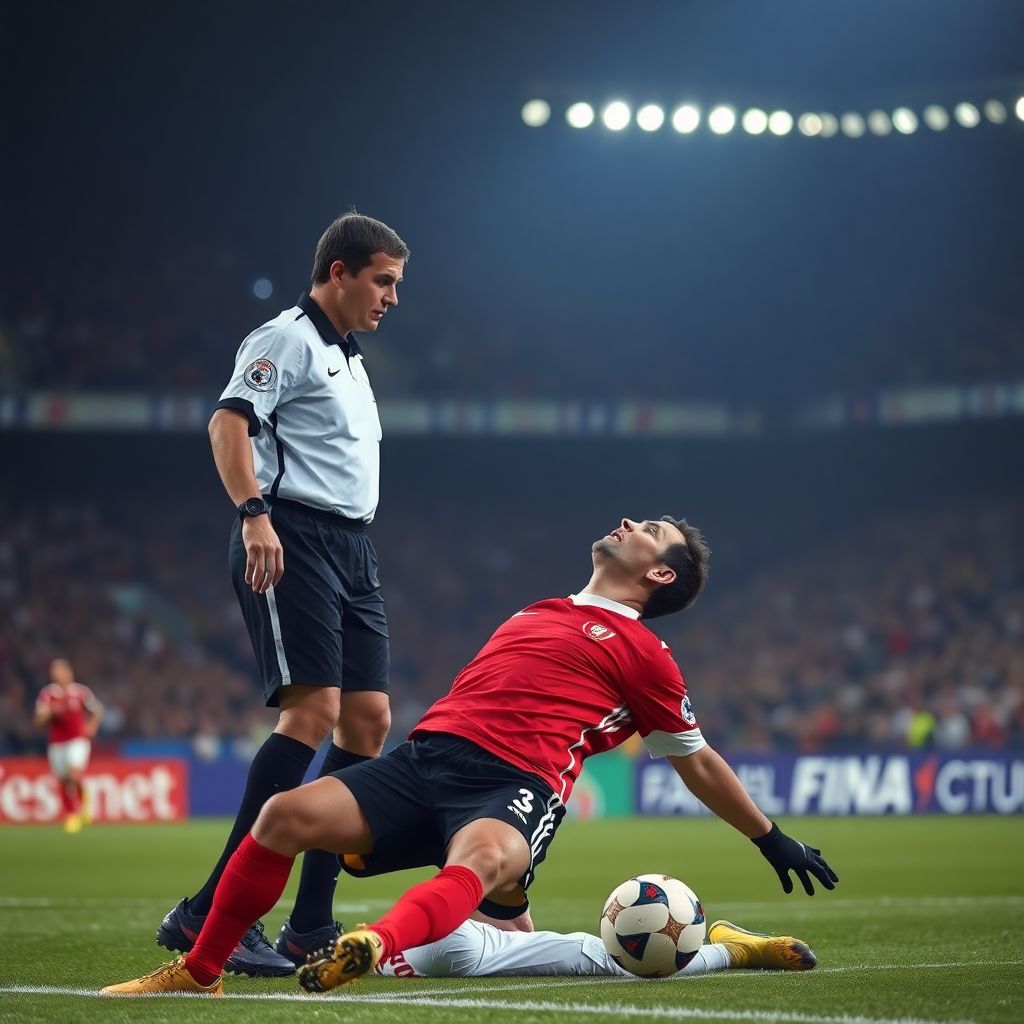
New rules to be applied at the 2026 FIFA World Cup are set to reshape how football is played and managed on the biggest stage. Under the leadership of Pierluigi Collina, head of FIFA’s Referees Committee, and in coordination with IFAB, a series of regulations will target time-wasting, covert tactical tricks and unsporting behavior. From goalkeeper “injury time-outs” to stricter VAR use and brand‑new red card offences, the tournament will effectively mark the beginning of a new officiating era.
1. Tactical breaks during goalkeeper “injuries” banned
One of the most controversial habits of recent years has been goalkeepers going down with minor knocks, allowing all outfield players to jog over to the technical area for a disguised tactical huddle. What once looked like a medical break increasingly became a planned pause to reset the team’s strategy and kill momentum.
At the 2026 World Cup, this practice will be shut down. When a goalkeeper is on the ground and play is stopped for a potential injury, outfield players will no longer be allowed to approach their coach on the touchline. They must either remain in their positions on the pitch or gather in the center circle.
Referees have been instructed to intervene proactively: they will prevent players from heading to the bench area rather than punishing them after the fact. No automatic yellow cards are foreseen just for moving toward the technical zone, but the guidance to officials is clear – break the contact between players and staff during these stoppages so that injury breaks cannot be used as covert time-outs.
This rule is intended not only to speed up games but also to restore the medical nature of stoppages. A goalkeeper’s treatment should be about health, not about drawing up a new scheme for the next five minutes.
2. VAR can now review attacking fouls before a corner is taken
Another major change involves how VAR is allowed to intervene in incidents on set pieces, particularly corners. Previously, the protocol only permitted VAR checks once the ball was back in play. That meant fouls such as holding, pushing or blocking inside the box before a corner was taken were effectively invisible to VAR, no matter how obvious they might look on a replay.
A high‑profile trigger for this change came in a 1-1 draw between England and Uruguay, when Adam Wharton impeded José María Giménez with an illegal block before the corner was taken, directly influencing the goal that followed. Because the ball had not yet been put into play, the VAR team was powerless to intervene under the old rules.
In 2026, that loophole disappears for attacking fouls. If an attacking player makes a clear, illegal block or similar infringement inside the box that directly prevents the defense from defending and leads to a goal from that same corner, VAR will be allowed to step in. The video assistant can then recommend that the referee annul the goal and order the corner to be retaken.
However, the rule is deliberately narrow. It applies only to attacking fouls that hinder defenders before the ball is kicked. Defensive holding, grappling or other infringements by the defending team before the corner is taken will not fall under this VAR intervention. The objective is to stop set‑piece routines built on illegal offensive screens rather than to re‑referee every bit of jostling in the area.
3. Covering your mouth during heated arguments becomes a straight red
FIFA is also moving aggressively against a relatively new and controversial form of misconduct: hiding your mouth with a hand, arm or shirt during a heated confrontation with an opponent. The spark for this decision was an unsightly incident in a Champions League match between Benfica and Real Madrid, involving Gianluca Prestianni and Vinícius Júnior, which eventually led to Prestianni receiving a six‑match ban.
From the 2026 World Cup onward, any player who, in a tense argument or on‑field altercation, shields their mouth while speaking to a rival by using a hand, arm or jersey will be sent off with a direct red card. The reasoning is that such behavior often coincides with abusive, threatening or discriminatory language that players wish to keep hidden from cameras and lip‑readers.
The regulation, however, makes an important distinction: covering the mouth during calm, friendly conversations – for instance, when discussing a tactical detail with a teammate or speaking privately to an opponent in a non‑confrontational manner – will remain allowed. The red card sanction is specifically tied to the context of a dispute or flashpoint, where the gesture suggests an attempt to conceal serious misconduct.
This rule is expected to have a strong deterrent effect. Players know that a split‑second gesture in an argument could cost them their place in the match and maybe the tournament, so the hope is that both language and behavior will become cleaner and more transparent.
4. Countdown rules to stamp out time‑wasting
Perhaps the most transformative package of changes concerns time‑wasting – an issue that became even more discussed after the marathon added‑time periods at the 2022 World Cup. Collina has pushed for clearer, more mechanical guidelines that remove the gray areas and force teams to respect the flow of the game.
The new framework introduces strict countdowns for several common restart situations:
Throw‑ins – 5 seconds
Once a player is ready to take a throw‑in, they will have just five seconds to put the ball back into play. If they deliberately delay and exceed this limit, the throw‑in will be awarded to the opposing team. This turns time‑wasting on the touchline into a direct risk rather than a low‑cost tactic.
Goal kicks – 5 seconds
Teams that drag their feet on goal kicks will face an even harsher consequence. If the referee judges that the goalkeeper or defenders are intentionally running down the clock and do not restart play within five seconds once ready, the opposing team will be given a corner kick. That is an enormous swing in advantage and is designed to make purposeful delays at goal kicks virtually suicidal.
Substitutions – 10 seconds to leave the field
For substitutions, the outgoing player will have exactly ten seconds to exit the pitch by the nearest boundary line. Should they take longer without a valid reason, the incoming player will not be allowed to join play immediately. Instead, the new player must wait on the sidelines for at least one minute, leaving his team a man down for that period. This punishes slow walks off the pitch and discourages late‑game theatrics when a team is trying to protect a lead.
Off‑field treatment – 60 seconds
Another point of contention has been players receiving on‑field treatment for minor injuries to run down the clock. Under the new rules, if medical staff enter the field and treat a player (with exceptions for goalkeepers, serious injuries and incidents where the opponent receives a card), that player must then leave the pitch and remain off for a full 60 seconds. The idea is simple: if you genuinely need treatment, you accept a brief absence; if you do not, you will think twice before going down.
Collina has also indicated that each half will include mandatory three‑minute cooling or water breaks. By scheduling these pauses, FIFA aims to reduce the temptation to create “fake” stoppages and allow players to recover in a controlled, transparent manner, especially in hot and humid conditions.
5. Subtle but important tweaks to VAR protocol
Alongside the headline changes, a set of smaller VAR adjustments will also apply at the tournament.
First, VAR will be allowed to correct the direction of a corner/goal‑kick decision – for example, whether the ball last touched a defender or attacker before going out – but only if the images provide an absolutely clear answer and only if the check happens almost instantaneously, before play is restarted. This is meant to fix obvious mistakes without turning every out‑of‑bounds call into a full‑scale review.
Second, the long‑standing rule that yellow cards cannot be reviewed remains mostly intact, but with one notable refinement. Incidents that might result in a second yellow card will not be reviewed before the card is shown, so the referee’s live judgment still stands in the moment. However, once a player has been dismissed for a second yellow, VAR will be permitted to check the specific incident that produced that second caution. If the video shows a clear error – for instance, that contact never occurred – the referee can be advised to reconsider, avoiding a potentially unjust dismissal.
These subtle modifications aim to balance two goals: correcting major injustices while preventing VAR from intruding into every minor disciplinary decision.
—
How these rules could change the World Cup experience
These reforms go far beyond cosmetic tweaks. They are likely to alter in‑game behavior, coaching strategies and even squad selection.
Teams that relied on frequent tactical huddles during goalkeeper “injuries” will have to find new ways to communicate – through pre‑planned signals, halftime adjustments, or more autonomous leaders on the pitch. The ability of coaches to micro‑manage every phase of play from the sideline will be reduced, potentially rewarding sides with intelligent, tactically flexible players.
Set‑piece coaches will also need to redraw their playbooks. Many modern corner routines rely on sophisticated blocking patterns to free up a target player. With VAR now empowered to punish clear attacking blocks before the ball is in play, those moves will have to stay within a much narrower legal line. Teams that adapt quickest and design clever but fair routines could gain a crucial edge at dead‑ball situations.
Discipline and communication will become even more important. The new red‑card rule for covering the mouth in confrontations means captains and senior players must lead by example, de‑escalating arguments rather than inflaming them. Federations may invest more time in educating players about on‑field language, gestures and the risks of being seen as hiding abusive comments.
Time management will be transformed. Sides that relied on subtle time‑wasting – slow jogs to the sideline, long pre‑kick rituals, exaggerated cramps – will face immediate, concrete punishments: lost possession, dangerous corners conceded, or a temporary numerical disadvantage. The likely result is a faster, more continuous style of World Cup football with fewer interruptions and more effective playing time.
For referees, these changes both simplify and complicate their job. On one hand, clear countdowns and automatic consequences remove some subjective judgment and give officials firm tools to combat delays. On the other hand, referees will need excellent awareness and time‑keeping to apply the limits consistently, as well as strong communication skills to explain their decisions in real time to players and benches.
Coaches may respond by adjusting fitness regimes and rotation policies. If matches are played at a higher tempo with less dead time, physical demands rise. Tournament squads could be built with an even stronger emphasis on endurance and versatility, while bench players might be used earlier and more frequently.
From a spectator perspective, the 2026 World Cup is likely to feel more intense and less fragmented. Fewer stoppages, more added value from corners and goal kicks, and stricter discipline in confrontations should make the game cleaner and, in theory, fairer. Yet there will almost certainly be criticism and controversy, especially in the early matches as teams and referees test the boundaries of the new framework.
In the longer term, these rules may set a template for domestic competitions and youth football across the world. If they succeed in reducing time‑wasting and encouraging more open, honest play, the 2026 tournament could be remembered not only for its champions but also as the moment when football’s laws took a decisive step into a new era.