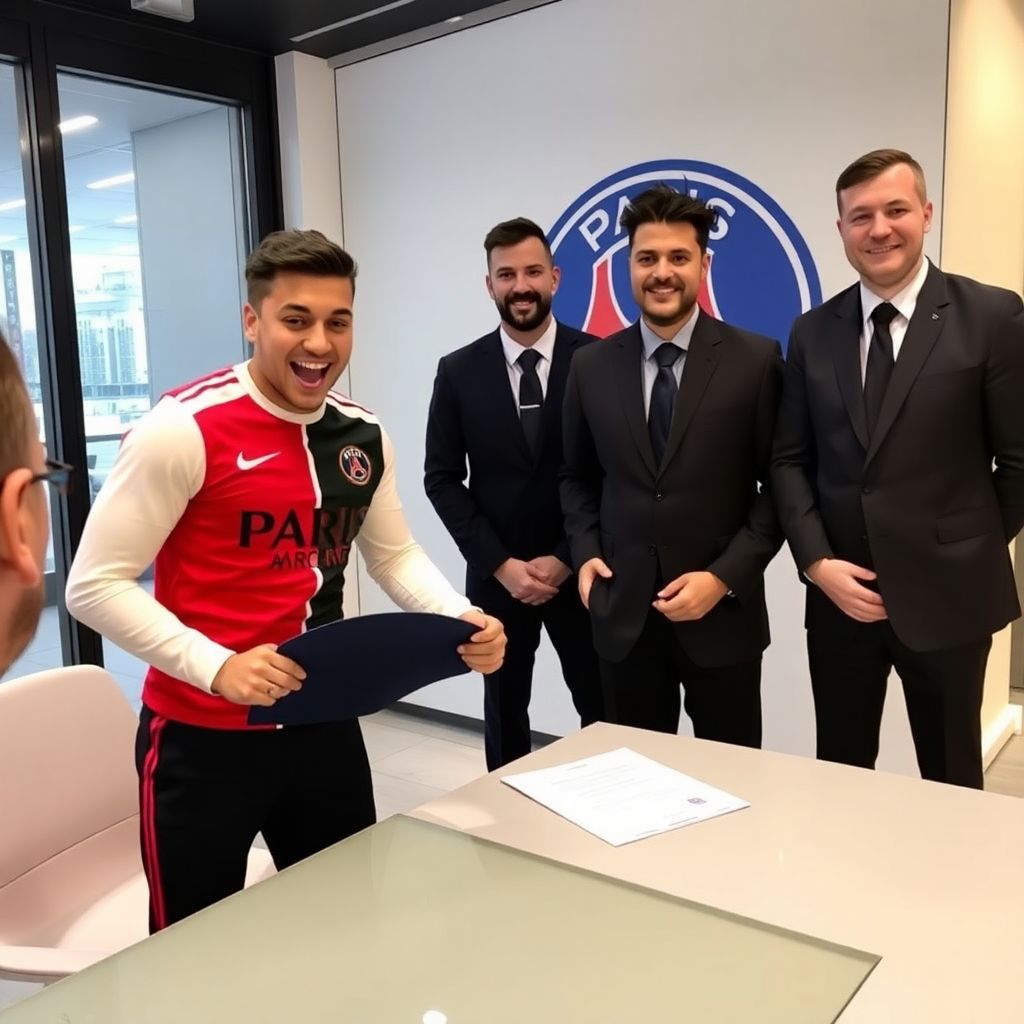
Mika Godts on verge of PSG move
According to reports from the Netherlands, Paris Saint-Germain are closing in on the signing of Ajax’s 21‑year‑old forward Mika Godts, with an agreement already reached on personal terms between the player and the French champions.
The young Belgian attacker, whose full name is Mika Marcel Godts, is understood to have given a clear green light to the transfer. Negotiations are now focused on the two clubs, with Ajax and PSG working to find a final agreement over the transfer fee.
Godts’ agent Niels De Jonck confirmed that the player has accepted PSG’s project and is eager to make the move. Speaking to Dutch media, De Jonck explained that the forward has already agreed in principle with the Ligue 1 side: Mika received an offer from Paris Saint‑Germain and both parties have come to an understanding. From this point, everything depends on the clubs reaching a deal.
Ajax are reportedly demanding around 60 million euros for their rising star. The French champions, who have dominated Ligue 1 in recent seasons and recently celebrated another league title as well as Champions League success, are said to be prepared to meet that valuation or come close enough to satisfy the Dutch club. PSG see Godts as an investment for the future rather than a short‑term gamble.
Despite his young age, Godts is already building a strong reputation. This season he has made 2 appearances for Ajax, while last year he enjoyed a breakout campaign. Across 44 matches in all competitions, he scored 17 goals and provided 15 assists, directly contributing to 32 goals. Those numbers have drawn attention from major European clubs, but PSG appear to be leading the race and are now very close to securing his signature.
Why PSG want Mika Godts
PSG’s interest in Godts fits their recent strategy of blending global superstars with some of the most promising talents in Europe. After years of relying heavily on established names, the French giants have been putting more emphasis on young players who can develop within their system and potentially become the next generation of club leaders.
Godts offers exactly that profile. Able to play both as a central forward and in wider attacking roles, he brings versatility to the frontline. His ability to operate between the lines, attack space behind the defense, and contribute both goals and assists makes him an attractive option for a club that often faces deep‑lying opponents in Ligue 1.
Playing style and strengths
Observers describe Godts as an intelligent attacker with a sharp final pass and a calm presence in front of goal. He is comfortable receiving the ball under pressure, uses quick changes of direction to escape markers, and has the vision to spot runners around him. His 17 goals and 15 assists last season are not only a reflection of his finishing skills, but also of his decision‑making in the final third.
Another key aspect of his game is his work rate. Modern forwards are expected to press aggressively and contribute defensively, and Godts has shown the willingness to chase back, close passing lanes, and help his team regain possession. That combination of technical ability and tactical discipline is especially valuable at top clubs where competition for places is intense.
How he could fit into PSG’s squad
At PSG, Godts would arrive in a dressing room packed with attacking quality, but also with opportunities. The club is still reshaping its frontline after several major departures in recent transfer windows. For the coaching staff, a player like Godts represents both immediate depth and long‑term potential.
He could be used as a rotation option in Ligue 1 while gradually earning minutes in the Champions League. Depending on tactical plans, he might feature as a second striker, an inverted winger cutting inside onto his stronger foot, or even as a false nine in matches where PSG want to dominate possession and pull defenders out of position.
This flexibility allows PSG to adjust systems without needing wholesale changes in personnel. For a club that competes on multiple fronts every season, having a young attacker capable of adapting to different roles can be crucial over a long campaign.
The Ajax side of the deal
From Ajax’s perspective, a transfer fee in the region of 60 million euros would represent a significant return on a player still at the start of his career. The Dutch club has built its reputation on developing talents and then selling them on to Europe’s richest sides, reinvesting the income into their academy and squad.
Losing Godts would certainly weaken their immediate attacking options, especially after a season in which he was directly involved in so many goals. However, Ajax are accustomed to managing this kind of turnover. The reported willingness of PSG to meet or approach the asking price makes it increasingly likely that Ajax will ultimately agree to the sale.
Pressure and expectations on the player
If the move goes through, Godts will face a major step up in terms of pressure, media attention, and competition. At Ajax, he has already experienced expectations at a historic European club, but PSG operate in a different financial and sporting dimension.
Every performance in Ligue 1 and the Champions League is scrutinized, and new signings are often judged quickly. For a 21‑year‑old, adapting to that environment can be challenging. The key for Godts will be patience: making the most of training sessions, learning from more experienced teammates, and focusing on gradual progress rather than instant stardom.
What this transfer means for PSG’s long‑term project
If PSG finalize the deal, it would send another signal about the direction of their recruitment policy. Rather than chasing only marquee names at their peak, they are increasingly combining star power with high‑ceiling talents who can grow within the club.
In the long term, this approach could help build a more balanced squad, reduce the need for constant large‑scale rebuilds, and create a core of players who identify strongly with PSG. Godts could become part of that new core if he adapts well and continues his development in France.
Impact on the French league
For Ligue 1, the arrival of a promising attacker from Ajax adds further quality to a championship that has been working to raise its international profile. Young, offensively minded players often attract global attention, especially when they perform on European nights.
If Godts succeeds, it could encourage more young talents to view Ligue 1, and PSG in particular, as a platform for growth rather than just a final destination for established stars. This would benefit the competitiveness and visibility of French football as a whole.
The next steps
At this stage, the key obstacle remains the agreement between Ajax and PSG. With personal terms settled, both clubs must now finalize the structure of the transfer: fixed fee, possible bonuses, and any future clauses. Given PSG’s financial strength and the player’s clear desire to make the move, negotiations are expected to be intensive but constructive.
Until the transfer is officially announced, Ajax can still count on Godts as part of their squad, but all signs point to a deal being close. Should everything be completed, Mika Godts will soon be swapping the Eredivisie for Ligue 1, taking on the challenge of proving himself at one of Europe’s most ambitious clubs.