Turkish football has never just been about noise in the stands and crazy derbies. Behind all that passion there’s a surprisingly rich coaching school that, step by step, has started to influence the global game. When people today Google *famous Turkish football managers* or argue in pubs about the *top Turkish football managers of all time*, they’re not just being nostalgic — they’re talking about coaches who genuinely shifted tactics, mentality and even club business models.
Below — a guided, conversational walk through those iconic figures, how they worked, what makes them different, и what all this means in 2026.
—
From Late Bloomers to Global Bench: Historical Context
How Turkish coaches went from “local heroes” to global references
For a long time Turkish football lived in a bit of a bubble. Until the 1990s, the country mostly exported players’ talent and imported coaching brains from abroad. Big Istanbul clubs were often led by foreigners, while local coaches got the “caretaker” or short‑term jobs.
The real turning point came in the 1990s and early 2000s. The national league opened up, money flowed in, European nights became a priority — and a new generation of Turkish managers began to stand up to the old guard. They were better educated, more confident with languages, and not afraid to copy ideas from Italy, Germany or the Netherlands.
The result? Suddenly, you had *Turkish football managers in European clubs*, Champions League quarter‑finals in Istanbul, and even a World Cup semi‑final. Turkish coaches stopped being “good for the domestic league” and started being seen as serious operators on the world stage.
—
The Golden Image: Why Turkish Coaches Became So Visible
Charisma, chaos and crazy comebacks
If you look at any *list of legendary Turkish football managers*, you’ll quickly notice one common trait: personality. These are not quiet figures in the background. They shout, they argue, they dominate TV talk shows. They build a culture around themselves.
On the touchline that charisma turns into a specific kind of football: emotional, intense, rarely boring. Late goals, wild comebacks, hostile atmospheres — Turkish managers embraced all of that and turned it into an advantage. For years European clubs hated travelling to Istanbul because they knew the coach would use the crowd like a twelfth (and sometimes thirteenth) player.
But charisma alone doesn’t beat top European sides. Under the surface many of these coaches were tactically flexible and very good at man‑management. They understood how to balance egos, especially with squads full of high‑paid foreigners and ambitious local talents.
—
The Icons: Who Actually Shaped World Football?
Fatih Terim – The Emperor of emotional football
It’s impossible to talk about the *best Turkish football coaches in history* without starting with Fatih Terim. “İmparator” is more than a nickname; it’s a job description.
Terim’s breakthrough moment came with Galatasaray’s UEFA Cup win in 2000. That run — beating Arsenal in the final — turned a domestic legend into a continental name. Tactically he used a very modern mix for that time: intense pressing, narrow but aggressive midfield, full‑backs bombing forward. For a lot of European audiences it was the first time they saw a Turkish team not just defending deep but dictating the tempo.
He then took that reputation to Italy, managing Fiorentina and AC Milan. It didn’t turn into a long Serie A dynasty, but it did prove a point: a Turkish coach could lead major European clubs and be respected in one of the toughest leagues in the world.
Short version: Terim showed that a Turkish manager can export ideas, not just passion.
—
Şenol Güneş – The quiet professor behind 2002
Where Terim is fire, Şenol Güneş is ice. He’s the calm, analytical face in the dugout — and the architect of Turkey’s third place at the 2002 World Cup. That campaign is still the single biggest advert Turkish football has ever had.
Güneş built a compact, clever team: disciplined lines, sharp transitions, and a mix of local stars and lesser‑known hard workers. His approach was less emotional and more system‑based. It looked simple on TV, but it was brutally efficient.
Years later, with Beşiktaş, he did it again: back‑to‑back league titles and a Champions League group win playing attractive, possession‑oriented football. European media suddenly had to accept that Turkish clubs under Turkish coaches could control games away from home too.
If Terim made people feel Turkish football, Güneş made people respect it.
—
Mustafa Denizli – The pioneer who did it everywhere
Mustafa Denizli doesn’t always get the same headline hype, but he’s one of the true pioneers. Long before it was trendy, he took Turkish club football deep into European competitions, including a European Cup semi‑final with Galatasaray in the late 1980s.
His unique resume? He’s the only coach to win the Turkish league with all three big Istanbul clubs — Galatasaray, Fenerbahçe, and Beşiktaş. That says a lot about adaptability and man‑management across very different club cultures and political environments.
For many older fans, Denizli belongs firmly among the *top Turkish football managers of all time* because he proved that a local coach could be trusted with the biggest jobs at a time when foreign managers were considered automatically superior.
—
The “modernists”: Avcı, Yanal, Buruk and beyond
Fast‑forward to the 2010s and 2020s and you see a new type of Turkish coach emerging. Less touchline theatre, more laptops and data dashboards.
– Abdullah Avcı built his reputation with structured, possession‑based football at İstanbul Başakşehir, culminating in a league title and regular European group stage appearances.
– Ersun Yanal pushed high‑tempo attacking styles, particularly at Fenerbahçe, where he delivered a long‑awaited league title playing front‑foot football.
– Okan Buruk, after gaining experience in smaller clubs and abroad as a player, took Galatasaray to new heights with a balance of modern pressing, detailed opponent analysis and classic Turkish emotional energy.
This generation grew up watching both Turkish legends and European tactical innovators. They’re more comfortable speaking multiple languages, more open to sports science, and more interested in consistent game models than in short‑term shock therapy.
—
Different Coaching Philosophies: Comparing Approaches
From “we win with heart” to “we win with structure”
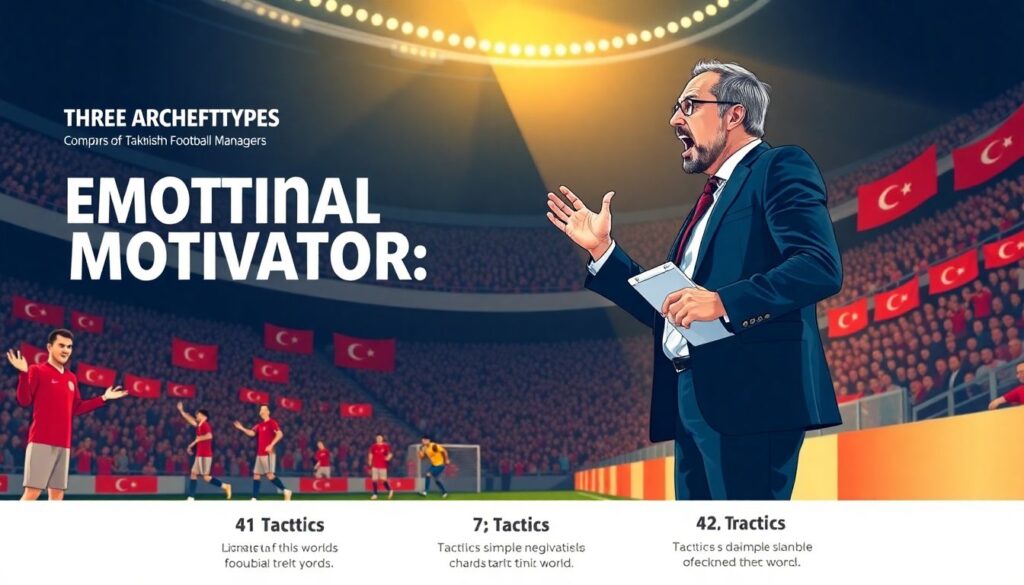
If we step back and compare the main schools of thought among *famous Turkish football managers*, three rough archetypes appear:
1. The Emotional Motivator
Think Fatih Terim. High‑energy team talks, “us against the world” mentality, flexible but not overly complex tactics. Strength: big games, especially at home. Weakness: can burn out squads over a long season.
2. The System Builder
Managers like Şenol Güneş or Abdullah Avcı. Clear game model, repeated training patterns, detailed roles for each player. Strength: consistency and player development. Weakness: sometimes accused of being too cautious or slow to change.
3. The Pragmatic Tactician
Coaches who adapt week to week, mixing styles depending on opponent and squad. They borrow from both emotion and structure. Strength: versatility. Weakness: can lack a clear identity, which makes long‑term planning harder.
In practice, most coaches blend these elements, but Turkish managers tend to lean heavily on identity. Fans and media in Turkey demand it: they want to “recognize” their team’s character immediately, not just read about it in post‑match xG charts.
—
Technology and Analytics: Pros and Cons for Turkish Managers
How “new school” tools changed “old school” touchlines
By 2026, no serious coach in Europe or Turkey can ignore technology: tracking data, video analysis, injury‑risk models, AI‑assisted scouting. Turkish managers have jumped into this space with varying levels of enthusiasm.
What technology brought to the table (the pros):
– Better opponent analysis: small details in pressing triggers or set pieces are now visible and coachable.
– Smarter recruitment: data‑driven scouting helped clubs find undervalued foreign players and local youngsters.
– Load management: GPS and wellness data reduce soft‑tissue injuries and help ageing stars survive intense seasons.
But there are clear cons and challenges too:
– Cultural resistance: some older coaches still prefer “feel” over numbers, which can create tension with data departments.
– Information overload: too many reports and dashboards can confuse players, especially in squads where not everyone speaks the same language.
– Short‑term thinking: clubs sometimes buy “data players” without a coach who actually knows how to use them.
The best Turkish coaches — especially from the newer generation — treat technology as a tool, not a religion. They still rely heavily on face‑to‑face communication but let numbers fine‑tune decisions on tactics, squad rotation and recruitment.
—
How to “Choose” a Style: Lessons for Clubs and Fans
Matching manager, club culture and expectations
If a club chairman, director or even a group of fans in 2026 were trying to pick from the *best Turkish football coaches in history* as role models, what should they actually look for?
Here’s a simple checklist.
1. Know your club’s natural identity
Is your fanbase okay with patient, controlled football, or do they demand non‑stop attack? Hiring a “Güneş‑type” for a club that wants chaos, or a “Terim‑type” for a patient possession project, is asking for trouble.
2. Check the squad profile
Do you have experienced leaders who can absorb complex tactical plans? Or a young, raw group that needs simple instructions and big emotional boosts? The best manager for your club is the one whose communication style matches the dressing room.
3. Look at time horizon
If you need immediate results (financial crisis, relegation fears), an emotional motivator with strong man‑management might be ideal. If you’re building a three‑year project, you probably want a system builder who can create a repeatable playing style and develop youth.
4. Evaluate openness to technology
In 2026, you can’t escape data and video. But the key is fit: some clubs are heavily data‑driven, others are still catching up. Choose a coach whose comfort with analytics matches the tools you actually have.
5. Language and international experience
For clubs in bigger leagues or with European ambitions, experience abroad — even as a player — still matters. That’s why many *Turkish football managers in European clubs* had an easier adaptation curve: they already understood the media, the calendar and the expectations.
—
Current Trends in 2026: Where Turkish Managers Are Headed
Less drama, more structure — but the fire is still there
Looking around in 2026, a few trends stand out among *famous Turkish football managers* and the new wave coming through:
– Hybrid pressing systems
Instead of 90 minutes of wild pressing, more coaches apply selective, well‑timed pressure. They’ve learned from German and Spanish models, blending them with the traditional Turkish hunger for duels.
– Smarter use of local talent
Young Turkish players are integrated earlier but with clearer pathways: loan systems, B‑teams, specialist coaches. Managers are judged not just on results but also on how many academy products they turn into serious pros.
– Greater international mobility
While it’s still not common to see Turkish managers dominate the Premier League or La Liga, you see more of them taking jobs in mid‑tier European leagues, Gulf countries and MLS‑adjacent markets. Each success story widens the door for the next one.
– Improved communication skills
Younger coaches are more media‑savvy, more comfortable in English, and more aware that modern football is also content. They sell their projects well — not only to presidents but to fans and sponsors.
– Balanced use of tech
The latest tactical trend is not a formation, it’s synthesis: using AI‑enhanced video, tracking data and psychological profiles without losing the human side. The best Turkish coaches now sit easily in a room with analysts and physios, building integrated plans.
Importantly, the emotional core hasn’t disappeared. Stadiums are still cauldrons, touchlines still volcanic. But the underlying structure is much stronger than it used to be.
—
What Makes Turkish Managers “World‑Class” Today?
Beyond trophies and touchline clips
When people debate the *top Turkish football managers of all time* in 2026, they usually throw around numbers — titles, European runs, World Cup finishes. That’s fair. But the real “mark on world football” runs deeper:
– They proved that a football culture known mostly for fan passion could also produce tactically sharp, adaptable coaches.
– They helped European clubs see Istanbul and beyond as a market for brains, not just players.
– They inspired a new generation of local coaches to educate themselves, learn languages, embrace technology and still keep that uniquely Turkish edge.
If you scroll back through any honest *list of legendary Turkish football managers*, you’ll see a story of evolution: from raw emotion to organized chaos, from local respect to international recognition.
And in 2026, the story clearly isn’t finished. The next “İmparator” or “professor” is probably somewhere on the touchline of an Anatolian club right now — tablet in one hand, training cones in the other — trying to blend data with noise, structure with passion, and preparing to take Turkish coaching’s next big step on the world stage.