Why regional rivalries matter more in TFF 1. Lig than in the Süper Lig
TFF 1. Lig is where Turkish football gets raw, local and personal. While the Süper Lig sells national and international narratives, second-tier clubs live and die by what happens inside their own province, valley or coastline.
A derby here is not just a match; it’s a referendum on who really owns the city, who speaks for the neighborhood, who gets to define what “local pride” means. That’s exactly why regional rivalries are the main engine shaping Turkish football league clubs identity in TFF 1. Lig.
And unlike the polished branding of the big Istanbul giants, 1. Lig identities grow out of bus routes, industrial zones, university campuses and sometimes a single arterial street that divides one set of fans from another.
Let’s unpack how that works — with real examples, stats, and some unconventional ways clubs could use these rivalries more strategically instead of just emotionally burning fuel every weekend.
—
From geography to identity: how a map turns into a derby
On paper, regional rivalries are just dots on a map: two clubs close to each other. In reality, three layers transform geography into identity:
– Economic layer – port vs. inland city, industrial vs. tourist region
– Cultural layer – conservative vs. secular, migrant-heavy vs. “native” areas
– Historical layer – old industrial clubs vs. “new money” municipally backed projects
Once these layers stack, you no longer have “just neighbors.” You have competing narratives about who represents the region.
Real-world example: Black Sea vs. the rest (Sakaryaspor, Kocaelispor, Samsunspor history)
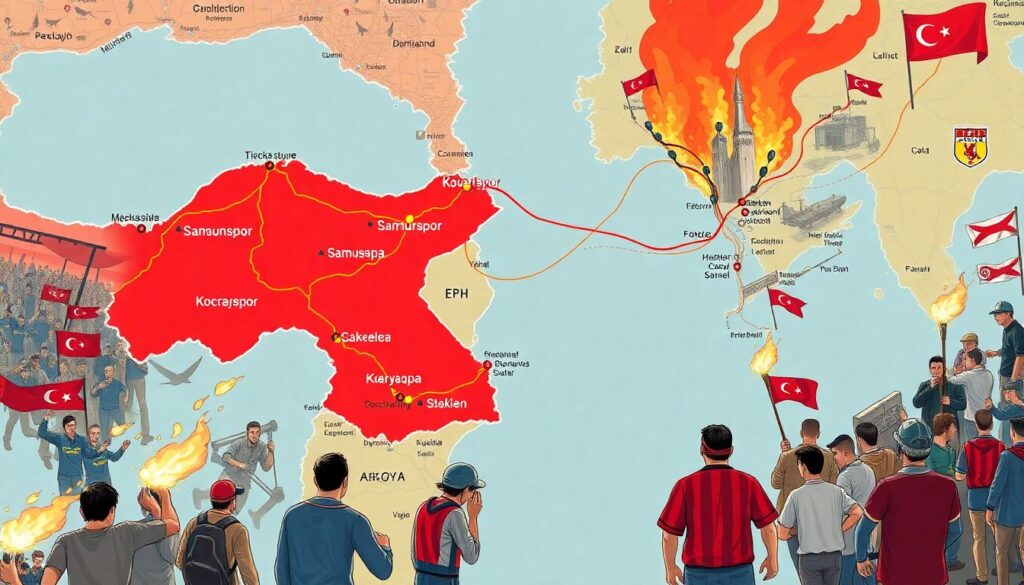
Even though Samsunspor has moved between divisions, its historical clashes with Black Sea neighbors and with Kocaeli–Sakarya corridor clubs show how TFF 1. Lig rivalries history grows out of transport and trade routes.
– Sakaryaspor and Kocaelispor draw heavily from workers and small business owners around the D‑100 highway and industrial belt.
– Samsun has long been a logistics hub for the eastern Black Sea and inland Anatolia.
When these clubs collide in 1. Lig, the narrative is less “who is richer” and more “whose city really drives this region’s economy.” Fans translate that into songs, tifos and away-day rituals that reinforce club identity every season.
Technical note (identity formation):
In sports sociology terms, this is socio-spatial identity construction. The club becomes a proxy for a *territory* plus a *way of life* in that territory. The closer two clubs are in space, the more they need to differentiate via symbols, colors, chants, ultras culture and even stadium architecture.
—
How rivalries hard-code club identity: four key mechanisms
Regional rivalries don’t just influence identity; they lock it in. There are four repeatable mechanisms you see across best TFF 1. Lig clubs to support if you want that intense local flavor.
1. Colors and symbols: “not like them” branding
A lot of visual identity work in TFF 1. Lig is “negative branding”: define yourself by *what you’re not*.
– Clubs avoid colors of nearby rivals, even when they might be historically relevant.
– Badges deliberately reference specific landmarks or industries (“our” bridge, “our” port, “our” mountain) that neighbors don’t have.
Example:
In several Anatolian cities, municipality-backed clubs that tried neutral colors or generic logos struggled to create deep attachment. Once rivalries intensified, rebrands started to include local motifs, historic dates and slogans that draw a line between “us” and “them.”
Technical note (brand architecture):
What you see here is defensive brand positioning driven by rival clubs. Identity assets (logo, colors, nickname) are optimized *against* close competitors rather than for a blank national audience.
—
2. Chant culture as an “oral constitution”
Chants in 1. Lig are not just noise — they’re the operating system for fan identity.
– Lines about “owning the city” or “real people’s team” vs. “bureaucrats’ team” show up again and again.
– Away-day songs encode geography: road numbers, district names, even *minibus lines* become part of the narrative.
Over 2–3 seasons, a derby’s lyrical canon can turn into a shared “oral constitution” of what the club stands for and who the enemy is.
—
3. Youth development shaped by rivalry pressure
Regional hate doesn’t stay in the stands; it reaches the academy.
– Young players are taught early that certain fixtures are “must not lose,” even if analytically they’re just 3 points.
– In some clubs, coaches deliberately give local kids starts in key derbies, accepting more emotional volatility in exchange for long-term cultural loyalty.
You can literally see TFF 1. Lig rivalries history imprinted on squad selection. It’s common to track how many players in a derby XI are from the city or province — it becomes a bragging metric for “realness.”
Technical note (talent pipeline):
This is a classic case of non-economic optimization. Clubs sacrifice a bit of short-term expected on-pitch efficiency to increase identity density (percentage of squad who share the local narrative). Over years, this can stabilize fan loyalty even in relegation cycles.
—
4. Matchday economics: derbies as financial exoskeleton
When TV money is modest, derbies are the bailout mechanism.
– It’s common to see home attendance jump 40–80% for big regional games.
– A club averaging 4,000 fans might hit 7,000–8,000 when the neighbor comes to town.
That’s where TFF 1. Lig tickets matter: dynamic pricing, early-bird packages and loyalty points can turn one or two big local games into the cash that keeps the season afloat.
Derbies don’t just finance transfers; they pay for buses, security, youth travel – the boring infrastructure that keeps identity alive.
—
Case snapshots: how specific rivalries sculpt identity
Let’s zoom in on patterns, without pretending a single “official” derby list exists (and it constantly changes with promotions/relegations).
Aegean and Mediterranean axes
In coastal regions, rivalries are often about two competing touristic or industrial centers.
Typical characteristics:
– Heavy use of city nicknames and coastal imagery in tifos
– Strong summer tourism workforce in the stands (students, seasonal workers)
– Club positioning as “real locals” vs. “tourist economy sellouts”
For these clubs, identity is partly a resistance movement against being reduced to a beach or a resort in national media.
—
Anatolian industrial belts
Inland rivalries tend to be more about:
– Factory workers vs. public employees
– Traditional neighborhood clubs vs. municipality-founded sides
– “Old stadium culture” vs. new modern arenas on the outskirts
The identity tension is clear: are you a club of the *workshop district* or of the *city hall*? Whole ultras groups are built around that divide.
—
How the fixture list quietly engineers identities
You can actually read the TFF 1. Lig derbies schedule like a psychological map of the season.
– Early-season derbies (August–September) often “set” identity narratives: a big win can define the tone of banners and social media for months.
– Mid-season rivalries (December–February) become stress tests when finances and injuries bite.
– Late-season derbies in April–May can either cement promotion myths (“we went up over their bodies”) or relegation trauma stories.
Technical note (schedule design):
Federations rarely admit it, but fixture makers often try to avoid stacking too many high-risk regional derbies in consecutive weeks for policing and security reasons. That scheduling constraint unintentionally spaces out emotional peaks and troughs, shaping how fans experience the identity rollercoaster over 34 matchdays.
—
Non-obvious data points: numbers hiding inside the noise
Let’s bring in some concrete metrics you can actually analyze over 2–3 seasons for any 1. Lig club:
– Attendance uplift:
– Baseline home league game: maybe 3,500–5,000 spectators
– Regional derby: +50–120% uplift is common, especially in promotion races
– Merch sales spikes:
– Up to 30–40% of annual scarf and flag sales can cluster around 3–4 key rivalry weeks.
– Social media growth:
– Some clubs see 10–15% follower bumps in the 7–10 days around viral derby incidents ( choreo photos, last‑minute winners, crowd videos).
These numbers show that rivalries are not “just feelings.” They’re measurable, recurring identity events with clear financial signatures.
—
Unconventional ways clubs can harness regional rivalries
Now to the fun part: what could clubs do differently, beyond the usual “sell more tickets and post more hype videos”?
1. Turn derbies into live identity labs
Instead of designing a brand strategy in a conference room, clubs could use rivalry games as A/B tests for identity.
Practical ideas:
– Launch two different tifo concepts in back-to-back derbies (e.g., “industrial pride” vs. “youth & future”) and track merch and social engagement.
– Test localized slogans targeting specific districts inside the same city and see which one fans spontaneously adopt in chants.
Fans will quite literally tell you, in real time, what version of the club they’re willing to bleed for.
—
2. Co-created away-day charters with rival fans
This sounds counterintuitive, but it works: let rival groups collaborate not on friendship, but on rules of engagement.
– Joint charters that define “off-limits” topics (e.g., disasters, certain political references) keep the rivalry white-hot but reduce reputational risk and fines.
– Co-signed codes can be published before the match, turning the rivalry into a kind of “regulated gladiator fight” instead of a free-for-all.
Technical note (risk management):
From a governance perspective, this is co-regulation. Instead of only top-down federation sanctions, you create horizontal peer pressure between fan bases, which is often more effective than any fine.
—
3. Rivalry-driven content for neutral fans
There is a big missed opportunity: neutrals looking for the best TFF 1. Lig clubs to support often see only league tables, not emotional maps.
Clubs could:
– Build bilingual “Derby Guides” explaining the history, neighborhoods, fan rituals, and even recommended pubs or tea gardens.
– Use short documentary-style clips featuring both sets of fans describing what the rivalry means — making it accessible instead of opaque.
For international viewers browsing for TFF 1. Lig tickets online, a compelling rivalry story can be more persuasive than league position.
—
4. Data-driven rivalry management
Instead of treating derbies as chaos events, clubs can run them like high-stakes product launches.
What to measure every time:
– Ticket sales curve (how fast sections sell out by day)
– Secondary market activity and price inflation
– Noise levels and attendance by block or stand
– Post-match incidents, complaints, and police reports
Over 4–5 derbies you build a rivalry performance dashboard. That lets you ask smart questions:
– Which entrance gets overcrowded first?
– Which price points still sell out instantly?
– Which family or neutral sections actually stay “neutral” and safe?
This is mundane work, but it directly feeds back into Turkish football league clubs identity by defining who feels welcome and where.
—
Rivalries as long-term assets, not seasonal explosions
Regional rivalries in TFF 1. Lig are often treated as one-off emotional volcanoes: erupt, burn, cool down, repeat next year. That’s wasteful.
If clubs think more strategically, each derby becomes:
– A data point for understanding fan segmentation and geography
– A live theater for testing identity narratives and symbols
– A predictable financial spike to stabilize fragile budgets
– A magnet for neutrals and foreigners curious about real, unpolished football
The trick is to stop seeing rival clubs only as enemies and start seeing them also as unwitting co-authors of your identity. Without them, your “us” has nothing to push against.
Handled well, the very matches that keep security teams awake at night can become the backbone of sustainable, distinctive club culture in TFF 1. Lig — and the strongest reason people keep buying those TFF 1. Lig tickets year after year, even when the football itself isn’t perfect.