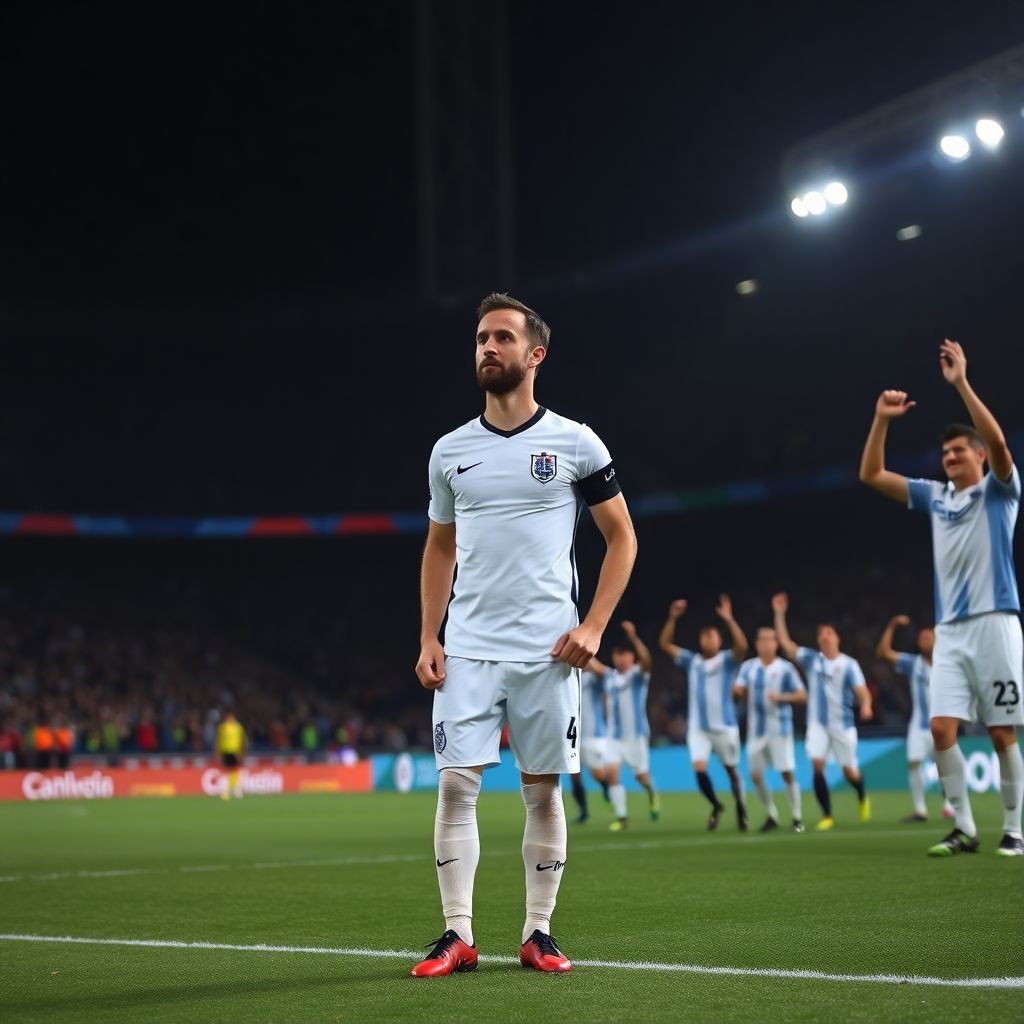
“Not Enough at This Level”: Harry Kane Reflects on England’s World Cup Heartbreak
England captain Harry Kane admitted that his side fell short when it mattered most after their dramatic 2-1 defeat to Argentina in the semi-finals of the 2026 World Cup. Conceding twice in the closing stages, England saw their hopes of reaching the final evaporate in agonising fashion.
Speaking after the match, Kane underlined that the team’s approach after taking the lead was ultimately costly.
“We played well for large parts of the game,” he said. “We went 1-0 up, but after that it looked like we were just trying to protect the score. At this level, that isn’t enough.”
The striker stressed that the team had poured everything into the tournament, only to come up short at the crucial moment.
“We are devastated,” he confessed. “We worked so hard to get here. The players gave everything they had – the running, the sweat, the blood, the tears, all of it. But in the end, it just wasn’t enough.”
Kane highlighted Argentina’s increasing pressure in the latter stages and admitted that England struggled to cope once they dropped deeper.
“After our goal they started pushing forward with more players,” he explained. “Either they committed more men or we weren’t able to match them one-on-one. The attacks came one after another. We tried to hold on, blocking shots and defending as a unit, but in the end it wasn’t enough.”
Despite the disappointment, the forward pointed out that England’s campaign also contained positives and evidence of progress.
“In this tournament we’ve had a lot of good moments and played some really strong games,” Kane noted. “We’ve reached another semi-final. We’re close, but we still need to find that missing piece in the final stages of these tournaments.”
He finished with an emotional message to everyone connected with the national team.
“I feel so sorry for the players, for the team, for the staff and for the fans,” he said. “Everyone has put so much into this. It hurts.”
—
England’s recurring semi-final hurdle
Kane’s words echo a familiar pattern for England in recent major tournaments. Once again, they advanced deep into the competition, only to fall at the semi-final stage. Under pressure, game management and mentality often become as important as technical quality, and England’s tendency to retreat after taking the lead has repeatedly invited trouble.
Going 1-0 up against Argentina should have been a platform to control the match, but instead it became a turning point. Rather than maintaining their intensity, England appeared to sink gradually into their own half, allowing Argentina to dominate possession and territory. At World Cup semi-final level, such a passive approach is rarely forgiven.
Game management under scrutiny
Kane’s admission that “we looked like we were just trying to protect the score” is a direct criticism not only of the players’ mindset but also, indirectly, of the team’s overall game plan in the final period. Protecting a lead is part of elite football, yet it demands much more than simply defending deep.
Top teams manage tempo, press intelligently, and keep the ball under pressure. England, however, struggled to string passes together once they were ahead. Each clearance handed Argentina another opportunity to build pressure. Kane’s reference to “attack after attack” paints a picture of a team trapped in a defensive cycle from which they could not escape.
Physical and emotional investment
Kane’s emphasis on “running, sweat, blood, tears” underlines the physical and emotional toll of a long World Cup run. Players arrive at this stage of the season fatigued, carrying knocks, yet still expected to perform at maximum intensity against the world’s best.
That investment also explains the depth of the disappointment. Getting to another semi-final confirms England’s place among the top footballing nations, but for a group that has spoken openly about winning major trophies, falling just short again feels less like progress and more like a painful repetition.
Argentina’s pressure and England’s response
Kane drew attention to how Argentina increased their attacking numbers after conceding, turning the game into a siege. From his description, two issues stand out: Argentina’s bravery and England’s inability to respond with equal aggression.
Whether it was a tactical instruction to sit deeper or an instinctive reaction, England’s defensive block became increasingly narrow and reactive. While they produced important blocks and last-ditch tackles, this reactive defending only delayed the inevitable. At this level, sustained pressure almost always yields chances, and Argentina took theirs when they came.
The “missing piece” in the final stages
Perhaps the most telling line from Kane is his claim that England need to “find the missing piece at the end of the tournament.” That missing element could be a combination of factors: mental resilience, tactical flexibility, bench depth, or simply the ability to stay proactive when defending a lead.
Repeated semi-final exits suggest that England are not far away, yet also that there is a ceiling they have not yet broken through. Turning semi-final appearances into trophies will require learning from these defeats rather than merely enduring them.
Leadership under the spotlight
As captain and star striker, Kane shoulders a unique burden. He is both the focal point of England’s attack and the emotional leader in moments of crisis. His honesty after the match is part of that responsibility: acknowledging that “this is not enough at this level” sends a clear message to teammates and coaches alike.
However, leadership in modern football also involves adaptation on the pitch. Captains are often the ones who sense when a game is slipping away and demand a change of approach, whether by pushing the team higher up the field, slowing the tempo, or encouraging more bravery on the ball. Learning to influence those dynamics in real time will be crucial in future tournaments.
What this means for England’s future
Despite the pain, there are reasons for cautious optimism. Reaching yet another semi-final demonstrates consistency, depth of talent, and a stable core of players who now possess extensive tournament experience. That experience, if harnessed properly, can become a powerful asset.
The challenge now is psychological as much as tactical. Can this group avoid being defined by near-misses? Can they convert heartbreak into hunger, and disappointment into the small margins that decide finals? Kane’s comments suggest that the players are aware of what is required, even if they have not yet managed to deliver it.
Rebuilding after heartbreak
In the weeks following a defeat of this magnitude, emotions are raw and analysis can be clouded by frustration. Yet for England to take the next step, this semi-final must be dissected in detail: why the team retreated after scoring, what options were available from the bench, and how they might handle similar situations differently in the future.
For Kane personally, the tournament will likely be remembered as another chapter in a career defined by both prolific goal-scoring and near-misses on the international stage. How he and his teammates respond will shape not only their legacy, but also the narrative around an England side that is consistently close to glory, yet still searching for that decisive breakthrough.
In the end, Kane’s verdict is both brutally honest and painfully accurate: at this level, simply hanging on is never enough. To win the World Cup, England will need not just effort and desire, but the courage to keep playing, keep attacking, and keep controlling games when the stakes are highest.