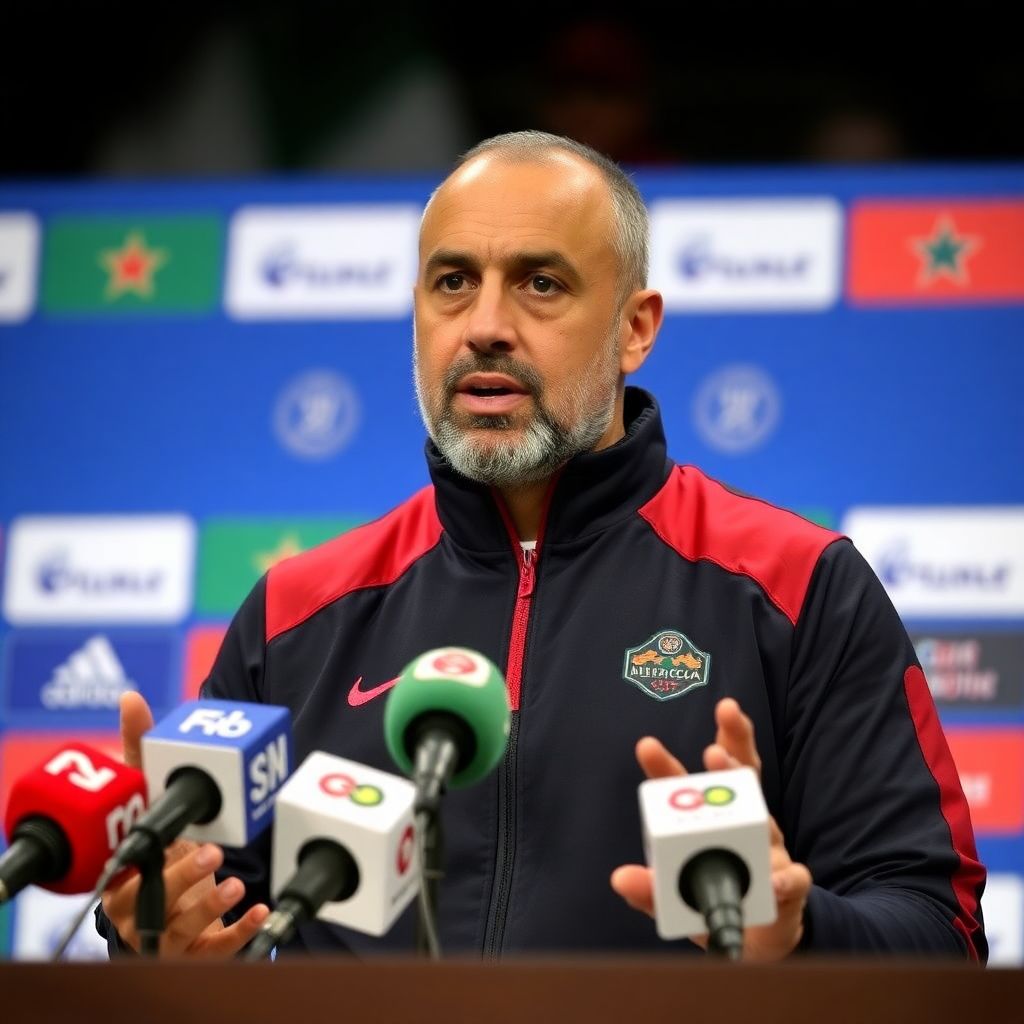
“We’ve done well so far – but the real bonus is winning the World Cup”
Morocco head coach Mohamed Ouahbi insists his team is not in the United States merely to enjoy the ride. On the eve of the 2026 FIFA World Cup quarter-final against France, the experienced coach rejected the idea that his side has already overachieved and should treat the rest of the tournament as a “bonus.”
Speaking at a press conference at Boston Stadium ahead of the clash, Ouahbi was clear: for Morocco, the bar is set much higher.
“We’re not going to listen to people telling us, ‘You’ve already done brilliantly, whatever happens now is great,'” he said. “France are the favorites, that’s obvious. But we will do absolutely everything we can to win and reach the semi-finals. I don’t like this feeling that ‘we’ve done a good job just by getting this far, and everything after that is a bonus.’ No. The real bonus is winning the World Cup. That’s the target. We’ve come this far with that mindset, and we want to go even further.”
Ambition shaped by history
Morocco’s aspirations are heavily influenced by their recent successes on the world stage. At Qatar 2022, the team reached the semi-finals, rewriting football history for Africa and the Arab world. According to Ouahbi, that achievement permanently raised expectations around the national team.
“For a team that played a World Cup semi-final recently, the objective can’t simply be to participate or just pass the group stage,” he explained. “Morocco have entered a new dimension. Our people expect us to compete with anyone. Respecting an opponent doesn’t mean fearing them.”
He stressed that past achievements are not a shield but a responsibility: “What happened in 2022 created a standard. Now we must prove that it was not a one-off. We’re here to confirm that Morocco belongs in the final stages of major tournaments.”
France favorites – but Morocco refuses to be a bystander
Ouahbi did not deny the strength of their quarter-final opponents and openly acknowledged France’s status in world football.
“France are a world powerhouse,” he said. “They have depth, experience, and players used to the biggest stages. On paper, they are favorites – that’s normal.”
However, he insisted that the underdog role does not mean surrender: “Being the outsider doesn’t stop you from being dangerous. It doesn’t prevent you from believing. We’re preparing to play to our own strengths, not just to limit theirs. Our goal is not to admire France; it’s to beat them.”
Playing without regrets: the key to victory
When asked what would be decisive in such a high-pressure match, Ouahbi focused less on tactics and more on mentality.
“The key to winning is to play the game with no regrets,” he stated. “When the final whistle blows, I want every player to be able to say, ‘I gave everything.’ That means total commitment in every duel, every run, every decision.”
He added that Morocco must avoid the trap of self-satisfaction: “We cannot allow ourselves to think, ‘What we’ve done so far is already good enough.’ The day you start thinking like that, you’re already losing. We have to push our limits, mentally and physically.”
“We must play at 2000 percent”
Ouahbi used a powerful expression to underline the level of intensity he demands from his squad.
“Tomorrow we must play at 2000 percent,” he said. “Not 100, not 150. This stage of the tournament doesn’t forgive half-measures. We have to go beyond what we think our limits are.”
He warned against any complacency: “If we start believing that what we’ve done is ‘not bad,’ we’ll stop progressing. This team has grown a lot, just like France, but growth only continues if you’re never satisfied.”
Morocco a team still evolving
The coach highlighted that, much like their opponents, Morocco is not a finished product but a side still on an upward trajectory.
“France are developing, but so are we,” he pointed out. “We are building a team capable not only of having one great tournament, but of being consistently competitive at the top level.”
He emphasized that improvement is a constant process: “There are still things we need to polish – our decision-making in the final third, how we manage transitions, how we stay calm in difficult moments. Every match gives us new lessons, and facing a team like France accelerates that learning.”
Tactical approach and mindset
Without revealing specific plans, Ouahbi hinted at the balance Morocco will try to strike between defensive solidity and attacking ambition.
“We know we must be extremely organized without the ball,” he explained. “France punishes the slightest mistake. But we will not stand in our own box for 90 minutes. To win, you have to create chances, not just defend.”
He stressed that Morocco’s identity must remain intact: “Our strength comes from our collective discipline and our courage going forward. We’ll respect our principles – compact defense, quick transitions, and the confidence to use the ball when we have it.”
Squad news: Saibari likely to miss out
One of the main concerns for the Moroccan camp has been the condition of midfielder Ismael Saibari, who is dealing with an injury. Ouahbi provided an update on his status.
“Except for Saibari, all of our players are ready,” the coach confirmed. “For him, this match comes a bit too early. We don’t want to take a risk that could cost him the rest of the tournament.”
At the same time, he expressed hope of seeing the player back later in the competition: “We’ll do everything we can so that he doesn’t miss the remainder of the World Cup. He’s important to us, but the group must be prepared to respond even without him.”
Psychological pressure and expectations
The Moroccan coach also addressed the growing expectations surrounding his team, both at home and internationally.
“When your country gets used to seeing its team in the last rounds of big tournaments, the pressure naturally increases,” Ouahbi admitted. “But that’s a positive pressure. It means that the players are no longer seen as outsiders who are just happy to be here.”
He pointed out that dealing with such pressure is part of becoming a truly elite team: “If you want to belong to the world’s best, you must accept that every match is a test and every slip is criticized. This is the price of ambition.”
Message to the players: courage over comfort
Ouahbi revealed the essence of the message he has been repeating to his squad in the build-up to the France match.
“I tell them: don’t seek comfort, seek courage,” he said. “Comfort is thinking, ‘We’ve already done something great.’ Courage is to say, ‘We can do more, we must do more.’ A World Cup quarter-final is not a reward, it’s an opportunity.”
He added that the players are fully aligned with this mindset: “They are aware of the moment they’re living. They know matches like this can define careers and inspire generations.”
Legacy beyond one match
While the immediate focus is on beating France at 23:00 (local Turkish time) in Boston, Ouahbi also spoke about the broader legacy of Morocco’s journey.
“Of course, the result is crucial,” he said. “But there is something even bigger: the impact on Moroccan football, on our young players, on the kids who are watching us and dreaming of wearing this jersey one day.”
According to him, playing without fear against giants of world football is part of shaping that legacy: “If we show that Morocco can stand up to anyone, we change mentalities – not just in our country but across the region. That is why we cannot be satisfied with just participating. We must aim for the very top.”
“The bonus is lifting the trophy”
In the end, everything about Ouahbi’s discourse returned to the same central idea: rejecting the narrative of “mission accomplished” before the job is truly done.
“We have indeed done a good job so far, but our story is not finished,” he concluded. “For us, the real bonus is not simply reaching the quarter-finals or even the semi-finals. The bonus is winning the World Cup. That’s the dream we’re chasing, and as long as we’re in this tournament, we’ll keep believing it’s possible.”