
Hidden U18 gems in Turkey are promising players in local academies and lower squads who show repeatable pro-level traits but are not yet widely hyped. To identify the next generation Turkish football stars under 18, blend live and video scouting with context-aware data, focusing on development trajectory rather than current fame.
Scouting essentials: what matters for U18 prospects in Turkey
- Prioritise decision-making, technique under pressure, and adaptability over viral highlights or youth goal counts.
- Judge physical tools by growth potential and injury history, not just today’s size or speed.
- Read club context: coaching quality, minutes path, and competition level in Turkish youth and reserve leagues.
- Cross-check live impressions with basic data to avoid bias toward spectacular but low-impact profiles.
- Track behavioural patterns: training habits, emotional control, and response to setbacks.
- Balance upside with risk by mapping two- to three-year development scenarios before committing fees or minutes.
Debunking myths about U18 prospects in Turkey
Conversation around the best young football talents in Turkey is still dominated by myths that make scouting less accurate and more risky. Many decision-makers equate early physical dominance or social media hype with long‑term ceiling, even though both are weak predictors of who will still matter at 23-24.
The first myth is that Super Lig minutes automatically equal elite potential. In reality, some top wonderkids playing in Turkish Super Lig get minutes mainly due to foreign player limits or club financial pressure, while stronger but less “ready” profiles stay hidden in U19 or regional setups. Early exposure is useful, but only if the player’s underlying habits and decision-making are scalable.
The second myth is that elite U18s must already be stars in big‑three academies. Turkey U18 football prospects 2025 will come from a wide base: Anatolian clubs, second-tier teams and even school-affiliated programmes. Turkish football youth academies scouting reports consistently show that late developers and position-switch players often emerge outside classic powerhouses.
The third myth: you can safely judge ceiling from highlights and simple stats. Youth football is full of game-state noise: physical mismatches, uneven pitches and tactical chaos. Without situational tagging (pressure level, number of touches, pitch zones), raw numbers such as goals or dribbles can mislead scouts into overrating “chaos merchants” who will struggle in structured senior systems.
The practical definition of a hidden gem U18 in Turkey is therefore: a player whose technical, tactical and psychological patterns project to a clear senior role, but whose market value is still suppressed by context (club, league, role, or lack of marketing). Your job as a scout is to separate contextual noise from transferable skills.
Profiles: five under-18 players currently turning heads
Instead of naming specific teenagers whose situations can change quickly, it is more useful to describe five recurring archetypes of hidden gems found in Turkey’s U18 landscape and how they typically look in practice.
- Press-resistant deep midfielder – Often undersized for now, but consistently receives under pressure, uses one- and two-touch play, opens body shape smartly, and breaks lines with passes rather than long carries. Risk: can be misjudged as “too passive” if staff focus only on tackles and distance covered.
- Inverted winger turned playmaker – Starts as a wide dribbler in U16-U17, later moves into half-spaces and central zones. Shows early timing on through balls, disguised passes and cut-backs. Risk: if the club keeps them stuck as a pure touchline winger, development of scanning and tempo control stalls.
- Late-maturing centre-back with elite reading of play – Lacks strength compared with peers but dominates in interceptions, cover runs, and body positioning. Very calm facing direct balls and crosses. Risk: may be written off because of aerial duels lost against early physical developers instead of being projected two years ahead.
- Box-crashing “third man” midfielder – Not flashy on the ball, but repeatedly arrives in the box at the right time, fills gaps in rest-defence, and tracks dangerous runners. Risk: highlight-driven observers underrate him because he rarely attempts risky dribbles or Hollywood passes.
- All-phase full-back – Comfortable both overlapping and underlapping, with good recovery pace and decent crossing. Shows discipline in holding the line and defending the far post. Risk: over-used as a pure runner in youth sides, masking his emerging playmaking and build-up contribution.
When you evaluate the next generation Turkish football stars under 18, try to tag prospects to archetypes like these. It makes comparisons, role projections, and risk assessment more structured than simply labelling players as “talented” or “not ready”.
Technical traits that reliably predict senior success
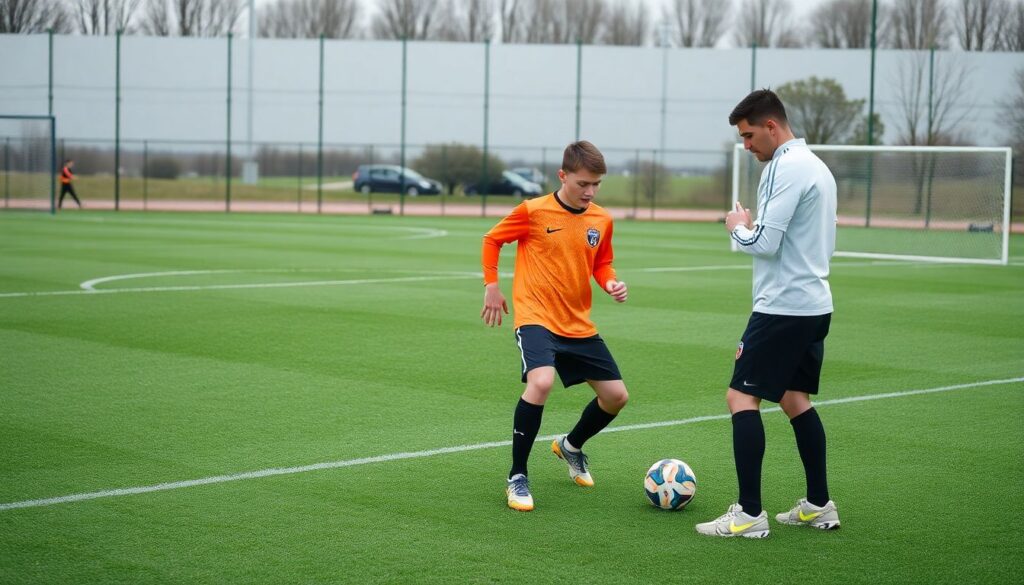
Technical quality at U18 is not about viral skills; it is about repeatable, efficient actions that hold up against faster, stronger and smarter opponents. Focus on whether a player’s core tools fit a clear senior role within your club’s game model.
-
First touch direction and body orientation
Watch how often a prospect’s first touch plays them into pressure versus away from it. Press-resistant players open their hips, receive on the back foot, and pre-scan. This is easier to implement and train further because it is mostly about habits and awareness rather than raw talent. -
Passing variety under different pressures
Note whether they can execute driven passes, clips, wall passes and feints with either foot when pressed. The risk is backing players who only look clean in unopposed or low-intensity contexts. For easier integration, prioritise those who can already hit basic patterns you use in the first team. -
Ball-striking consistency in finishing and long passes
Good hidden gems show repeatable technique: similar run-up, body over the ball, clean contact. Over time, this consistency beats raw power. It is more convenient to refine a stable technique than to correct chaotic mechanics at 20. -
Receiving and playing in tight spaces
Middle-third players destined for the top levels in Turkey must handle tight pockets. Track the number of successful one- and two-touch actions in congested zones versus turnovers. Players comfortable in chaos usually transition faster to Super Lig tempo. -
Defensive footwork and tackling posture
Rather than counting tackles, watch foot position, ability to delay opponents, and capacity to tackle without going to ground unnecessarily. This lowers card and injury risk later and is relatively straightforward to reinforce via targeted drills. -
Weak-foot usage
U18 players who already receive, pass and clear with their weaker foot are much easier to plug into flexible possession systems. The risk with one-footed stars is that they become predictable at senior level, requiring system tweaks to protect them.
Physical and psychological benchmarks scouts should track
Because reliable public data is limited, many clubs rely on crude physical impressions when judging the best young football talents in Turkey. A structured benchmark approach lowers risk and makes comparisons between players and age groups more meaningful.
Core physical indicators and why they matter
- Movement quality, not just speed – Track acceleration patterns, change of direction, and running mechanics. Poor biomechanics increase injury risk and make it harder to sustain high-intensity roles.
- Repeat sprint ability – For wingers and full-backs especially, note how performance drops across multiple sprints. This indicates whether a profile can handle senior transitions and pressing demands.
- Base strength and robustness – Look at ability to hold duels, absorb contact and remain available across a full youth season. Consistent availability at 16-18 is a strong sign of sustainable training loads.
- Growth and maturation status – Late developers may look behind physically but can overtake peers by 20. Ignoring biological age leads to over-investing in early-maturing players who plateau.
Key psychological markers and practical limits
- Training habits and self-management – Punctuality, intensity, recovery routines and nutrition awareness. These factors are relatively easy to evaluate via staff feedback and are strong predictors of how quickly a prospect can handle pro demands.
- Resilience after mistakes – Hidden gems often stand out in how they react to errors: quick reset, asking for the ball again, refusing to hide. This is crucial for positions exposed to risk, like centre-backs and playmakers.
- Coachability and tactical learning speed – Track how quickly a player implements new roles or corrections. High learning speed reduces integration cost when changing leagues or systems.
- Competitive temperament – Look for controlled aggression and leadership signals: communication, organising, demanding standards. The risk is overvaluing “fire” that spills into needless cards or conflicts.
Psychology is context-dependent and difficult to measure perfectly. Use multiple inputs (coaches, team-mates, game footage) rather than single anecdotes, and avoid treating one visible meltdown or one heroic performance as a fixed personality label.
How club environment and coaching accelerate talent
Two similarly talented U18s can end up with very different careers depending on club environment. For hidden gems, the right pathway and coaching systems often matter more than a marginal difference in talent level.
-
Assuming “big club” always means better development
Large academies offer better facilities but can limit minutes. For some turkey U18 football prospects 2025, a stable role at a smaller club with a clear pathway to the first team is safer and easier to manage than competing with imported prospects in a top-three giant. -
Confusing exposure with proper role usage
Playing an attacking midfielder as a defensive wide runner just to fit a system can slow or distort his development. Assume that misused minutes carry risk: the player builds habits that are hard to reverse later. -
Overloading fixtures and underloading individual work
Chasing youth trophies can lead to too many games, too little individual coaching. Hidden gems need tailored work on position-specific details (e.g., full-backs on underlaps, centre-backs on body orientation) rather than endless generic sessions. -
Inconsistent communication with the player and family
When pathway expectations are vague, young players jump at any offer abroad, sometimes into unstable environments. Clear plans reduce this risk and make it easier for both sides to commit to a two- or three-year roadmap. -
Scouting only at high-profile tournaments
If your view of top wonderkids playing in Turkish Super Lig is shaped only by televised youth events, you miss late bloomers and players from lower divisions. A broader network of local and regional contacts is harder to build but carries less long-term risk of groupthink.
Before signing, map how your environment compares with alternatives in coaching quality, minutes, positional competition and staff stability. This is the only realistic way to weigh convenience of integration against medium-term development risk.
Career pathways: from youth squads to pro contracts and moves
Pathways for hidden gems are rarely linear. A player might move from a regional academy to a mid-table Super Lig club’s U19, then to a loan in the 1. Lig, and only later break into a bigger side. Comparing possible routes helps clubs and families balance safety, minutes and upside.
Below is a simplified step-by-step pathway template you can adapt when planning for promising teenagers identified in Turkish football youth academies scouting reports:
- Identify role and archetype – Define the player’s primary position, secondary position, and closest archetype (e.g., press-resistant 6, all-phase full-back).
- Check three-year internal pathway – U18, U19, reserves, first team. Estimate realistic minutes in each stage and what needs to happen for promotion.
- Score external options by risk and fit – Compare offers by league style, coaching stability, track record of integrating youth and language/cultural load.
- Plan targeted loans only if necessary – Use loans to fill specific gaps (physicality, tactical discipline), not as a parking lot for prospects you do not fully trust.
- Review and adjust every six months – Reassess role, minutes, and training focus based on objective progress rather than reputation or pre-season expectations.
When deciding how aggressively to push the best young football talents in Turkey, weigh convenience (existing network, language, travel) against the long-term risk of stagnation. Sometimes a slightly less glamorous but more stable pathway offers a better chance of turning a hidden gem into a reliable senior professional.
Clarifying recurring scout questions
How early can we reliably judge an U18 player in Turkey as a future starter?
You can flag high-potential profiles around 16-18, but certainty is impossible. Treat each judgment as a probability range, updated every season with new information on minutes, health, adaptability and learning speed.
Is it safer to recruit from big-club academies than smaller regional teams?

Big academies lower some risks (training quality, basic standards) but introduce others (competition, fewer minutes, higher costs). For some profiles, smaller clubs with clear pathways and stable coaching are easier environments for turning potential into reliable output.
How much weight should we give to youth statistics?
Use youth stats as context, not as final truth. They are helpful for spotting trends and red flags, but should always be paired with video and live observation that accounts for role, game state and opponent quality.
Should we prioritise physical monsters or technical late developers?
The answer depends on your game model and time horizon. For immediate depth, strong athletes with basic technique are convenient. For higher ceiling over three to five years, technically sharp late developers with good learning capacity usually offer more upside.
How many positions should an U18 prospect be able to play?
One clear primary position plus one or two realistic secondary roles is usually ideal. Forcing teenagers into excessive versatility may slow mastery, but rigidity can limit options for integration and loans.
When is a European move right for next generation Turkish football stars under 18?
It makes sense only when the destination offers better coaching, clear playing time, and strong support off the pitch. A rushed move to a bigger badge but weaker pathway often increases dropout risk.
How do we compare hidden gems in Turkey with foreign prospects?
Create a unified benchmark: same role definitions, physical and technical thresholds, and psychological criteria. Then adjust only for league style and adaptation costs such as language, culture and travel.