
The road from TFF 1. Lig to the spotlight of the Süper Lig and beyond looks chaotic from the outside, but once you zoom in, it’s surprisingly structured. Hidden behind “lucky breaks” are patterns: smart loan moves, data‑driven scouting, and players who learn faster than the league can kick them down. Let’s walk through how an ordinary second‑tier player in Turkey can turn into one of those turkish football players in top european leagues everyone suddenly pretends to have followed since day one.
—
From bus rides to packed arenas: how TFF 1. Lig shapes mentality
TFF 1. Lig is unforgiving: long away trips, heavy pitches, opponents who treat every duel as a 50–50 between the ball and your ankle. This is not “development league” football; it’s survival training. Players coming through here learn to handle pressure long before TV cameras find them. When someone finally gets promoted to the Süper Lig, they usually arrive with 80–120 senior matches, not just academy hype, and that’s a huge psychological edge. They’ve missed penalties in front of hostile stands, learned how to manage games in the 85th minute, and dealt with coaches getting fired mid‑season.
“`text
Technical block: typical TFF 1. Lig experience profile
– Age at first full season: 19–21 years
– Matches per season: 25–32 (league + cup)
– Duels per 90: 12–18 for midfielders; 9–14 for forwards
– Expected goals (xG) vs. actual goals gap often ±15–20%, reflecting chaotic game environments
– Result: acceleration of mental adaptation and decision-making under stress
“`
—
Real promotion arcs: from anonymous to indispensable
Enes Ünal: the “too early, too foreign” loop and course correction
Enes Ünal is a perfect case of how messy, but powerful, the path can be. Debuting for Bursaspor at 16, he went abroad fast, yet his real rebuilding years looked more like a tour of football’s grey zones: KRC Genk, NAC Breda, FC Twente. The turning point came with consistent minutes and a clear role; essentially a TFF 1. Lig style education in foreign sleeves. His underlying metrics at Twente – over 0.6 non‑penalty goals per 90 and strong xG numbers – were the signal behind the noise of multiple loans. When Getafe gave him stability, he evolved into one of the more reliable turkish football players in top european leagues, not because he dodged setbacks, but because he treated every “demotion” as a new lab for testing his game.
“`text
Technical block: the “loan carousel” pattern
Key factors that predict success after chaotic early years:
– Stable minutes: >1,500 minutes in at least one season before age 23
– Role consistency: playing 70%+ of games in the same tactical role
– Offensive contribution: >0.35 xG+xA per 90 for attackers over 2 seasons
– Psychological indicators: minimal drop in output after moving to a more physical league
“`
—
Kenan Karaman, Ozan Tufan and the “second career” after early hype

Kenan Karaman didn’t jump directly from TFF 1. Lig to a Champions League night, but his story shows how adaptation beats reputation. After spells in Germany, he came back into the Turkish ecosystem with a more complete understanding of pressing triggers and transitional play. Players like Kenan and Ozan Tufan illustrate how “coming back down” – whether to a mid‑table Süper Lig side or even flirting with TFF 1. Lig interest – can be the reset point that turns messy potential into consistent performance data. Clubs that dominate the best turkish super lig players transfer market know how to read those second acts: instead of asking “why did he fail once?”, they ask “what did he learn from failing?”
—
From invisible to indispensable: tff 1 lig to super lig promotion success stories
If you talk privately with Süper Lig scouts, many will admit their favourite signings didn’t come from flashy academies, but from players who had already survived the TFF 1. Lig grind. The step up is not just about quality; it’s about proving your game scales. A winger who beats tired full‑backs in the second tier may struggle when space shrinks; a centre‑back who clears everything aerially might be exposed if his line defends 20 metres higher. The true tff 1 lig to super lig promotion success stories are those where the player upgrades decision‑making speed, not just physical stats. The promotion season is often the live experiment: can their strengths still work when the team faces better‑organized defences and more complex pressing schemes?
“`text
Technical block: key transition metrics (TFF 1. Lig → Süper Lig)
– Forwards: maintain at least 60–70% of xG/90 after promotion
– Midfielders: progressive passes per 90 often dip by 10–15%, but accuracy should stay above 80%
– Defenders: successful defensive actions per 90 drop slightly, but errors leading to shots must stay below 0.05 per 90
– Interpreting data: small statistical drops are normal; the critical sign is stability under higher tactical complexity
“`
—
Scouting differently: how to spot the next late bloomer
Why “pretty highlights” are your worst advisor
YouTube compilations love dribblers, but promotion success is rarely about the gif‑worthy moment. When creating a turkish football rising stars scouting report for a second‑tier player, the smart move is to zoom out: how often does he make the right “boring” choice? Does he know when not to dribble, when to foul tactically, when to recycle possession? Many breakthrough stories started with scouts paying more attention to off‑ball behaviour than to showreels. A winger who tracks back 30 metres, then sprints forward again, tells you more about his ceiling than a single wondergoal. In TFF 1. Lig, chaos sometimes hides discipline; the trick is to separate players who generate chaos from those who control it.
“`text
Technical block: non‑glamorous indicators with high predictive value
– Reactions after losing the ball: recovery sprint within 1–2 seconds
– Compactness: distance to nearest teammate in defensive phase (ideal 8–15 m)
– Positional scanning: number of head turns before receiving; elite players hit >6 per 10 seconds in central zones
– Tactical fouls: 0.3–0.6 per 90 in midfield often correlate with good game-reading
“`
—
Non‑standard solution: “stress simulations” instead of friendly matches
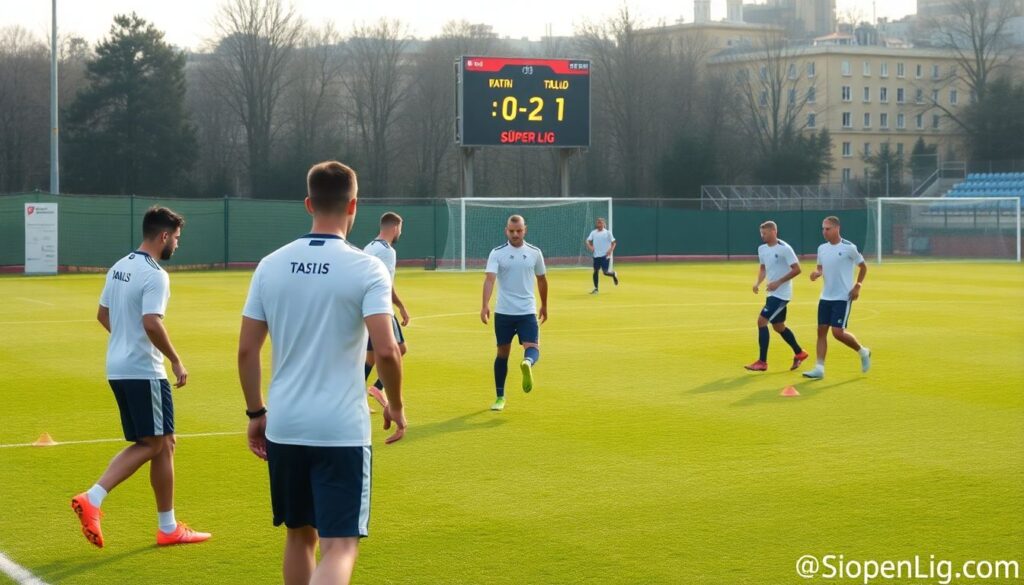
One unconventional idea used by some progressive Turkish analysts is to simulate high‑pressure Süper Lig scenarios inside training games for TFF 1. Lig prospects. Instead of standard friendlies, they script absurd constraints: being one man down from minute 30, starting 0–2 behind, or forcing the team to play with an inverted full‑back just to see who adapts quickest. These micro‑experiments reveal which players can recalibrate their positioning and decision‑making in real time. If a young holding midfielder keeps team structure intact under those artificial crises, his promotion probability is often higher than that of a technically flashier peer who collapses as soon as the script changes.
—
How Super Lig transfers 2024 Turkish players reshape career paths
Looking at super lig transfers 2024 turkish players, a clear pattern emerges: more clubs are buying from TFF 1. Lig not as a budget compromise, but as a deliberate strategy. Instead of overpaying for one flashy foreign name, sporting directors are investing in 3–4 physically ready, locally adapted players with high minutes and resilient injury records. Data shows that these signings often offer better cost‑per‑minute and quicker tactical integration. For example, a 23‑year‑old full‑back with 70 TFF 1. Lig games is usually cheaper and more reliable than an untested import who needs half a season just to adjust to the tempo and travel routine. The market is slowly rewarding those who read underlying indicators rather than sticker prices.
“`text
Technical block: cost–performance snapshot (TFF 1. Lig imports)
– Average transfer fee: 300k–800k € for established starters
– First‑season minutes: often 1,800–2,400 minutes if fitness history is clean
– Salary: 30–50% lower than similar‑profile foreign signings
– Resale potential: 2–4x initial outlay if player adapts and reaches mid‑table Süper Lig starter level
“`
—
Building an environment where promotion isn’t a coincidence
From “miracle season” to repeatable model
Clubs that regularly turn unknowns into stars treat promotion stories as processes, not miracles. They coordinate the academy, the TFF 1. Lig loans, and the first‑team squad planning. One non‑standard but effective approach is to design “role corridors” throughout the club: if the Süper Lig team plays with an aggressive left‑back who inverts into midfield, the U19s and loaned players in TFF 1. Lig learn the same triggers and movements. That way, when a full‑back comes back from a loan, he doesn’t just return fitter; he returns tactically compatible. This alignment shrinks the adaptation gap and makes it easier for coaches to trust promoted players with real minutes, instead of leaving them stuck on the bench as decoration.
—
Psychological infrastructure: invisible, but decisive
Another underrated component is mental support. A TFF 1. Lig player moving up to a big Süper Lig club faces a double shock: tactical demands jump, and public scrutiny explodes. Clubs serious about turning promotion into long‑term success now integrate sports psychologists and performance coaches into the process. Pre‑promotion, they work on routines: breathing techniques before penalties, focus reset rituals after mistakes, strategies to handle social media pressure. This isn’t soft science; it directly affects output. Players who can “reset” within 30 seconds after an error maintain higher involvement stats and are less likely to hide from the ball, which is one of the hidden parameters behind sustainable breakout years.
“`text
Technical block: mental resilience indicators
– Ball touches within 5 minutes after a major mistake (e.g., error leading to goal)
– Heart-rate recovery: returning near baseline within 60–90 seconds after high-intensity actions
– Self-report scales on confidence and anxiety tracked across a season
– Correlation: players with stable psychological scores show lower performance variance in big matches
“`
—
What this means for the next generation
The glamour of top leagues can make young players obsess over instant moves abroad, but the career arcs we’ve looked at suggest a different blueprint. Instead of treating TFF 1. Lig as something to escape as fast as possible, it can be used as a controlled stress lab: learn how to play three positions, how to suffer through a promotion race, how to adjust to a different coach in mid‑season. For clubs, the real edge is to treat this league as a development asset, not a dumping ground.
If Turkish football fully commits to integrating its second tier into long‑term planning – aligning tactics, investing in data and psychology, and embracing those “ugly” matches as laboratories – we’ll see more players making the jump not just to the Süper Lig, but eventually joining the pool of turkish football players in top european leagues. The next wave of stars will not be the ones who skipped the grind, but those who learned to turn TFF 1. Lig chaos into a competitive advantage.