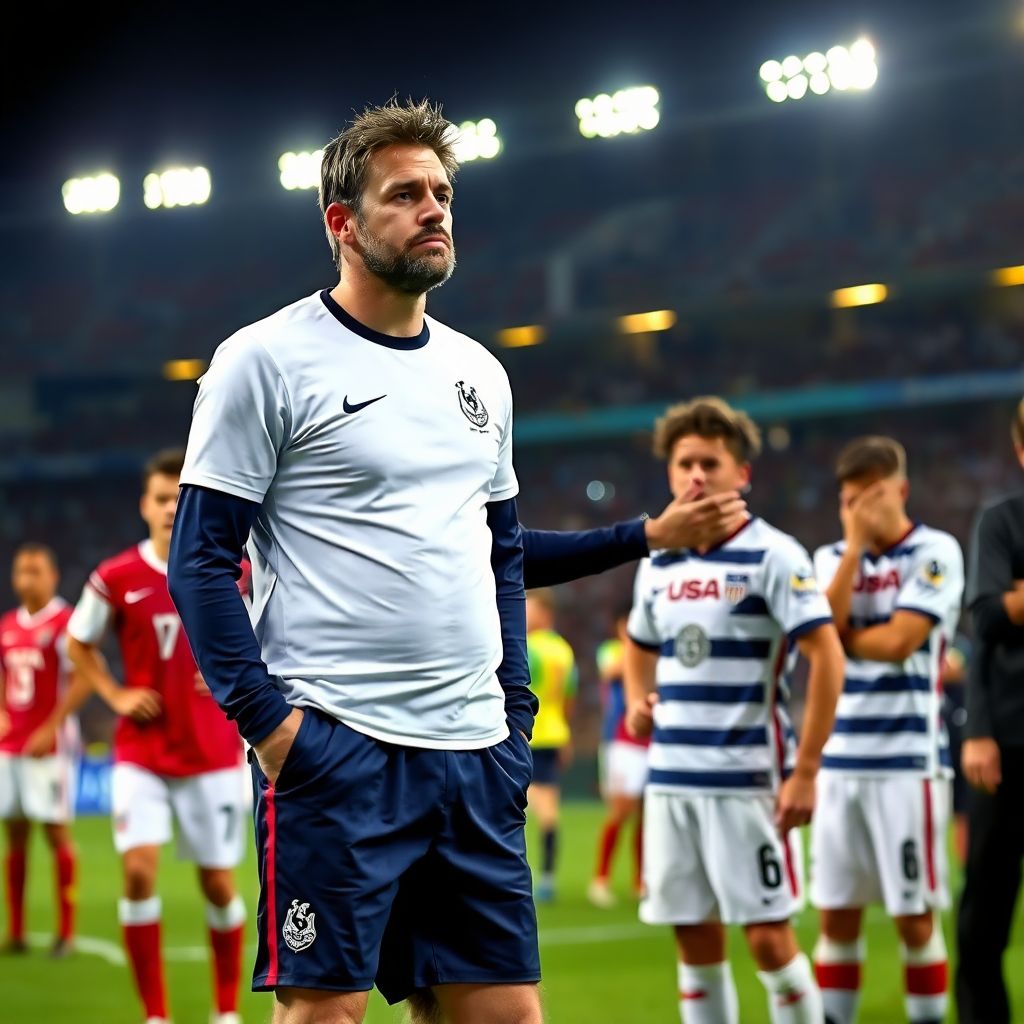
Pochettino after USA’s World Cup exit: “It just wasn’t our day”
The United States saw their 2026 World Cup journey come to an abrupt end in the round of 16, suffering a heavy 4-1 defeat to Belgium. After the final whistle, head coach Mauricio Pochettino gave a candid assessment of his team’s performance, openly admitting that his side fell well short of their usual standards on the biggest stage.
Speaking about the match, Pochettino did not look for excuses and started by congratulating the victors:
“From the very beginning it was really difficult. Belgium were superior and deserved the win; they were better than us. It simply wasn’t our day,” he said.
The Argentine coach stressed that the loss cannot be brushed aside as a one-off bad performance. Instead, he underlined the need for deep introspection within the squad and staff:
“We have to learn from this, analyze the game in detail and understand why we didn’t play the way we did in the rest of the World Cup. That’s the key question for us now.”
A promising World Cup ends in disappointment
The United States had built momentum in the group stage, impressing with their intensity, aggressive pressing and collective discipline. Expectations were growing that this generation could push deeper into the knockout rounds. Against Belgium, however, many of those strengths seemed to disappear.
Belgium’s experience and composure under pressure quickly tilted the balance. Their ability to control the tempo and exploit space between the American lines exposed weaknesses that had previously been masked by strong team organization. Despite moments of resistance and a consolation goal, the US never truly looked like overturning the Belgian advantage once they fell behind.
Tactical battle that never clicked for the USA
Pochettino’s sides are usually praised for their structure and clear identity, but this time his game plan didn’t translate onto the pitch. Belgium repeatedly found gaps in midfield, drawing the American press and then playing through it with quick combinations and diagonal passes.
The US front line struggled to apply cohesive pressure, which allowed Belgian defenders to build calmly from the back. In transition, the US were often a step late, and their defensive block oscillated between pressing high and dropping deep without the necessary coordination. This lack of clarity left spaces that Belgium punished clinically.
Pochettino’s substitutions aimed to inject energy and adjust the shape, but by the time the changes arrived, the rhythm of the game was firmly in Belgium’s hands. The tactical corrections only partially stabilized the team and were not enough to mount a serious comeback.
Mental and physical factors on the day
Beyond tactics, Pochettino hinted that psychological and physical elements also played a role. The pressure of a knockout match on home soil in 2026 – with high expectations and media scrutiny – may have weighed on the younger players in particular.
The US looked a fraction slower to second balls, and their usual intensity dropped after conceding. Unforced errors in simple passes, hesitation in duels and a lack of sharp decision-making in the final third suggested that nerves and fatigue combined at the worst possible moment. Pochettino’s remark that “it wasn’t our day” is partly a reflection of these fine margins that decide tournament football.
Learning from defeat: what Pochettino wants next
Despite the heavy scoreline, Pochettino’s tone was not one of resignation but of responsibility and rebuilding. He emphasized that the team must treat this match as a case study, not a tragedy.
According to his comments, the next steps include a detailed video and data review of the game, individual and collective feedback sessions, and an honest internal discussion about what went wrong. For Pochettino, the core objective is to ensure that such a drop in performance level does not recur in future high-pressure fixtures.
He also pointed out that the overall World Cup campaign provided positive signs that cannot be overshadowed by one bad night. Maintaining that perspective, while still being ruthless in self-critique, will be crucial for the group’s growth.
A turning point for the US men’s national team
This defeat may come to be seen as a defining moment for the US project. Reaching the round of 16 shows progress, but a 4-1 loss against a top-tier European side underlines the gap that still exists at the very highest level.
The match exposed several areas in need of improvement:
– Depth in key positions: When the intensity drops, the team struggles to find like-for-like replacements who can maintain the tactical demands.
– In-game management: Adapting quickly to an opponent who has figured out the initial plan remains a challenge.
– Match control under pressure: Once the game turns against them, the US still finds it difficult to slow things down, regain composure and dictate the tempo.
Pochettino’s experience in European club football could be vital in closing that gap, as he has faced similar scenarios in continental competitions and domestic title races.
Players under the spotlight
Several members of the US squad will inevitably face scrutiny after such a defeat. Defensive lapses, missed chances and positioning errors will all be dissected. Pochettino, however, is known for publicly protecting his players, preferring to address individual mistakes privately.
Inside the camp, this match is likely to serve as a reference point for mental resilience. Young talents, who may have shone in the group phase, now have to respond to adversity and criticism. Their ability to bounce back from this experience will shape the next cycle for the national team.
Veteran players, meanwhile, will be expected to provide leadership in the aftermath – guiding younger teammates, maintaining unity and setting standards for how to respond to a setback of this magnitude.
Belgium’s quality highlights the standard to reach
While focusing on US shortcomings, Pochettino did not overlook the level of the opposition. Belgium’s attacking fluency, game intelligence and ability to execute under pressure illustrated the standard that teams must reach to contend for a World Cup title.
The Belgians’ control of key moments – early phases of each half, transitions after turnovers, and clinical finishing – showed why knockout football is unforgiving. They punished nearly every American error and rarely allowed the hosts to build sustained pressure.
For the US coaching staff, this match provides a clear benchmark: it is not enough to perform well against teams of similar standing; the next step is to consistently compete with and defeat opponents of Belgium’s caliber.
What this means for the next cycle
Looking ahead, Pochettino’s comments suggest that continuity and evolution, rather than drastic overreaction, will guide the next phase. The core of the squad is young enough to feature in future major tournaments, and the experience of a harsh elimination can become a catalyst for growth.
The focus is likely to be on:
– Refining the team’s tactical identity so it holds up under knockout pressure.
– Strengthening competition for places to raise internal standards.
– Developing leaders on the pitch who can manage difficult stretches of games without relying on the touchline for constant instruction.
Pochettino’s philosophy centers on collective responsibility and long-term development. His insistence on understanding “why we didn’t play as we had in the rest of the World Cup” is not just about this match, but about building a culture where performance levels remain stable when it matters most.
Beyond the scoreline: a lesson in margins
A 4-1 result suggests a one-sided contest, yet in tournament football, matches often hinge on a few key incidents: an early chance missed, a lapse in concentration, a moment of brilliance from the opponent. Pochettino’s reflection that it “wasn’t our day” captures the sense that several of those key moments went against the US.
Still, the coach made it clear that blaming luck alone is not an option. The task now is to reduce the role of chance by improving structure, mentality and readiness for different match scenarios. Only then can the US expect to consistently go beyond the round of 16 and challenge the world’s best.
In the end, Pochettino’s message was one of sober realism. Belgium earned their place in the quarterfinals; the United States must accept the result, extract every possible lesson and return stronger. This World Cup exit may hurt, but for a team still maturing on the global stage, it could become the foundation for future success – provided they respond with the same honesty and self-criticism their coach showed after the final whistle.