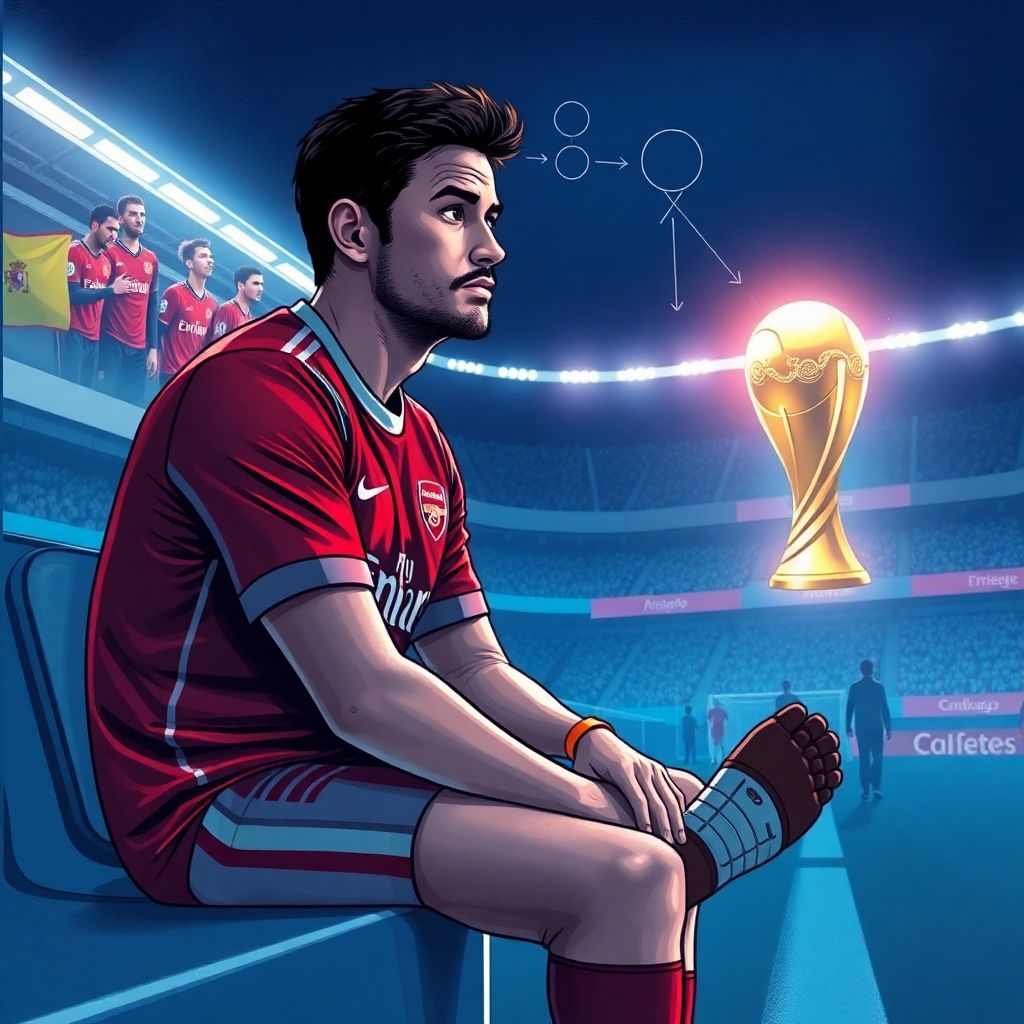
Merino’s World Cup dream in serious jeopardy after surgery blow
Arsenal and Spain midfielder Mikel Merino faces a race against time to save his World Cup ambitions after being diagnosed with a serious right foot injury that requires surgery. Medical examinations have confirmed a fracture in his right foot, and the player is set to go under the knife in the coming days, with a lengthy rehabilitation process already mapped out.
The setback could not have come at a worse moment. Merino suffered the injury on 25 January in Arsenal’s clash with Manchester United, leaving the pitch in obvious discomfort. Subsequent scans and specialist consultations confirmed the worst-case scenario: an operation is unavoidable, and his return date remains uncertain.
Although the joint objective of Merino and the club’s medical staff is to bring him back into full training before the end of the season, the timeline is extremely tight. Even in the most optimistic scenario, he is expected to miss the decisive stretch of the campaign – the period in which Arsenal are fighting on multiple fronts and need maximum depth in midfield.
From Arsenal’s perspective, the loss is substantial. Merino has been increasingly influential in the heart of the team, offering control in possession, defensive balance, and an ability to break lines with late runs from deep. His versatility had made him one of the trusted options in rotation, especially in matches with high physical and tactical demands.
The first direct consequence on the international stage is already clear: Merino will not be available for Spain’s matches in March. That absence includes the high-profile Finalissima against Argentina, a prestigious encounter that was seen as a key test of Spain’s competitiveness against one of the strongest teams in the world. Spain will now have to approach that challenge without one of their most complete midfielders.
For head coach Luis de la Fuente, the blow is significant. In recent months, Merino had transformed from a useful squad player into a near-automatic selection. His intelligence without the ball, defensive positioning, aerial ability, and constant support between the lines allowed Spain to maintain balance while still committing numbers forward. Losing that profile reduces tactical flexibility at a time when the team is trying to consolidate its identity ahead of major tournaments.
Beyond the short-term implications, the injury immediately raises a more worrying question: what does this mean for Merino’s chances of playing at the 2026 World Cup? On paper, the tournament is still some distance away, but long-term injuries have a way of altering careers. Recovering from surgery, regaining match rhythm, and returning to a peak physical and mental level is rarely straightforward, particularly in a position where competition for places is fierce.
The emotional weight of the situation is heavier given Merino’s recent past. He already missed out on Qatar 2022 and had openly targeted the next World Cup as the greatest goal in his international career. For a player in his prime years, the margin for error is slim: a long spell on the sidelines can mean falling down the pecking order just as others emerge and consolidate their roles.
His immediate priority will be clear: avoid rushing, complete every stage of the rehabilitation correctly, and come back as the player who had become indispensable for both club and country. Any attempt to cut corners could risk setbacks, further injuries, or a permanent drop in performance, something no professional of his calibre can afford in such a delicate phase of his career.
Spain, meanwhile, enters March without a key pillar in midfield and will be forced to adapt. The coaching staff will closely monitor how the team copes without Merino’s presence, aware that any prolonged absence not only disrupts their short-term plans but could also have knock-on effects for squad hierarchy and tactical structures on the road to the World Cup.
What Merino’s absence means for Spain’s midfield
Merino’s profile is not easy to replace. He combines the physical presence of a defensive midfielder with the intelligence and timing of an advanced playmaker. Spain will likely need to reshuffle roles rather than simply slot another player into his position. The coaching staff may turn to more creative midfielders to maintain the team’s passing quality, but that can leave them vulnerable in transitions, an area where Merino’s work rate and positioning are crucial.
Another alternative is to opt for more conservative, defensively oriented midfielders to preserve balance. However, that risks sacrificing some of the verticality and late runs into the box that Merino offers. These tactical adjustments in March could provide an early indication of how Spain might adapt if his absence extends, even partially, into the next stages of World Cup qualification.
The psychological challenge of a long-term injury
Beyond the physical recovery, such an injury carries a serious mental component. A player who was starting to feel established at the top level suddenly has to reset, watching teammates and rivals compete and grow while he is confined to the gym and treatment room. Managing frustration, doubt, and impatience will be essential.
Merino will have to accept a new routine: long hours of physiotherapy, gradual strengthening work, and a slow return to running and ball work. Each stage brings its own psychological tests. The fear of re-injury often appears when players first return to full contact training and competitive matches, especially in situations similar to the one that caused the original problem.
Working closely with sports psychologists, medical staff, and coaches will help him maintain focus on long-term goals rather than short-term setbacks. The clearer his roadmap back to elite competition, the easier it becomes to handle the inevitable ups and downs of rehabilitation.
Competition for places ahead of 2026
Spain traditionally produces an abundance of midfield talent, and this generation is no different. While Merino recovers, younger players or those previously on the fringes will have an opportunity to impress. Each international window that he misses creates space for others to strengthen their case for a permanent spot in the squad.
By the time the 2026 World Cup approaches, the competition could be even more intense. New stars may have emerged, tactical systems may have evolved, and the coach’s preferences could shift. That is why Merino’s objective cannot be simply “return to play”; he must return at a level that forces his inclusion in both Arsenal’s and Spain’s starting plans.
Arsenal’s tactical adjustments without Merino
For Arsenal, the injury forces an immediate rethinking of midfield rotations. Depending on the opponents and competition, Merino’s role may need to be shared among several players rather than handed to a single direct replacement. Some may provide his pressing energy but lack his passing range; others may offer creativity but not the same defensive cover.
This could lead Arsenal to adapt their game model slightly, either by asking their attacking players to contribute more defensively or by introducing a more physical midfielder to compensate for Merino’s absence. The way the team manages this period could influence not only their results this season but also how Merino fits back in upon his return. If the team thrives with a new structure, he will need to adapt quickly to different demands when he is cleared to play again.
The importance of not rushing the comeback
Given the calendar pressure and the emotional weight of a potential World Cup spot, the temptation to accelerate the recovery timeline is strong. However, foot injuries are notoriously sensitive, particularly for players whose game involves frequent changes of direction, pressing, and duels. Returning too early can lead to recurring problems that may haunt the player for years.
The medical team will monitor bone healing, muscle balance, and biomechanical factors before giving the green light. A cautious approach, even if it means missing more matches in the short term, is often the best way to safeguard the player’s long-term career and keep the World Cup dream alive.
What Merino must do to keep his World Cup hopes alive
To remain in the frame for 2026, Merino’s path is clear but demanding. He must:
1. Complete his rehabilitation with discipline, respecting every phase of recovery.
2. Regain full physical fitness, including strength, explosiveness, and endurance.
3. Recover his match sharpness at club level, proving he can once again dominate high-intensity games.
4. Demonstrate consistency over a sustained period so that both Arsenal’s coach and Spain’s staff regain full confidence in his durability.
If he succeeds in these steps, the World Cup remains a realistic goal rather than a fading dream. Coaches value reliability and tactical intelligence, and Merino has already shown both traits during his rise for club and country.
A decisive period for career and legacy
This injury marks a turning point in Mikel Merino’s career. How he responds will likely shape not only his immediate future but also his long-term legacy. A successful recovery followed by a strong return could cement his status as one of Spain’s key midfielders heading into 2026. Conversely, prolonged struggles might relegate him to the background in one of the most competitive national team environments in world football.
For now, Spain and Arsenal must learn to live without him, while the player begins a demanding and often lonely journey back to the top. The hope on all sides is that this forced pause will not become the defining chapter of his story, but rather a difficult obstacle overcome on the way to finally stepping onto a World Cup stage.