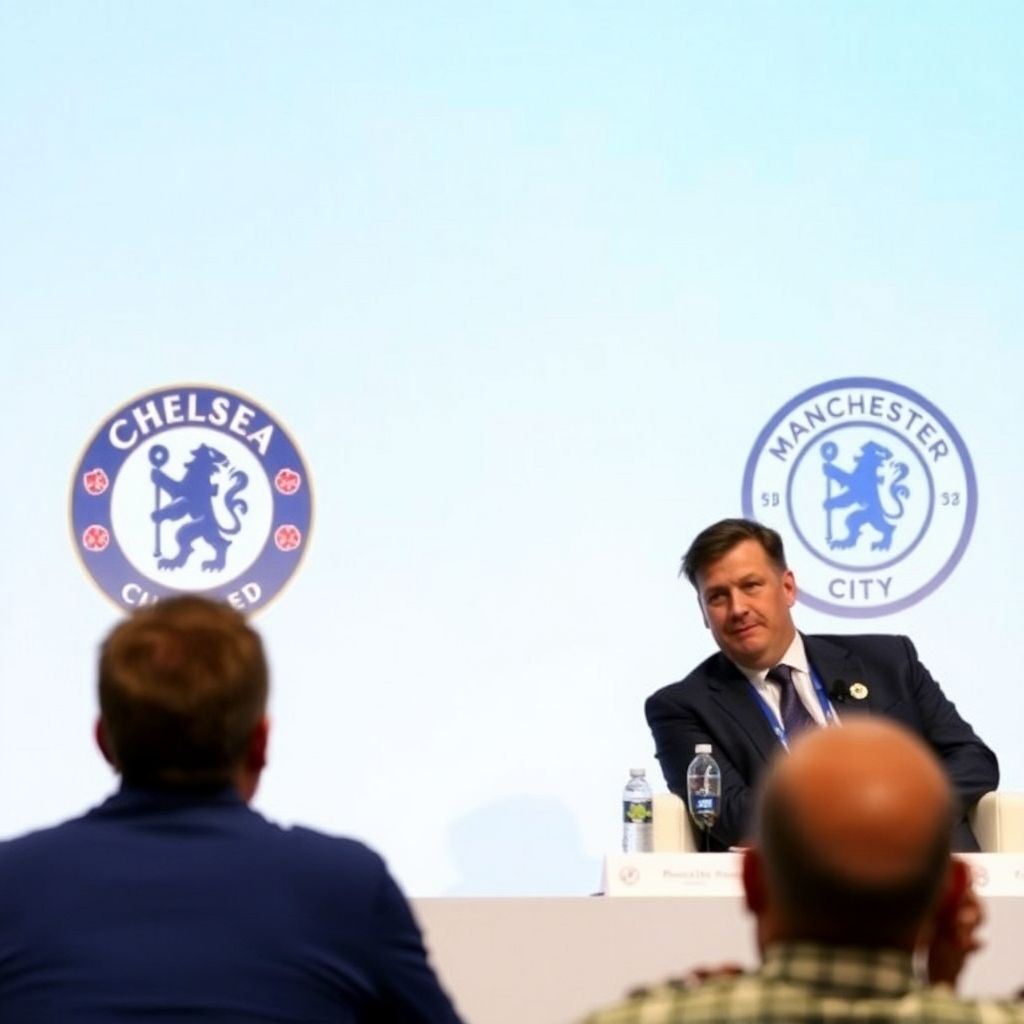
The unusual logic behind Marc Cucurella’s Chelsea transfer has finally been laid bare by the man who pushed the deal over the line: club co-owner Todd Boehly. Speaking candidly at a panel during the iConnections event, the American investor explained that the move for the Spanish left-back was driven by a remarkably simple – and highly unconventional – thought process: if Manchester City wanted him, Chelsea should get him first.
Boehly revealed that during one hectic summer window he was forced to step in as interim sporting director, despite having no background in football recruitment. As he told the audience, he suddenly found himself responsible for key transfer decisions in one of the world’s biggest clubs, without the expertise usually associated with such a role.
“Over the summer I had to act as interim sporting director,” he admitted. “And I had no idea what actually makes a good footballer. But with Marc Cucurella, my logic was straightforward: if Manchester City are trying to sign him, then I want him too. From that perspective, the decision was pretty simple.”
That “simple” decision resulted in Chelsea paying a reported 62 million pounds for Cucurella, one of the most expensive left-back deals in Premier League history. The transfer quickly became one of the most debated moves of Boehly’s early reign at the club, sparking intense discussion about Chelsea’s new transfer strategy, spending habits and long-term planning.
At the time, Manchester City had shown serious interest in Cucurella, fresh off an impressive season at Brighton. The defender’s ability to play both as a traditional left-back and as a left-sided centre-back in a back three made him particularly attractive to elite clubs. In the eyes of Boehly, the involvement of Pep Guardiola’s City – widely praised for their meticulous scouting and recruitment – effectively served as a stamp of quality.
Instead of relying on a detailed internal evaluation or a long-term scouting dossier, Boehly admits he leaned heavily on that external signal. In finance, this might be described as “following the smart money”: if a proven winner wants a particular asset, securing it first feels like a shortcut to success. Translated into football terms, it meant outbidding City for Cucurella.
The logic, however, also reveals how turbulent and improvised Chelsea’s early post-takeover period really was. After the ownership change, the club underwent major structural shifts, including changes in the boardroom and recruitment departments. With established sporting leaders departing, a vacuum emerged at exactly the moment when Chelsea were trying to reshape their squad. Boehly stepping into a sporting director role was a direct consequence of that transition.
In the traditional model of European football, sporting directors and recruitment departments are built on continuity, data, long-term scouting networks and a deep understanding of tactical profiles. Boehly’s admission that he “had no idea what makes a good footballer” underlines how far Chelsea had drifted from that norm during this particular window. Decisions worth tens of millions of pounds were influenced by intuition and rivalry, not by a well-established sporting structure.
The Cucurella case also illustrates the risks of what might be called “reactive transfers” – signings made primarily to beat a rival or to make a statement, rather than to fill a precisely defined tactical or squad need. When a club pays a premium fee largely because a direct competitor is also in the race, the margin for error becomes tiny. Any subsequent dip in form or perception that the player is struggling immediately magnifies the scrutiny on the deal.
In the months following his arrival, Cucurella’s performances became a lightning rod for frustration among some Chelsea supporters. The club as a whole was underperforming, managers were changing, and the team’s structure on the pitch was far from settled. In such a chaotic environment, even a versatile defender can look lost, and a 62 million pound price tag only intensifies the spotlight. Whether Cucurella was ever the right profile for Chelsea at that moment became a frequent talking point.
From a broader perspective, Boehly’s comments highlight a clash between two worlds: American-style investment thinking and the deeply nuanced ecosystem of elite football. In business, copying the strategies of a proven market leader can be a rational shortcut. In football, however, success depends not only on signing talented players, but on how precisely they fit the manager’s system, the dressing room dynamics and the club’s long-term plan.
There is also an important lesson here about over-reliance on “transfer signals” from rival clubs. That another top team wants a player is useful information, but it cannot substitute for internal analysis. Manchester City’s interest did not automatically mean Cucurella would be the perfect fit for Chelsea’s tactical context or squad composition. City’s needs, style of play and long-term planning differ significantly from Chelsea’s, especially during a period of managerial and structural upheaval at Stamford Bridge.
At the same time, Boehly’s openness about his own inexperience in the sporting director role is striking. Few club owners so bluntly admit that they were effectively learning on the job while committing such substantial sums. His remarks can be read as a form of hindsight: an acknowledgment that what seemed “simple” logic at the time may not have been the most sophisticated way to build a top-level squad.
In the years since that window, Chelsea have moved towards a more conventional structure, with professional sporting directors and technical staff tasked with making recruitment decisions. That evolution suggests the club recognised that ad‑hoc decision-making, however bold or ambitious, is not sustainable in the hyper-competitive environment of the Premier League.
The Cucurella transfer, then, has become more than just a story about one player. It stands as a case study in how ownership transitions, missing structures and competitive pressure can shape major transfer decisions. It also raises a broader question: how should modern clubs balance the instincts of powerful owners with the expertise of football professionals?
For Chelsea, the answer now seems to lie in building a stable, data-informed recruitment model, where major signings are the result of long-term planning rather than reactive moves to outmuscle rivals. For Boehly, the experience appears to have been a lesson in the limits of simple logic in a complex sport. The idea that “if City want him, we want him too” may sound appealing in a boardroom, but on the pitch, success demands something far more sophisticated.