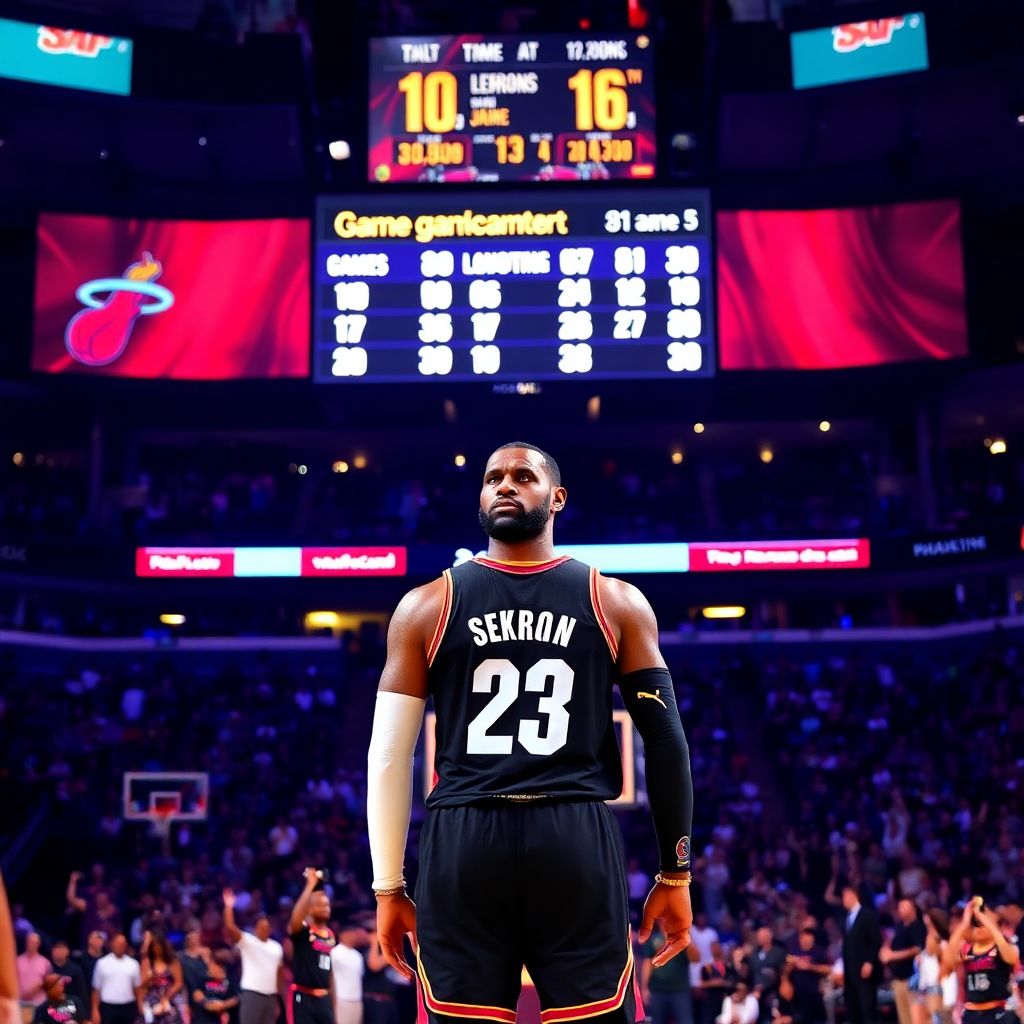
Another Record for LeBron: James Equals Robert Parish’s Games-Played Mark
LeBron James has added yet another milestone to his legendary résumé. In the matchup against the Miami Heat, the Los Angeles Lakers star took the floor for the 1,611th regular-season game of his NBA career, drawing level with Hall of Famer Robert Parish for the most games played in league history.
At 41 years old, James continues to push the boundaries of what longevity looks like in professional basketball. His appearance against Miami did more than just tie a statistic; it symbolized two decades of consistency, durability, and elite-level preparation. Every game has built on the last, and now he stands side by side with a record that stood as one of the league’s most enduring benchmarks.
Robert Parish originally set the record by playing 1,611 regular-season contests over a 21-season career spanning from 1976 to 1997. During that time, he surpassed Kareem Abdul-Jabbar’s previous mark of 1,560 games back in 1996, establishing himself as the standard for longevity. For almost 30 years, no one had matched that total – until LeBron stepped onto the court against his former team in Miami.
Parish, who watched his record approached and now equaled, responded with admiration rather than concern. In an interview, he praised James’s commitment to his craft, underscoring the professionalism behind the achievement. According to Parish, LeBron’s discipline in conditioning and lifestyle choices mirrors his own approach during his playing days. For Parish, this shared philosophy is no coincidence; he sees it as the foundation that has allowed both men to sustain such long and successful careers.
James is not only rewriting the record books in terms of games played. He is already recognized as the leading scorer in NBA history, and he has managed to maintain a remarkably high standard of play even deep into his career. Entering the showdown with Miami, LeBron was averaging 21.4 points, 6.8 assists, and 5.6 rebounds per game this season – numbers that would be impressive for a player in his prime, let alone one in his 21st year in the league.
The game itself was a reminder that James is far from just a ceremonial participant chasing milestones. The Lakers defeated the Heat 134-126 in a fast-paced, high-scoring contest, and LeBron once again took center stage. Against the franchise with which he won two championships, he recorded the 124th triple-double of his career, reinforcing that he remains one of the league’s most complete and impactful players.
LeBron’s journey to this point began when the Cleveland Cavaliers selected him with the first overall pick in the 2003 NBA Draft. He made his league debut on October 29, 2003, arriving with unprecedented expectations as a high school phenom. Over time, he not only met those expectations but redefined them, becoming a global icon and one of the most decorated players the game has ever seen.
Over the course of his career, James has been named to the All-Star Game 22 times, an extraordinary streak of excellence and popularity. To go along with that, he has collected four NBA championships and four Most Valuable Player awards, achievements that place him firmly in any discussion about the greatest player of all time. Each season has added layers to his legacy: clutch performances, Finals runs, individual awards, and now a durability record that underscores his staying power.
What makes this latest milestone particularly remarkable is the combination of volume and sustained quality. Many players who remain in the league into their late 30s and early 40s see their roles reduced significantly. James, on the other hand, still functions as a central offensive engine and a primary decision-maker on the floor. His ability to adapt his game – evolving from an explosive slasher into a masterful playmaker and efficient shooter – has allowed him to stay effective even as his athleticism has naturally changed.
Behind the scenes, his longevity is widely credited to his meticulous care of his body. Specialists often highlight his year-round conditioning work, strict training routines, and attention to recovery as key reasons he can continue logging heavy minutes at an advanced age for an NBA player. This off-court investment, which Parish also pointed to, has transformed the perception of how long a superstar can realistically dominate in the league. Younger players now often look to LeBron’s habits as a model for how to potentially extend their own careers.
Equalling Parish’s games-played record also opens another chapter in the discussion about how we measure greatness. Traditional counting stats like points, rebounds, and assists have always been central, but durability and availability are increasingly recognized as crucial components of a player’s value. Being able to show up night after night, season after season, and still make a meaningful impact is a rare skill in itself – one that James has mastered.
With 1,611 regular-season games now behind him, LeBron is poised to stand alone atop the games-played list as soon as he steps onto the court again. Once he moves past Parish, every additional appearance will extend a new record that future generations will chase. Given his current form and ongoing commitment, it is reasonable to expect that he will put even more distance between himself and the rest of the field before he eventually retires.
For the Lakers, LeBron’s continued excellence is more than a historical note; it is a crucial part of their present ambitions. His versatility allows the coaching staff to use him in multiple roles – primary ball-handler, scoring option, facilitator, and even as a small-ball big man when lineups demand it. As he keeps delivering triple-doubles and orchestrating the offense, Los Angeles remains a dangerous opponent in any given matchup.
This new record also enriches the narrative of LeBron’s career arcs with the teams he has played for. Facing Miami – the team where he won his first NBA titles and solidified his status as a champion – while tying a longevity record adds a layer of symbolism. The player who once left Cleveland as a rising superstar, then transformed into a fully realized champion in Miami, and later brought a title back to his home state, is now extending his legend in Los Angeles while redefining how long a superstar can remain elite.
As his career progresses, every milestone invites the question of what remains for LeBron to accomplish. Statistically, he continues to climb or lead many all-time lists. From a legacy standpoint, each new record strengthens his case in the never-ending debate over basketball’s greatest player. But beyond arguments and comparisons, feats like matching Robert Parish’s 1,611 regular-season games highlight perhaps the most underrated aspect of his greatness: an unwavering availability, a refusal to fade quietly, and a commitment to excellence over an almost unmatched span of time.
In the end, this is more than just “another record” for LeBron James. It is a testament to an entire era he has shaped, outlasting peers, rivals, and even some franchises’ rebuild cycles. With every game he plays from this point forward, he is not only setting a new benchmark but also extending a career that has already altered the history and expectations of the NBA.