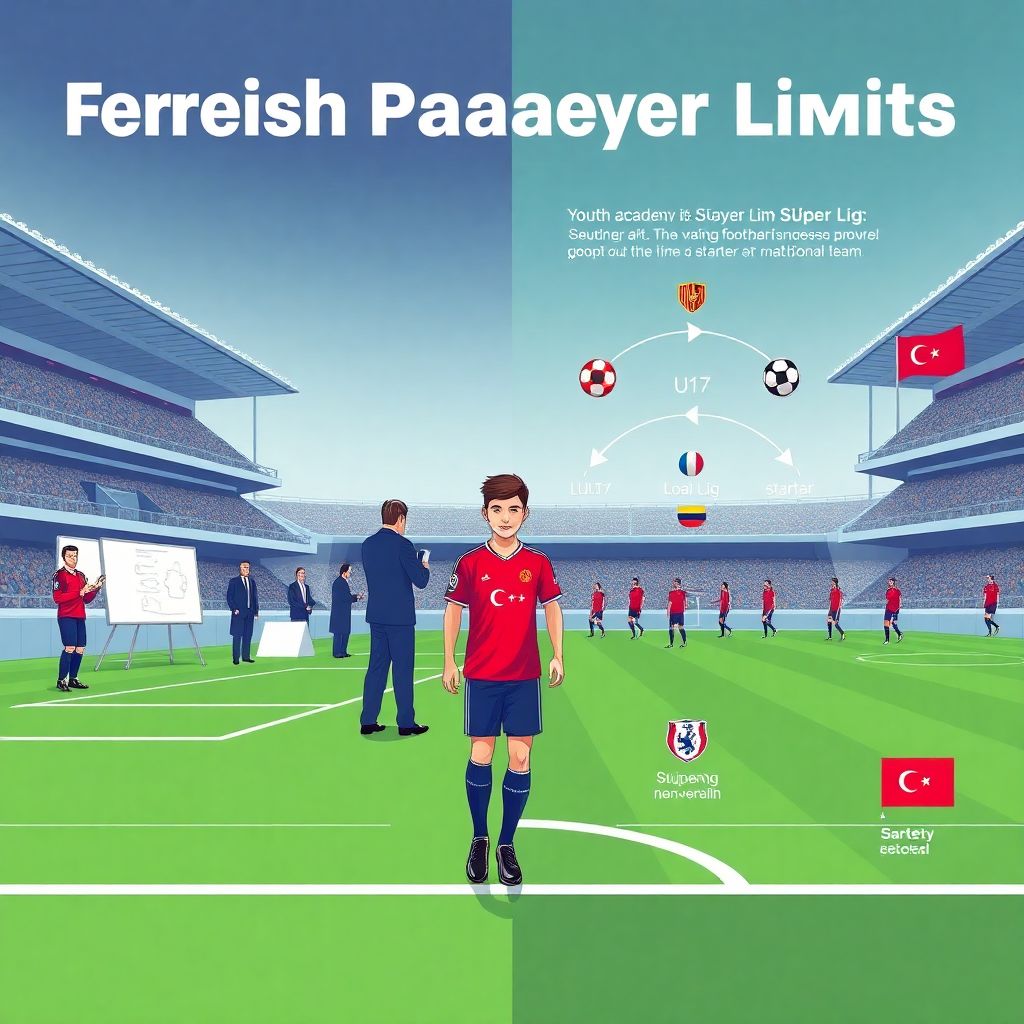
Why Foreign Player Limits Matter More Than People Think
If you follow the Süper Lig even casually, you’ve heard endless debates about the turkish football foreign player rule. Some say “open the doors, we need quality,” others insist “protect the locals, or we’ll never see another Arda Güler.” Behind all that noise, there’s a practical question: how do foreign player limits actually affect the development of young turkish footballers on the ground — in training, contracts, and match minutes — not just in theory? Let’s unpack this in a down‑to‑earth way, with concrete examples and simple “mental diagrams” you can picture without needing a coaching license.
Key Terms: Getting the Vocabulary Straight
What Are “Foreign Player Limits” in Practice?
When we talk about turkish super lig foreign player limits, we mean regulations that cap how many non‑Turkish players a club can register and/or use on the pitch at the same time. Leagues tweak the details all the time, but the basic idea is:
– You can sign only up to X foreigners in the squad, and/or
– You can field only up to Y foreigners in the starting XI and matchday squad.
For a club director, this rule doesn’t live on paper — it shapes transfer strategy, contract decisions, and even which youth players get promoted. For a 19‑year‑old Turkish winger, this might literally be the reason he gets ten more top‑flight games in a season… or loses them.
Who Counts as “Home‑Grown” or “Local”?
“Local” in this context usually means Turkish citizens registered with the Turkish Football Federation (TFF). Some rules also consider “home‑grown” status — players trained in a Turkish club for a certain number of years between ages 15–21, even if they have dual nationality.
Why does this matter? Because if clubs are required to include home‑grown players in their squads, suddenly turkey football academy training programs aren’t just a nice PR project; they’re a strategic necessity. The pathway from academy to first team becomes an asset, not an accident.
How Foreign Player Limits Shape Daily Club Decisions
A Simple Mental Diagram: Squad Slots as a Chessboard
Imagine a very simple “diagram” of a 25‑man squad as a row of boxes:
[Diagram: 25 squad slots = 14 foreign slots + 11 Turkish slots]
If the rule says “maximum 14 foreigners,” then every time a sporting director wants to sign another foreign player, they must ask: “Whom do we push out? A foreign backup? Or a Turkish youngster?” In practice, this leads to three very common scenarios:
1. Experienced foreign starters + Turkish backups.
2. Foreign players in attacking positions, Turks in “workhorse” roles (full‑backs, destroyer midfielders).
3. A deliberate mix: a few foreigners in key roles, balanced by high‑potential Turkish talents groomed for resale.
Where your favourite club sits along this spectrum usually tells you how seriously they take the development of young turkish footballers.
Where the Limits Help: Forcing Clubs to Look Inside
Foreign player caps can push clubs to mine their own academies instead of paying mid‑level foreigners big wages. You see it when:
– A club can’t fit in another foreign centre‑back, so they finally give a 20‑year‑old Turkish defender 15–20 league games.
– The rule nudges coaches to keep at least two Turkish players on the bench who can actually change a game instead of “just in case” veterans.
– Sporting directors start scouting U17 and U19 leagues with the same seriousness as the European market.
When applied with clear long‑term planning, the turkish football foreign player rule can act like a gentle push toward smarter youth integration. The problem is not the idea itself — it’s what clubs decide to do with the constraint.
Where the Limits Hurt: Inflated Prices and Fake Minutes

There’s also a darker side, which you likely recognise from transfer rumours every summer:
– Overpriced local players. If clubs must fill a certain number of Turkish spots, agents know it. Average local players suddenly cost as much as high‑quality foreigners.
– Token minutes. Coaches may throw on a Turkish player for the last five minutes just to hit a numeric requirement, not because he fits the game plan.
– Short‑term fixes. Instead of building a long‑term academy strategy, clubs sometimes buy 27‑year‑old Turkish squad players to “tick the box” for the rule.
This is where the effects of foreign players on turkish football become tricky: the rule alone can’t guarantee better development. It needs to be paired with serious training culture and intelligent incentives.
What Actually Changes for a Young Turkish Player?
The Real Career Path: From Academy to Süper Lig Pitch
Let’s map a typical journey for a young prospect into a simple flow diagram you can visualise:
[Diagram: Academy (U15–U19) → Reserve / U21 → Loan to 2. Lig / 1. Lig → Süper Lig bench → Regular starter → International call‑up]
Now add foreign player limits into this picture. At each stage, the rule can play a different role:
– At academy level: No direct impact, but clubs adjust how many Turkish vs foreign youth they sign.
– At loan level: Lower‑division teams often rely more on domestic players, so limits indirectly create extra spots for young Turks to get real minutes.
– At first‑team level: This is where it gets critical — the last step from “promising kid” to “reliable pro” either happens or stalls.
If the first team already has six foreign forwards taking almost all attacking minutes, a Turkish striker may be stuck on the bench for two seasons. With clearer limits, the club might instead carry three foreigners up front plus a local youngster who genuinely rotates into the lineup.
1–2–3: Practical Levers to Improve Development Under Any Rule
Here are three concrete things clubs can do to turn any version of the turkish super lig foreign player limits into an advantage rather than a handicap:
1. Role‑based planning, not position‑based.
Instead of saying “we need a foreign winger,” define roles: “We need one foreign winger as a starter, one Turkish winger as a rotation option, and one academy winger who trains with the first team.” This ensures every foreign signing has a clear purpose and doesn’t block all pathways.
2. Mandatory development minutes.
Internally, clubs can set their own target: “Two U21 Turkish players must play at least 1,000 league minutes each this season.” That’s about 11 full matches per player. It’s enough to actually evaluate them, not just give them symbolic appearances.
3. Structured loan strategy.
Instead of dumping youngsters on any club willing to take them, build a proper network: specific partner clubs, agreed positions, and minimum playing time clauses. This is how foreign limits start pushing talent upwards instead of creating bottlenecks.
Comparing Turkey’s Approach With Other Leagues
England: No Direct Cap, But Tough Entry Barrier
The Premier League doesn’t set a hard cap like the turkish football foreign player rule; instead, it uses work permits and home‑grown rules. In practice:
– No strict limit on foreigners from an EU‑style perspective, but
– Non‑UK players must meet specific criteria (national team appearances, league quality, etc.).
– Home‑grown requirement: Each 25‑man squad must have up to eight home‑grown players.
Effect on local players? English talents still face intense competition, but the market protects top local prospects by making certain foreign signings more complicated. Crucially, clubs also invest massively in academies because home‑grown players increase roster flexibility and can be sold for huge fees.
Germany: The Balanced Model
The Bundesliga doesn’t scream about foreign limits every summer, yet it consistently produces players. Why? The emphasis is on:
– Strong, standardised youth coaching
– Leaning heavily on U23 and B‑team competitions
– Culturally accepting that 18‑ to 20‑year‑olds can start in big games
There’s no dramatic foreign cap, but you see many clubs with a natural blend: a foreign player in a key creative role and two or three academy‑bred Germans filling in around him. It’s a subtle reminder that regulations alone can’t replace a coherent football culture.
Spain and Italy: Quality Over Quantity
La Liga and Serie A use non‑EU quotas and various home‑grown rules, not unlike the logic behind turkish super lig foreign player limits. But the key difference is how they use foreign players:
– They invest heavily in top‑tier foreign stars or undervalued talents.
– Local players compete in a very tactical environment that accelerates learning.
– B‑teams (like Barcelona B, Real Madrid Castilla) bridge the gap between youth and first team.
For Turkey, the takeaway is practical: limits should not be about simply counting passports, but about raising the bar of who earns one of those precious foreign slots while creating clear bridges for Turkish talents to cross into senior football.
Practical Impacts on Coaching and Training
How Limits Change What Coaches Prioritise
On the training pitch, foreign player limits can indirectly shape what coaches focus on. If foreigners tend to occupy playmaking roles, local players must bring something extra to break that pattern. Coaches who understand the effects of foreign players on turkish football use this intentionally:
– Tactical versatility: Training Turkish youngsters to play multiple positions (e.g., full‑back who can invert into midfield) increases their usefulness under strict squad limits.
– Physical and mental robustness: If you’re getting fewer minutes than your foreign counterpart, you must make every appearance count. Coaches emphasise decision‑making and game impact rather than just “doing OK.”
– Game intelligence: Reading space, anticipating second balls, adapting to different tactical setups — these skills can close the gap when raw talent or experience favours foreign teammates.
Upgrading Academies: From “Talent Storage” to Performance Labs
With modern turkey football academy training programs, the best clubs don’t just copy drills from YouTube. They build a pipeline aligned with first‑team demands:
– Playing the same system. If the first team presses high and plays a 4‑3‑3, the U17s and U19s mirror that. When a player is promoted, the tactical language is already familiar.
– Data‑driven evaluations. Instead of “this kid looks good,” academies use GPS data, match footage, and physical benchmarks to decide who’s genuinely ready to leap into the senior setup.
– Individual development plans. For example, “In the next 12 months, we want this U18 midfielder to improve line‑breaking passes and pressing intensity to first‑team level.”
Done properly, this turns foreign limits from a headache into a competitive weapon: your Turkish players are so well‑prepared that they’re not just filling quotas; they’re winning starting spots on merit.
Realistic Scenarios: What Clubs Can Do Tomorrow Morning
Scenario 1: Mid‑Table Club With a Tight Budget

Imagine a mid‑table Süper Lig club with limited money and a few decent foreigners already under contract. Here’s a practical plan they could execute even under strict limits:
1. Protect core foreigners; clear out luxury signings.
Keep the foreign players who truly raise the team’s ceiling (e.g., your main playmaker, a reliable centre‑back, a clinical forward). Let go of foreign backups who offer only marginal gains over academy options.
2. Identify three academy players with first‑team potential.
Bring them into every first‑team training session. Give each a clear role model: “You’re learning from our foreign No. 10; in two years, we want you to challenge him.”
3. Build a minutes plan.
Before the season starts, decide: “We will target at least 900–1,200 Süper Lig minutes for each of these kids.” Then use cup games, home matches versus weaker teams, and late substitutions to reach that goal.
4. Use loans intelligently.
If a young striker is blocked by two strong foreigners, loan him to a 1. Lig team where he’ll start every week — but have a staff member regularly analyse his games, not just check his goal tally.
Within two or three seasons, this approach can produce a couple of sellable Turkish players whose transfer fees fund better‑quality foreigners, creating a healthy cycle instead of permanent dependence.
Scenario 2: Big Club Aiming for Europe
For a top club chasing European football, the stakes are higher, but the logic doesn’t change — just the margins:
– Foreign signings must be difference‑makers. If a foreign winger isn’t clearly better than your best Turkish academy winger, don’t sign him just because he has a “bigger name.” Use that foreign slot on a true game‑changer.
– Turkish talents as rotation leaders. Aim to build a spine where at least two or three key positions are held by top‑class Turkish players. They understand the league, the culture, and reduce your risk if rules change again.
– European exposure for young Turks. Give promising Turkish players minutes not just in the league, but in early European qualifiers or group games where possible. The experience differential multiplies their development speed.
This way, even if foreign limits get tighter in future, your squad doesn’t collapse — your Turkish core is already good enough, and foreign players become the final 10–20% that lifts the ceiling.
Balancing Act: Regulation vs Responsibility
What Rules Can and Can’t Do
Foreign player limits can:
– Create space in squads for domestic players.
– Discourage low‑quality foreign signings just to fill numbers.
– Push clubs to value academy products more seriously.
But they cannot:
– Automatically improve coaching quality.
– Guarantee meaningful playing time.
– Instantly turn an average Turkish player into an international‑level star.
That’s why discussions about the turkish football foreign player rule should always be paired with talk about coaching education, sports science, mental training, and infrastructure. Without that, we’re just moving numbers around without raising the actual level of Turkish footballers.
What Success Could Look Like in 10 Years
If Turkey manages this balancing act well, a realistic best‑case scenario might look like this:
– Most Süper Lig squads have a clear backbone of Turkish players who are tactically sharp and physically elite.
– Foreign players occupy clearly defined, high‑impact roles rather than simply filling holes everywhere.
– Academies feed three or four players into the professional ranks every couple of years, helped by consistent turkey football academy training programs aligned with first‑team needs.
– When European clubs scout Istanbul, Ankara, or Izmir, they’re not just looking for one wonderkid; they see a steady stream of well‑developed Turkish talents ready for the next level.
In other words, foreign limits stop being a political football and become what they should have been all along: one tool, among many, to build a sustainable environment for the development of young turkish footballers.
If clubs, coaches, and the federation treat the rules as a framework rather than a shortcut, the long‑term impact can be genuinely positive — not just for Turkish players, but for the overall quality and reputation of the Süper Lig itself.