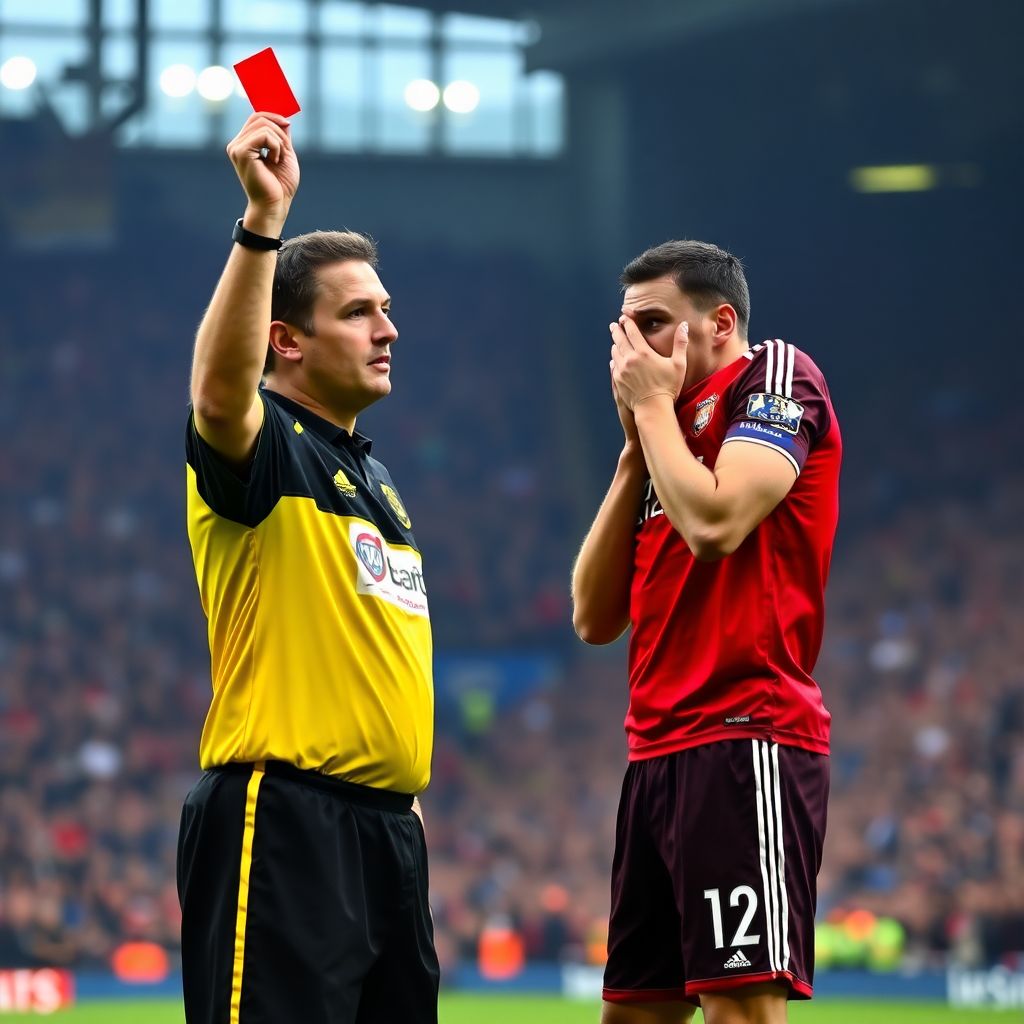
FIFA considering radical rule change: red card for players who cover their mouths while speaking
FIFA president Gianni Infantino has hinted at a potentially groundbreaking rule change that could fundamentally alter player behavior on the pitch. According to Infantino, footballers who cover their mouths while speaking – especially in situations where racist or discriminatory language might be suspected – could in the future face a straight red card and be sent off.
This potential regulation is still only at the discussion stage, but the mere idea has already sparked major debate in the football world. The concept gained momentum in the aftermath of a recent racism controversy involving Vinicius Junior and Gianluca Prestianni in a Champions League match. Prestianni was accused of using a racist expression towards the Brazilian forward while hiding his mouth with his hand. The young player denied the allegations, yet UEFA opened an investigation and imposed a temporary suspension during the process.
Infantino, speaking to Sky News, directly connected the new idea to the wider fight against racism in football. “If a player covers his mouth and says something, and there is a racist outcome, he should clearly be sent off,” he stated. He then went further, framing the act of covering the mouth as inherently suspicious: “If you have nothing to hide, you don’t cover your mouth when you speak. Otherwise, it must be assumed that something that should not be said has been said.”
The FIFA president underlined that tackling racism requires much more than symbolic gestures and social campaigns; it demands tough, concrete measures on the field. In his view, sanctions must be severe enough to act as a deterrent, and a direct red card for such behavior could be one of those tools. By linking the physical act of hiding the mouth to possible offensive language, FIFA aims to reduce the room for ambiguity when investigating racist incidents.
At the same time, it is being emphasized that this proposal is still in a very early and exploratory phase. No immediate implementation is expected, and the legal and practical dimensions of such a change will require thorough review. This includes how referees would interpret incidents, what kind of evidence would be needed, and how to protect players from wrongful accusations.
Despite these uncertainties, there are indications that the idea is being taken seriously at the highest levels of football governance. Federations from England, which share a seat with FIFA on the International Football Association Board (IFAB), are reported to be open to discussing such a rule. The issue has already been raised in technical meetings, signaling that it may eventually appear as a formal proposal on IFAB’s agenda, where the laws of the game are defined and amended.
The context behind this possible rule change is a growing frustration with the persistence of racism in stadiums. Campaigns, slogans on kits, and pre-match ceremonies have not been enough to eliminate insults aimed at players on the basis of their skin color or origin. Authorities are increasingly looking for mechanisms that allow faster, clearer intervention on the field – and a visible behavioral cue like covering the mouth could become one of those triggers.
However, the potential rule also raises a number of complex questions. Players frequently cover their mouths for reasons unrelated to abuse: to prevent opponents from reading their lips, to hide tactical instructions from cameras, or simply out of habit. Many coaches and captains use the gesture during set pieces or tense moments to maintain strategic secrecy. Turning this into a possible red-card offense would require very precise wording in the law and clear guidelines for referees.
Another layer of complexity is the need for solid evidence. Even if a player covers his mouth and an opponent accuses him of a racist remark, how will officials determine what was actually said? Will video and audio technology be expanded? Will lip-reading experts become more common in disciplinary cases? Without clear standards of proof, such a rule could risk unfair punishment and long, controversial appeals.
On the other hand, supporters of the idea argue that the current situation already leaves too much space for deniability. When a player hides his mouth, replays and cameras often cannot help investigators reconstruct the incident. A rule that directly penalizes this behavior in sensitive contexts could, in theory, discourage players from attempting to mask verbal aggression in the first place. In that sense, the threat of a red card might function more as a preventive tool than a punishment frequently applied.
From a broader perspective, this proposal also reflects how modern football is changing under the influence of technology and media. Every word spoken on the pitch can be captured, analyzed, and broadcast, and players are increasingly aware that their gestures are scrutinized worldwide. Covering the mouth became a common reflex in the era of high-definition cameras and social media, where private exchanges can quickly turn into public controversies. FIFA’s signal suggests that even this defensive habit could soon have disciplinary implications.
If such a rule were eventually adopted, football’s culture would likely shift. Players might receive new guidance during internal briefings, being explicitly warned to avoid covering their mouths in confrontational situations, especially when addressing opponents or referees. Youth academies could integrate this into their education, teaching future professionals that transparency of behavior is now part of the game’s expectations.
Clubs and national teams would also have to adapt. Media training already instructs players on how to handle interviews and online presence; in the future, it may also extend to behavior on the pitch, including what gestures to avoid. Coaches might look for alternative methods to communicate discreetly, perhaps relying more on pre-agreed signals or written notes, rather than whispered conversations behind a hand.
The legal and ethical debate around this idea is likely to be intense. Human-rights advocates and sports-law experts may question whether presuming “you cover your mouth, therefore you said something wrong” is compatible with principles of fairness and presumption of innocence. FIFA and IFAB, if they proceed, will need to strike a delicate balance: sending a strong message against racism without creating a rule that is too vague or open to abuse.
In practical terms, any such change would almost certainly be introduced first in selected competitions or trial formats, as has been the case with other experimental rules in the past. Feedback from referees, players, coaches, and disciplinary panels would then shape revisions before any worldwide rollout. This phased approach would allow football authorities to measure not only the effectiveness of the rule in combating racism but also its side effects on game flow and player behavior.
What is clear is that Infantino wants to move the discussion beyond statements of intent. His comments underline a desire for clear, visible consequences when racist incidents are suspected on the field. Even if the specific proposal about covering the mouth evolves or is softened during consultations, it signals a readiness to reconsider long‑standing norms if they are seen as shielding discriminatory conduct.
Ultimately, the direction of travel seems set: football’s governing bodies are under pressure to deliver results in the fight against racism, not just campaigns. Tougher sanctions, expanded use of technology, and now even scrutiny of seemingly minor gestures like covering the mouth are all part of a broader attempt to reshape the culture of the game. Whether players, fans, and experts will accept such a drastic measure remains to be seen, but the conversation has clearly begun, and its outcome could redefine how players speak – and behave – on the pitch in the coming years.