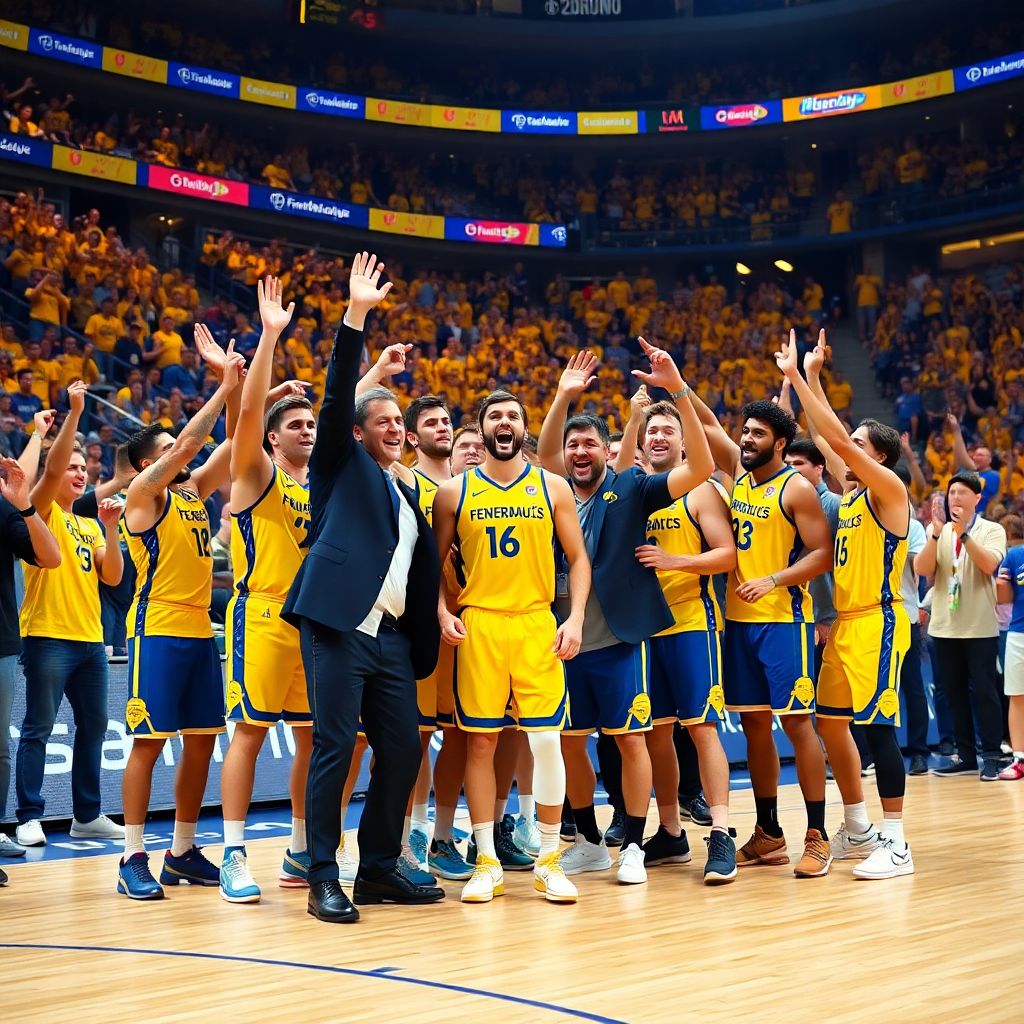
“We Didn’t Play Perfectly, But We Were Good”
In Round 30 of the EuroLeague regular season, Fenerbahçe Beko claimed an emphatic 88-70 home win over French powerhouse AS Monaco, and head coach Sarunas Jasikevicius left the court satisfied, if not completely ecstatic. Speaking after the game at Ülker Sports and Event Hall, the Lithuanian coach underlined that his team did not deliver flawless basketball, but still produced a strong and convincing performance on both ends of the floor.
Jasikevicius opened his post-game remarks by congratulating his players and expressing gratitude to the fans. He highlighted the packed arena and the intensity of the support throughout the night, noting that all available tickets had been sold. According to him, the energy from the stands played a key role in sustaining Fenerbahçe’s defensive focus and composure against one of the most dangerous offenses in the competition.
The coach emphasized that Fenerbahçe’s defensive consistency across 40 minutes was the backbone of the victory. He described Monaco as a “very dangerous” opponent, capable of punishing even brief lapses. In the first half, Fenerbahçe allowed the visitors too many trips to the free-throw line, something Jasikevicius did not hide his displeasure about. Despite those early issues, he felt his team maintained structure and discipline, especially as the game wore on.
Reflecting more broadly on the performance, Jasikevicius was candid: they had not shown “amazing” or spectacular basketball, yet they were clearly “good” and efficient. He pointed out Monaco’s size, length, and athleticism, stressing how tough it is to control such a roster over the course of a full game. In that context, he viewed the 18-point margin not just as a win, but as a “very good victory” in terms of quality and significance.
Injury problems have been a recurring theme for Fenerbahçe this season, and the coach did not shy away from that topic. He admitted that the team has never truly enjoyed a stretch with the entire roster healthy and available at the same time. They have had to constantly adapt, reshuffle roles, and make tactical adjustments on the fly as injuries piled up in different positions.
Jasikevicius took a moment to praise the club’s management and staff for their response to those setbacks. He mentioned several long-term injuries and explained that the organization has been trying to make the “right moves” in the market and in roster management to keep the team competitive. “We are not perfect,” he said, “but we are fighting and trying to stay on our feet.” That phrase summed up the mentality he wants his players to embody: resilience in the face of adversity.
One of the standout performers on the night was Tucker, who exploded for 28 points and finished as the game’s top scorer. Jasikevicius was effusive in his praise for the guard, recalling that this was not the first time Tucker had delivered against Monaco. In their previous meeting, Tucker had played a critical role in overturning a 17-point deficit. This time, Fenerbahçe managed to give him the necessary space and structure to operate, and he seized the opportunity.
The coach pointed out that the game plan allowed Tucker more room to move, attack mismatches, and find rhythm both off the dribble and off the ball. With those conditions in place, Tucker produced what Jasikevicius called an “unstoppable performance.” His scoring outbursts, timely shots, and aggressiveness on offense repeatedly broke Monaco’s defensive schemes, forcing adjustments and opening up opportunities for teammates.
Another positive story for Fenerbahçe was the return of Silva from injury. The Lithuanian coach responded to a question about Silva by emphasizing how valuable he was, particularly in switching defenses. Silva’s ability to guard different positions, slide his feet on the perimeter, and still provide presence near the rim was a real asset against Monaco’s athletic frontline and dynamic guards.
Jasikevicius reminded everyone that Silva had been sidelined for roughly two months with an injury that literally restricted his movement. For a player whose key strengths are athleticism and energy, being unable to train or compete for that long is a major setback. Before this layoff, Silva had only managed to play in three games with the team, which further delayed his integration into the system and chemistry with teammates.
Now, the first target for Silva is to fully regain his explosiveness, timing, and overall physical form. The coach stressed that the forward’s biggest weapons are his verticality, hustle, and motor. According to Jasikevicius, the performance against Monaco was an important sign: Silva demonstrated glimpses of what he can bring when he’s closer to his best. It was not just about stat lines, but about defensive presence, rotations, and the ability to change the tempo with pure effort.
On the opposing bench, Monaco head coach Vassilis Spanoulis was straightforward in his assessment of the game. He admitted that Fenerbahçe deserved the victory, calling the Istanbul side a “more healthy team” at this moment. Spanoulis pointed out that his squad has had to deal with several off-court and extra-basketball issues that have complicated their preparation and consistency, a contrast to Fenerbahçe’s current situation.
Spanoulis also complimented Fenerbahçe’s roster quality and coaching. He underlined the depth and balance of the team, as well as the way it is led from the sideline. In his view, that combination of talent, structure, and leadership was clearly visible in the game and justified the final scoreline. For him, there was no doubt: the hosts “earned” the win.
Beyond the direct comments, this match carried deeper implications for both teams. For Fenerbahçe, beating a playoff-caliber opponent like Monaco by such a margin sends a message to the rest of the EuroLeague. It shows that even without playing “perfect” basketball, they can dominate high-level rivals when their defensive focus is sharp and their key scorers find rhythm. It also strengthens the team’s confidence heading into the decisive stretch of the regular season and potential playoffs.
Tactically, the game highlighted several hallmarks of a Jasikevicius-coached side. Fenerbahçe relied on structured half-court sets, but did not hesitate to speed up when opportunities arose. Defensively, they mixed physical man-to-man coverage with smart switches, especially when Silva and the other mobile bigs were on the floor. Their ability to protect the paint while still contesting perimeter shots limited Monaco’s usual offensive flow and forced them into more difficult, isolated attempts.
The handling of rotations was another noteworthy aspect. With ongoing injury issues, Jasikevicius had to manage minutes carefully, making sure key players did not burn out too early. He strategically inserted energy guys like Silva to change the pulse of the game, especially on defense, while keeping offensive creators fresh enough to close out quarters and capitalize in critical moments. This balance between short-term impact and long-term management is crucial in a long EuroLeague season.
From a psychological standpoint, wins like this help unify a group that has been constantly disrupted by injuries. When players see that the system still functions, that different individuals step up at different times, and that the coaching staff trusts the entire roster, it creates a collective belief. Tucker’s explosion, Silva’s return, and the solid contributions from role players all support the idea that Fenerbahçe is more than just a sum of a few stars.
For Monaco, the defeat can serve as a warning and a learning opportunity. Spanoulis’ team is known for its athleticism, aggressive perimeter play, and ability to score in bunches. Against Fenerbahçe, however, they struggled to maintain offensive rhythm and allowed the hosts to dictate the tempo for long stretches. Addressing issues such as shot selection, foul discipline, and defensive communication will be vital if they want to stay firmly in the playoff race.
Looking ahead, both coaches will likely focus on recovery and adjustment. Jasikevicius will be hoping that the worst of the injury crisis is behind them, so he can finally work with a more stable rotation and refine the details of his playbook. Getting players like Silva up to full match sharpness could significantly raise the ceiling of this Fenerbahçe team, especially on the defensive end where versatility and energy can change entire series.
At the same time, maintaining the connection with the fan base will remain a priority. The sold-out arena and the intense atmosphere against Monaco demonstrated how powerful home-court advantage can be. For a team built to compete deep into the EuroLeague season, having a fortress-like home is a strategic asset. Jasikevicius’ explicit thanks to the supporters was not just politeness; it was recognition that their presence can lift the group during difficult stretches.
In summary, Fenerbahçe’s 88-70 victory over Monaco was more than a simple regular-season win. It showcased a resilient team that continues to fight through injuries, a coach who demands high standards while acknowledging imperfections, and key players who rise to the moment when given the stage. They may not have been “fantastic” in every possession, as Jasikevicius openly admitted, but they were undeniably good – and, on this night, that was more than enough to beat a formidable opponent.