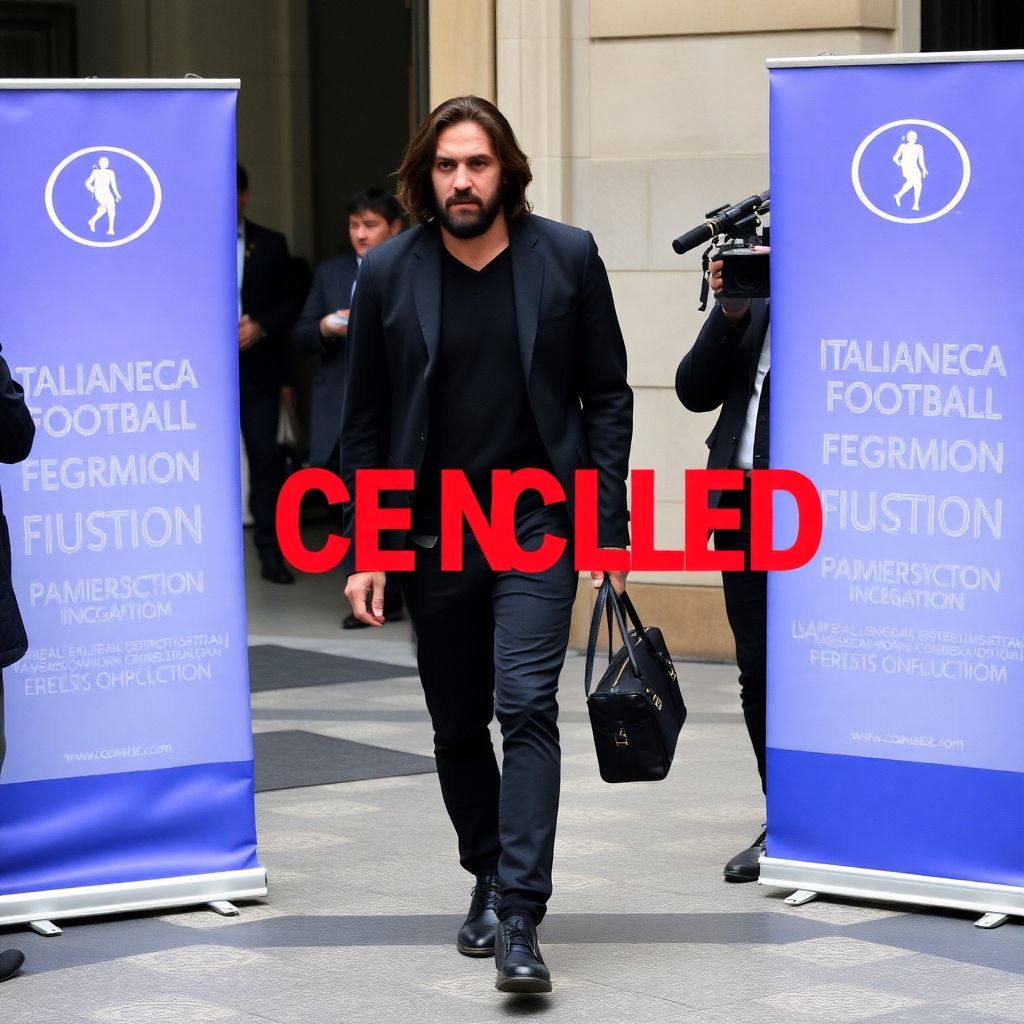
Andrea Pirlo will not become the next head coach of the Italian national team.
Despite being widely mentioned as the leading candidate to take charge of the Azzurri, the negotiations have been halted and his name is no longer considered among the options for the job.
According to reports from Italy, the scheduled meeting in Rome between Pirlo’s representatives and the Italian Football Federation was called off at the last minute. With that cancellation, the process aimed at appointing the World Cup winner as national team coach has effectively come to an end, at least for the current selection cycle.
This development also casts doubt on the future of Paolo Maldini and his advisor Leonardo within the broader technical project surrounding the national team. The pair were reportedly driving a plan that included Pirlo as the central figure on the bench. It is claimed that if a coach aligned with their football philosophy is not appointed, both Maldini and Leonardo might consider stepping down from their roles rather than continue with a project that does not reflect their strategic vision.
Pirlo’s candidacy had already become the subject of heated political and public debate in Italy due to his commercial partnership with a Russian betting company. The collaboration, signed during his time working in the United Arab Emirates, was criticised in some political circles, where it was framed as incompatible with the symbolic and institutional weight of the national team job.
The coach, however, insisted from the beginning that the agreement had been misunderstood. He repeatedly underlined that the contract was purely commercial and related to his professional activity in football, stressing that it did not carry any political implications. “My contract is commercial in nature, not political,” he stated, attempting to draw a clear line between business and ideology.
After remaining silent for days while the controversy intensified, Pirlo decided to break his silence with a detailed statement on social media. He explained that out of respect for the Italian Football Federation and all the institutions involved, he had initially chosen not to comment. That changed once he was informed that he was no longer being considered for the national team position.
“In recent days, I have followed with deep sadness the debate that grew around my name and the possibility of me becoming head coach of the national team,” he wrote. Pirlo emphasised that throughout his career, first as a player and then as a coach, he has always respected the laws of every country he worked in and honoured every contract he signed.
Addressing directly the partnership at the heart of the storm, he clarified that the collaboration in question was part of his professional activities in the United Arab Emirates and had a strictly commercial and sporting character. Assigning any political meaning to it, he noted, meant attributing to him opinions and beliefs he has never held and never expressed.
Pirlo also reserved special words of gratitude for Maldini and Leonardo, acknowledging the support and trust they had shown him during the process. He praised their competence, seriousness and lifelong dedication to Italian football, hinting that their backing had been one of the main reasons he seriously considered the role.
What particularly hurt him, he admitted, was seeing a sporting matter quickly turned into a public and political argument, loaded with intentions and interpretations that he rejects. He expressed disappointment that a decision about a football job evolved into a broader debate in which his name was associated with positions that do not represent who he is.
In closing, Pirlo insisted that his bond with Italy goes far beyond titles, roles or official positions. “My love for Italy does not depend on any job,” he stressed. For him, the national team and the country are part of his personal story and identity, something that will accompany him throughout his life regardless of whether he sits on the Azzurri bench.
—
The end of Pirlo’s candidacy opens a new and delicate phase for the Italian Football Federation. The search for a national team coach becomes more complicated after such a high‑profile name has been withdrawn under public pressure. The federation now needs a figure who can unite fans, satisfy political and institutional sensitivities, and at the same time guarantee a clear footballing project for the future.
From a sporting perspective, Pirlo’s profile had seemed to tick many of those boxes. As a player, he embodied Italian football’s elegance and intelligence, winning a World Cup, Champions League titles and multiple domestic trophies. As a coach, his career has been more uneven, with experiences at Juventus, in Turkey and in the Gulf region, but his footballing ideas and leadership qualities still made him an attractive candidate for a national role focused on rebuilding and generational transition.
The political dimension of the debate, however, proved decisive. In modern football, especially at national team level, image management and symbolic coherence are treated almost as seriously as tactical schemes. Any connection with sensitive geopolitical contexts, even when strictly commercial, can become a problem when it concerns someone who is expected to represent an entire country on the international stage.
The controversy around a betting company partnership also highlights another sensitive area for football institutions: the relationship with gambling sponsors. Across Europe, there is a growing scrutiny of how deeply betting brands are integrated into the game, from shirt sponsorship to advertising campaigns. When a potential national coach is directly tied to one such company, the discussion quickly shifts from sport to ethics and public responsibility.
For Pirlo himself, this episode may shape how he approaches future roles. He has been reminded that, at the highest level, every contractual choice – no matter how strictly professional it may seem – can later be interpreted differently depending on the political climate. Coaches and players looking at lucrative commercial deals in emerging or controversial markets are likely watching this case closely, understanding that today’s sponsorship can become tomorrow’s headline when a prestigious public role is at stake.
The situation also places Maldini and Leonardo in an uncomfortable position. Their project was reportedly built around a specific football philosophy: modern, proactive, rooted in technical quality and long‑term planning. If they decide to leave due to the failure to appoint a coach aligned with that vision, it could trigger a wider reshuffle behind the scenes and send a signal that sporting criteria are being overshadowed by political or media pressures.
For Italian football, the timing is critical. The national team stands at a crossroads: recent tournaments have shown both impressive peaks and painful disappointments. A clear, coherent technical direction is essential if Italy wants to remain competitive on the international stage while integrating a new generation of players. The coach is the visible face of that direction, but the structure around him – including figures like Maldini and Leonardo – is just as important.
There is also a broader cultural debate in Italy about how to balance tradition and modernity in football. Pirlo, with his mix of classic Italian schooling and experiences abroad, symbolised a possible bridge between the old and the new. His absence from the bench does not end that debate; it merely shifts it onto other potential candidates, who will now be weighed not only for their tactical value but also for the political and commercial implications of their past choices.
In the long term, Pirlo’s case might prompt the federation to develop clearer guidelines about commercial partnerships and conflicts of interest for anyone in or around the national team setup. Transparent rules would help avoid similar storms in the future and give coaches and staff a better understanding of which collaborations could become problematic if they aspire to institutional roles.
For now, one thing is certain: Andrea Pirlo’s path will continue away from the Italian national team dugout. Whether he returns one day under different circumstances will depend not only on his results as a coach, but also on how football, politics and business learn to coexist more clearly in a world where every gesture, contract and sponsorship is under constant scrutiny.