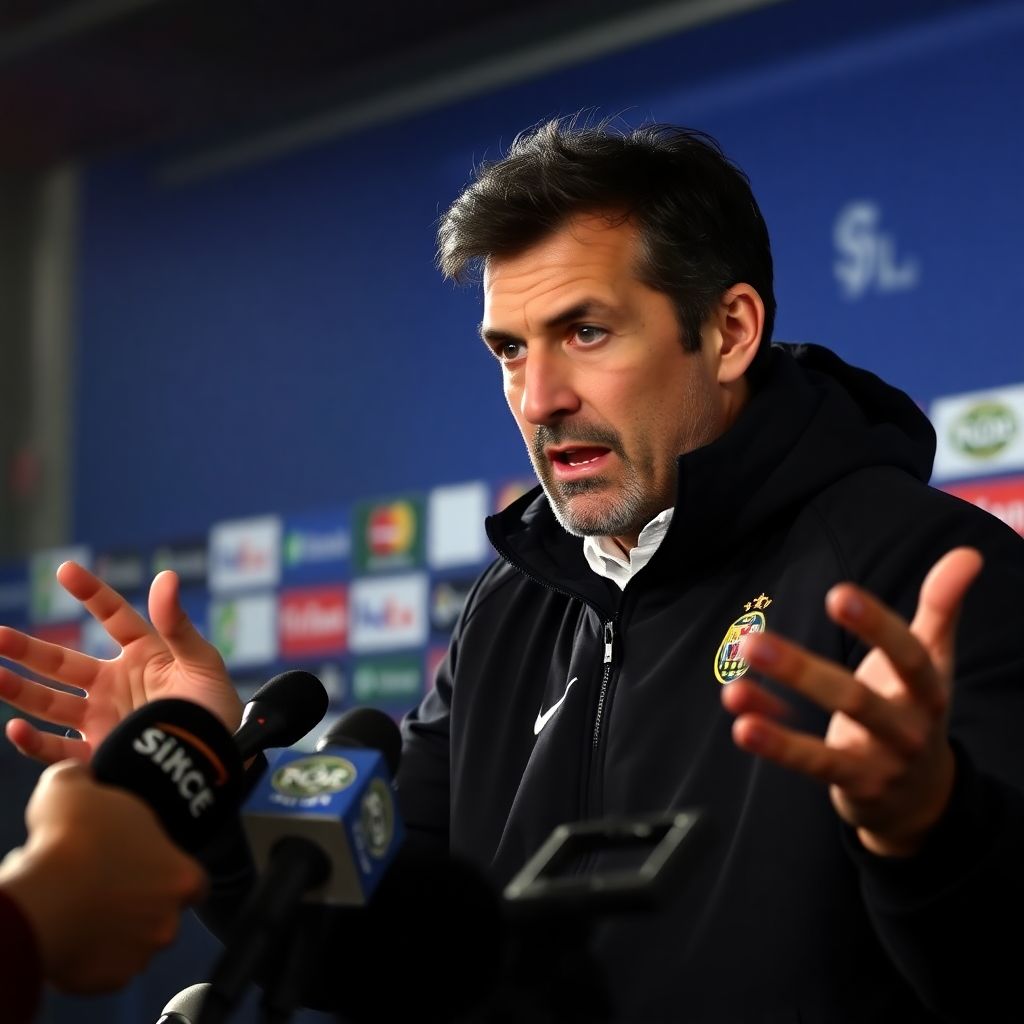
Alvaro Arbeloa: “Everything looks very dark right now”
Real Madrid head coach Alvaro Arbeloa did not hide his frustration after the 1-0 defeat to Getafe, directing attention both to his team’s inefficiency and to the way the match was officiated. Speaking after the final whistle, he stressed that Real created the clearer chances but failed to convert, while Getafe maximised a single opportunity.
“We had the clearer chances and more of them than Getafe,” Arbeloa began, underlining his belief that the result did not reflect the balance of play. “The referee allowed this type of game to happen; there were many interruptions and constant shirt-pulling. This is not a criticism of Getafe, because they simply used what the referee was allowing.”
Focus on the referee’s criteria
Arbeloa repeatedly pointed to the pattern of frequent stoppages and physical duels. In his view, the referee’s permissive criteria determined the rhythm of the match, favouring a defensive side content to slow the game down.
“He let the game be played in a certain way,” he insisted. “With all the pauses and grabs, it’s difficult to find fluency. Getafe defended well, they did what they had to do, and if the referee does not punish it, you cannot blame them for taking advantage.”
Despite that, Arbeloa was careful not to hide behind the match official entirely. His message was that Real Madrid needed more precision and aggression in the final third regardless of the context.
“This is Real Madrid, nobody is going to give up”
Looking ahead to the remaining league matches, Arbeloa tried to keep a competitive tone, even if his words carried a sense of urgency.
“There are still 36 points to play for,” he reminded. “Our only objective is to win every single one of them. Nobody here is going to throw in the towel. We believe we can cut the gap. This is Real Madrid, and nobody will give up.”
The coach acknowledged the disappointment in the stands and the sense of pessimism that followed the defeat, but emphasised that the season is far from over.
“When you lose like this, everything looks very dark and hope seems to fade,” he admitted. “But there is a very difficult game waiting for us in Vigo, and we must arrive with the mentality that everything is still possible.”
Struggling to break down Getafe’s defence
Arbeloa accepted that his team had a hard time finding space against Getafe’s compact defensive block. Still, he insisted that the number and quality of opportunities created should normally be enough to score.
“We had very clear chances,” he recalled. “Vini had his opportunities, Rüdiger had one, Rodrygo as well. We did enough to deserve a goal, but football is not about what you ‘deserve’. We knew exactly the kind of match we were going to face.”
In his analysis, Real Madrid lacked that final touch in the penalty area, but not necessarily ideas or approaches.
“The responsibility is mine”
One of the key messages Arbeloa tried to send was the assumption of personal responsibility. While he defended the players’ effort, he did not hesitate to place the blame for the defeat on himself.
“I will not criticise the effort of my players for a single second,” he stated. “The responsibility lies with me, of course. If there is someone to blame for the defeat, it is the coach, and I accept that.”
He also spoke about the reaction of the supporters, many of whom left the stands before the end of the match, a visual sign of frustration.
“There are 36 points left and our goal is to collect them,” he repeated. “I understand the fans. When you lose at home in this way, it’s normal that everything seems negative. They want to see their team winning and competing for everything.”
Can Real Madrid turn it around?
Asked whether he truly believed in the team’s capacity to reverse their current trajectory, Arbeloa was clear and firm.
“Yes,” he replied without hesitation. “We have great players and a strong squad. Some important players will come back. We have to do things better, no doubt, but the quality is there.”
He accepted criticism of the team’s level, but pointed out that even on an off day, Real produced enough to change the scoreboard.
“I understand the criticism,” he said. “Even if we played badly, worse or simply average, we still created enough to score. They scored a fantastic goal; we did not make the most of our chances. That is the difference.”
What is the main problem?
When pressed to identify the key issue, Arbeloa drew a comparison with another recent match.
“The game today was different from Pamplona,” he explained. “We faced a rival who closed down very well, and we needed to be more aggressive in the front line, on both wings.”
According to him, Real Madrid too often fall into the comfort of always looking for Vinicius as the primary outlet on the left.
“As a team, we usually choose the easy solution: give the ball to Vinicius,” he said. “But we need players on both flanks capable of beating their man. We must improve and correct this. We require more one-on-one threat on both sides, not only on one.”
For Arbeloa, the problem is less about overall structure and more about individual daring and speed in the final third.
“The team doesn’t look like it is playing well”
Some observers suggested that Real Madrid simply are not playing good football. Arbeloa neither fully rejected nor fully embraced that idea.
“We created chances to score, that’s true,” he responded. “We can play better, that’s also true. But again, if someone is looking for a culprit, that person is me. I’m the coach, and I accept that.”
His line was consistent: the performance level can rise, but he remains convinced that the underlying foundations are solid enough to change the dynamic if the team is more clinical.
Explaining his substitutions
Arbeloa also commented on his in-game decisions, which sparked debate in the stands. Each substitution, he insisted, responded to a specific tactical need or physical issue.
“With Dean, we brought him on because Alaba was feeling some discomfort,” he said. “We wanted our centre-backs to carry the ball forward more aggressively. Against such a closed block, that progression from the back is vital.”
Regarding Carvajal, Arbeloa explained that the change on the flank was meant to widen the pitch and increase intensity on the wings.
“In Carvajal’s case, we were looking for more width and aggression on the flanks,” he noted. “We needed more depth and more overlapping runs to stretch Getafe’s back line.”
As for Rodrygo, Arbeloa highlighted his ability to operate in tight areas near the box.
“Rodrygo can produce a lot in small spaces,” he said. “We wanted someone who could receive between the lines, turn and accelerate the play around the area.”
Understanding the whistles for Thiago’s substitution
One of the most controversial moments came when Thiago was substituted, prompting whistles from part of the crowd. Arbeloa said he both understood and respected the reaction.
“In Thiago’s substitution, I fully understand why I was whistled,” he admitted. “His character on the pitch deserved applause. He gave everything and certainly merited recognition. The whistles are for me, and I accept and understand them.”
He repeated that the players, particularly those who show personality and fight, should be applauded, while it is the coach who must stand at the front when things go wrong.
No excuses over missing stars
When asked about the absence of Jude Bellingham and Kylian Mbappé, Arbeloa refused to use injuries or unavailable stars as an explanation for the loss.
“When you lose, everyone remembers the players who are missing,” he conceded. “But we have enough quality to win matches even without them. I’m not going to look for excuses.”
His stance was categorical: Real Madrid’s squad is built to compete regardless of absences, and the expectation remains the same.
Suspensions for the Celta match
Looking ahead to the game against Celta, Arbeloa will be without Huijsen, Carreras and Mastantuono, all ruled out due to cards. The coach considered those situations regrettable but did not frame them as intentional or strategic.
“These are things that should not happen,” he commented. “If Mastantuono was sent off, there must have been a reason. As for Huijsen and Carreras, I don’t believe their yellow cards were taken on purpose.”
The absences will force him to adjust his plans for Vigo, further testing the depth of his squad.
Tactical lessons and what must change
Beyond his immediate frustrations, Arbeloa’s words offered clues about how he wants his team to evolve. Against deep, compact defences like Getafe’s, he believes Real Madrid must increase tempo, width and individual initiative.
He is calling for more risk in one-on-one situations, especially from players who operate on the right, so that the team does not become predictable by always building through Vinicius on the left. The idea is to divide responsibility and create uncertainty for opponents who know Real’s usual patterns.
Moreover, he wants centre-backs and full-backs to be braver when carrying the ball forward. In matches where the rival defends low, defenders stepping into midfield can break lines and pull markers out of position, creating the spaces that were missing against Getafe.
Managing pressure and expectations
Arbeloa is working in an environment where every dropped point is analysed to the smallest detail. He knows that at Real Madrid, a single defeat can trigger alarm bells, especially if it coincides with a period of inconsistent results.
By publicly taking responsibility, he aims to shield the squad, reinforcing the message that effort is not the issue, while also demanding more quality in key moments. His references to the remaining 36 points are a reminder that the title race or the chase for objectives is not over, even if “everything looks very dark” after a bitter defeat.
For the team, the challenge is psychological as much as tactical: converting frustration into motivation, rediscovering calm in front of goal and making sure that matches like the one against Getafe become exceptions, not the rule.
What comes next for Real Madrid
The upcoming clash with Celta in Vigo will serve as an immediate test of the squad’s resilience and Arbeloa’s capacity to adjust. With suspensions, injuries and pressure from the stands, the coach will need to get his selection and game plan right to prevent the current bad feeling from deepening.
If Real Madrid can translate their possession and chance creation into goals, the narrative could quickly change. But if the wastefulness in front of goal and difficulties against low blocks continue, criticism will intensify and talk of “everything looking dark” will only grow louder.
For now, Arbeloa stands firm: the responsibility is his, the belief in the squad remains intact, and the path forward is clear-play better, be braver, finish chances and fight for every one of the 36 remaining points.