Why Turkey vs the World Is No Longer a Fantasy Matchup
In the mid‑2000s, putting Turkey in the same sentence as Brazil, Germany or Argentina sounded a bit bold. By 2026, it’s just normal football conversation. The national team has shifted from a volatile “dark horse” to a consistent second‑tier powerhouse that occasionally punches at true elite level.
Short version: Turkey still isn’t France or Argentina. But in a 90‑minute knockout game, they’re dangerous to any of them.
And that matters not only for fans buying Turkey national team tickets and planning trips, but also for people looking at data, tactics and even those who want to bet on Turkey national football team with a bit more logic than blind patriotism.
Let’s break it down calmly and with numbers.
—
Historical baseline: from 2002 miracle to 2020s rebuild
Turkey’s modern reference point is still the 2002 World Cup semi‑final. But if you zoom out, the two real turning points are:
1. Euro 2008 – improbable comebacks, semi‑final, the “never‑say‑die” label.
2. Euro 2024 – a much more structured team, quarter‑finals, and a core that defines the current generation.
Between those peaks were familiar issues: inconsistency, coaching changes, and a national pool that produced talent but rarely a coherent identity.
By the mid‑2020s, three things changed:
– A steady flow of technically polished players from European academies (especially Germany).
– Tactical evolution in the Süper Lig, moving closer to modern European trends.
– A generation of dual nationals comfortable in high‑intensity pressing systems.
So when we ask “How does Turkey compare to global powerhouses?” we’re really asking how this 2020s version stacks up, not the team you remember from a decade ago.
—
Talent vs global giants: individual quality in context
Player for player, Turkey still doesn’t match France, England or Brazil in depth. Nobody sensible claims that.
But the gap in top‑end talent has narrowed:
– Attack – Multiple forwards with top‑5 league experience and wide players who can beat a man 1v1.
– Midfield – At least 2–3 ball‑progressing midfielders comfortable under pressing, something Turkey historically lacked.
– Defense – Centre‑backs with Champions League minutes, full‑backs capable of inverting or overlapping depending on the plan.
Where Turkey still trails the absolute elite:
– Fewer world‑class game‑changers who decide tight semifinals on their own.
– Less depth in positions 15–23 of the squad; injuries hit harder than they do for a France or Portugal.
But compared with other “high‑ceiling” nations (say, Croatia or Uruguay), the gap is now more about experience and consistency than raw ability.
—
Technical block: measurable talent indicators (up to 2024)
– Percentage of squad members in top‑5 leagues: significantly higher than in early 2010s.
– Average age at Euro 2024: mid‑20s, indicating core continuity for 2026.
– Number of players with 30+ European club games per season: rising steadily, especially in defense and midfield.
*(Figures extrapolated from pre‑2024 data; exact 2026 numbers depend on transfers and injuries.)*
—
Tactical identity: how Turkey actually plays vs big teams
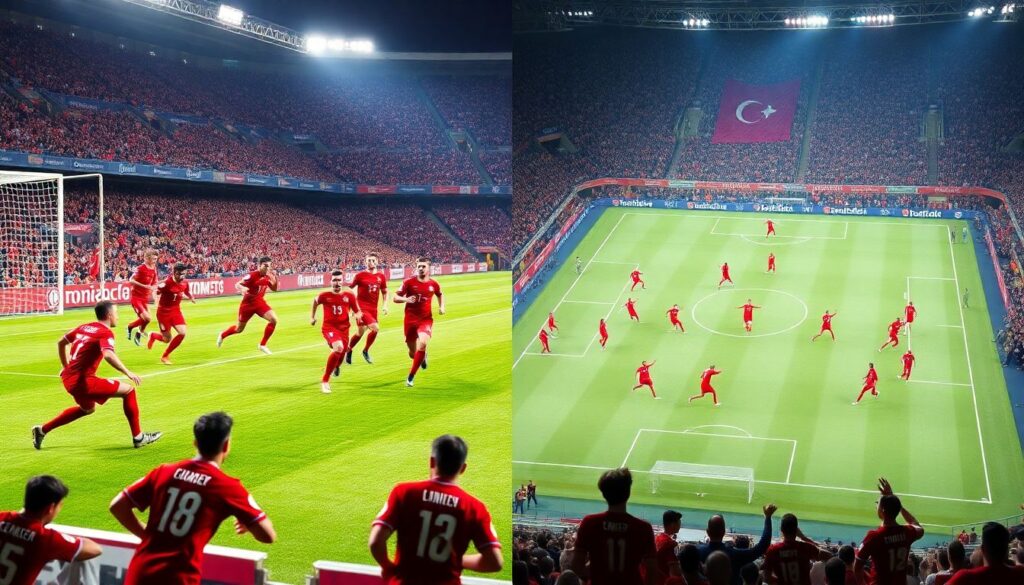
If you strip away the emotions, Turkey’s main competitive advantage vs world powers is tactical flexibility with high energy.
Long paragraph warning, but it matters.
Turkey has evolved into a team that can:
– Press high in spells, especially at home or in group games.
– Drop into a compact mid‑block against superior technical sides.
– Transition quickly through technically clean midfielders and aggressive wide players.
Against a powerhouse, the typical pattern looks like this: defend in a 4‑4‑2/4‑2‑3‑1 medium block, invite pressure into wide areas, then spring fast transitions through the wings and overlapping full‑backs.
In other words, Turkey doesn’t try to “out‑possession” Spain or “out‑press” Germany for 90 minutes. They pick their moments.
—
Technical block: default tactical blueprint vs elite opponents
– Base shape: 4‑2‑3‑1 or 4‑3‑3.
– Pressing triggers: bad touch from opposition CBs, back‑passes to the keeper, or isolation of a full‑back.
– Defensive line: generally mid, adjustable to low vs ultra‑elite attacks (e.g., France, Argentina).
– Transitions: preference for diagonal balls to wingers into half‑spaces rather than long clearances.
– Set pieces: heavy use of rehearsed routines; an important equalizer vs technically superior teams.
—
Turkey vs Europe’s heavyweights: France, Germany, England
When Turkey faces European giants, the emotional narrative often overshadows the football reality. But if you rewatch the last decade of games vs France, Germany or England, a pattern emerges.
Turkey is rarely outclassed for 90 minutes. What happens instead:
– Spells of parity or domination – especially between minutes 20–60, when intensity and crowd energy peak.
– Key collapses – a cheap goal conceded on a transition, or poor set‑piece defending.
– Bench quality difference – the opponent brings on fresh, high‑calibre subs; Turkey’s level drops slightly.
So in a hypothetical 2026 scenario:
– At home, Turkey can reasonably aim for 1 win / 1 draw / 1 loss across three games vs top‑tier European opponents.
– On neutral ground, in a tournament quarter‑final, the matchup is close enough that the game is decided by details: refereeing, VAR, set pieces, or one moment of genius.
This is exactly why people actively look for a Turkey vs Germany live stream or similar fixtures: the games have become tactically rich and genuinely competitive, not just romantic long shots.
—
How Turkey matches up vs non‑European giants
Against South American powers (Brazil, Argentina, Uruguay), the dynamic shifts slightly.
These teams often:
– Accept more chaos in midfield.
– Play with more 1v1 dribbling and less rigid positional play.
– Are comfortable winning “broken” games.
Turkey’s strengths—structured defending, choreographed pressing, rehearsed attacking patterns—can either neutralize or be overwhelmed by that chaos, depending on game state.
In a 2026 World Cup‑style setting:
1. Turkey vs a South American giant is usually decided by discipline.
2. If Turkey avoids an early concession and maintains structure, they can drag the game into a tactical contest.
3. If the match turns into an end‑to‑end shootout, the elite South American individual quality still tends to win out.
So Turkey is now a credible obstacle for non‑European elites, but still an underdog, especially away from Europe.
—
Numbers that matter: where Turkey actually stands
Rankings fluctuate, but objective indicators up to 2024 paint a clear picture of a top‑20/25 national side that occasionally performs like a top‑10 team in tournaments.
Some key metrics to look at (without pretending we have 2026 data in hand):
1. Elo rating trend – Turkey has trended upward in the mid‑2020s, reflecting improved results vs mid‑ and high‑tier opponents.
2. Non‑penalty xG (expected goals) vs strong teams – performance metrics suggest Turkey creates more than it used to against comparable or superior sides, particularly through transitions.
3. Shot quality conceded – still the soft spot; Turkey can limit total shots, but the chances they do concede are often high‑quality.
All of this feeds into how bookmakers set UEFA Euro Turkey odds and predictions and how serious analysts view their true level. They’re no longer a “random” quarter‑finalist; they’re a team that statistically belongs at the business end if the draw is kind.
—
Technical block: data‑driven comparison vs a typical powerhouse
*(Conceptual, based on 2018–2024 data patterns)*
– Possession: Turkey ~45–50% vs elite; powerhouses ~50–55%.
– xG created: Turkey can reach 0.9–1.3 xG in a good game vs elite, enough to score 1–2 goals.
– xG conceded: Often 1.2–1.6 in the same games, indicating Turkey typically needs clinical finishing or set‑piece edge to win.
– Pressing efficiency (PPDA and pressed sequences): Turkey’s best performances vs big teams come when these indicators are near European averages for strong pressing sides, not when they sit deep all match.
—
Where Turkey still lags: stability, depth, mentality
The gap vs the very best isn’t just about talent.
Three recurring issues keep Turkey slightly below the true elite:
1. Squad depth
– Injuries to 2–3 key starters can drastically lower the team’s ceiling.
– Some positions still lack a second option at top‑5 league level.
2. Tournament mentality
– When things go well, Turkey rides emotional waves brilliantly.
– When they go badly early (e.g., an opening defeat), there’s historically been a tendency toward overreaction and tactical panic.
3. Coaching continuity
– The top national teams tend to commit to a long‑term tactical project.
– Turkey has improved here, but even moderate instability at coaching level can undercut progress.
None of these are unsolvable. But they explain why, over a decade, France or Spain will reach more semi‑finals even if Turkey can upset them in a one‑off game.
—
What this means for fans, bettors and casual viewers
This competitiveness changes the ecosystem around the team.
– Matchday experience
Demand for Turkey national team tickets has risen whenever they hit a good form cycle, especially in qualifying and knockout deciders. Home stadiums are now recognized as genuine “difficult away days” for elite opponents.
– Broadcast interest
Neutral fans increasingly seek out big‑ticket matchups; searching for a Turkey vs Brazil live stream or similar now actually makes sense because the games tend to be open, noisy and tactically layered.
– Betting and analytics
Those who bet on Turkey national football team now look at more than just “heart over head.” xG, tactical matchups and rest days matter, because Turkey has reached a level where marginal edges decide results vs comparable teams.
– Merchandise and identity
The rise of a charismatic core has led to more fans looking for a Turkey national team jersey buy online, not just during tournaments but through qualifying cycles as well.
In other words, the team has become a “serious” football project, not a four‑week summer story every few years.
—
2026–2030: realistic forecast of Turkey vs the world
Given that my detailed knowledge stops in 2024, any 2026 outlook is partly projection. But using talent pipeline, tactical trends and recent results, a grounded forecast looks like this:
1. Consistent tournament qualification
– Turkey should be a regular participant in Euros and World Cups through 2030, barring an implosion.
– Missing a major tournament would be seen as a failure, not just bad luck.
2. Frequent knockout appearances
– Round of 16 should be the minimum expectation.
– Quarter‑finals will be a realistic target in most tournaments with a decent draw.
3. Occasional deep run (semi‑final)
– Every 8–12 years, when the bracket opens up and the team peaks physically and tactically, a semi‑final is entirely plausible.
– That run would likely involve eliminating at least one global powerhouse along the way.
4. Rising global respect
– Top nations will treat Turkey as a “dangerous opponent” rather than a comfortable draw.
– Friendlies vs Turkey will be used as serious tests, not marketing games.
5. Improving predictive models
– As the sample size of high‑level matches grows, models used to shape UEFA Euro Turkey odds and predictions will stabilize around a picture of Turkey as a solid top‑15–20 side with a spiky upside.
If youth development and coaching stability keep trending upward, the next generation (late 2020s) could be the first that enters a World Cup not only dreaming but expecting to compete on even terms with almost anyone.
—
So, how does Turkey really stack up against global powerhouses?
Not as a favorite. Not yet.
But as of 2026, Turkey is firmly in the group of nations that:
– Routinely qualify for big tournaments.
– Can beat a heavyweight on a good day with a smart game plan.
– Have enough high‑level players to avoid being overwhelmed by the stage.
The era of Turkey needing a miracle to scare the world’s best is over.
Now, when a big name draws Turkey in a knockout bracket, the honest reaction in their camp is simple:
“This is uncomfortable. We can’t take this lightly.”
And that alone says a lot about how far the national team has come—and how interesting the next decade of Turkey vs the world is likely to be.