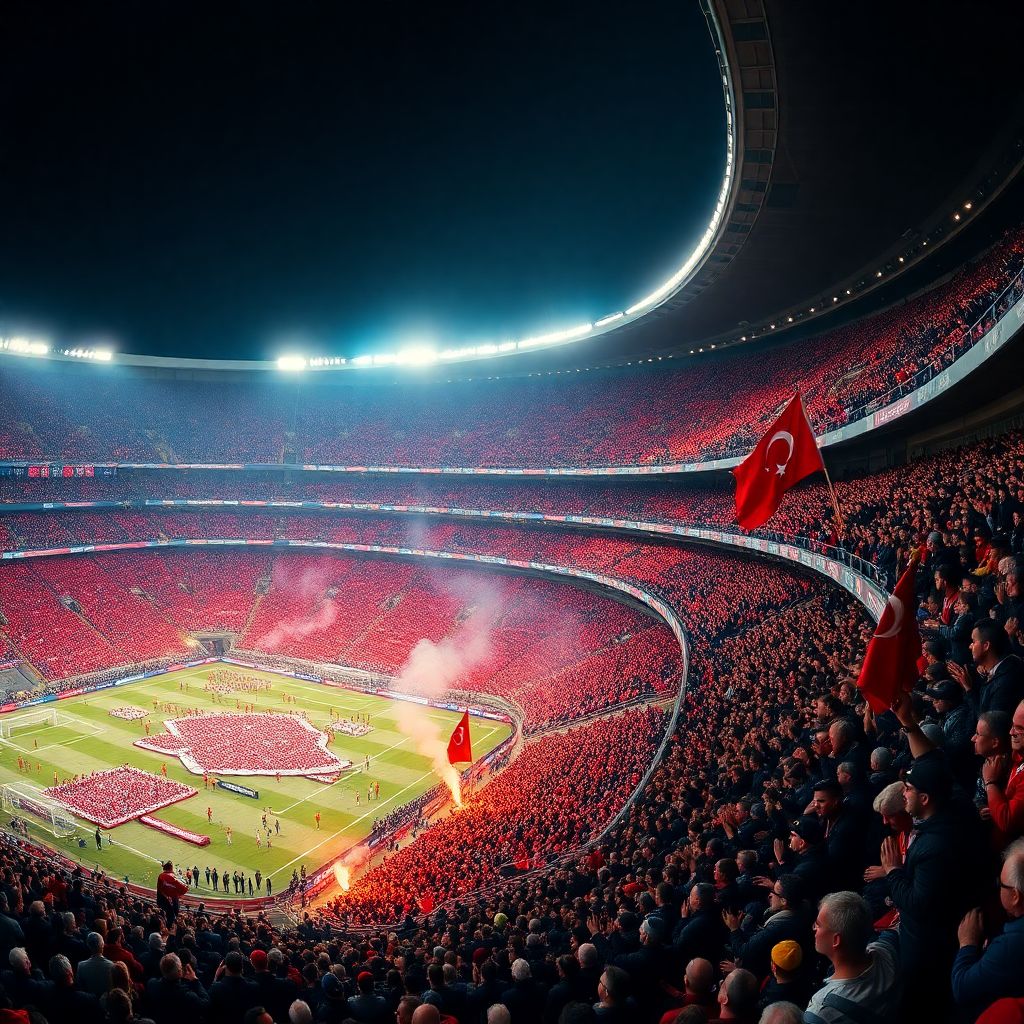
Why Turkish fan culture feels different from the rest of the world
If you talk to anyone who has seen football on several continents, there is a recurring pattern: Türkiye keeps coming up as an outlier. It is not just about “loud fans” or “crazy ultras”; it is about how the entire matchday is engineered as a continuous ritual. While many European and South American clubs also have intense support, the density of noise, pyrotechnics, and collective behavior in Istanbul or Trabzon is closer to a controlled combustion process than to a casual weekend activity. To understand this properly, we need precise definitions, a bit of comparative analysis, and a few concrete case studies from real derbies and Champions League nights.
Key definitions: ultras, chants, and stadium atmosphere as systems
In a technical sense, ultras are highly organized supporter groups with persistent identity, internal governance, and stable repertoires of visual and acoustic support. They operate like a semi-formal “operations unit” inside fan culture: they handle banners, choreographies, drums, and sometimes logistics for away travel. A chant is a structured vocal pattern (rhythmic + melodic) designed for mass participation with minimal learning cost. Stadium atmosphere is the integrated output of these subsystems: the sum of sound pressure (measurable in dB), visual signaling (flags, tifos, flares), and behavioral synchronization (jumping, clapping, coordinated gestures). In Türkiye, these elements are designed and executed with a level of intentionality that often exceeds what you see in average Western European leagues, where entertainment can be more fragmented and commercial.
Text-based diagram: components of fan culture
Imagine a conceptual diagram described in text form:
– Level 1 (Core): Club identity, city culture, political and social context
– Level 2 (Organized units): Ultras groups, fan associations, travel groups
– Level 3 (Tactical tools): Chants, drums, megaphones, tifos, pyrotechnics
– Level 4 (Output): Noise level, intimidation factor, broadcast images, player motivation
You can think of Turkish fan culture as a system where Level 2 and Level 3 are unusually strong and tightly coupled, so the Level 4 output is remarkably intense and continuous, especially in derbies and European nights.
Turkish ultras vs. global ultras: how similar structures behave differently
Across the world, from Curva Sud in Italy to barras bravas in Argentina, ultras share some universal traits: hierarchy, clear leadership, informal codes of conduct, and sometimes links with local politics or subcultures. Turkish ultras—like ultrAslan (Galatasaray), Çarşı (Beşiktaş), and Genç FB (Fenerbahçe)—fit this template, but tend to operate with higher participation from “ordinary” fans. In Germany, for instance, ultras often dominate one end of the stadium while the rest behaves more like traditional spectators; in Türkiye the boundaries blur more, with entire stands often following the ultras’ instructions in real time. The result is less segmentation and more stadium-wide synchronization, which foreigners often describe as “the whole bowl is vibrating” rather than just one noisy corner.
Diagram in text: comparison of participation intensity
Let’s outline a notional, text-based “intensity profile” of stadium participation:
– Typical Western European big club:
– Ultras section: 80–100% active (chanting, flags, jumping)
– Side stands: 30–50% active
– VIP / main stand: 5–15% active
– Typical Istanbul derby:
– Ultras section: 95–100% active
– Side stands: 70–90% active
– Main stands: 30–60% active
This is not about “better or worse” but about distribution: in Türkiye, high-intensity behavior is spread more evenly, leading to a thicker acoustic wall and a more immersive environment even for a neutral visitor.
Case study 1: Galatasaray – Fenerbahçe derby as an engineered event
Take the Galatasaray – Fenerbahçe derby. Weeks before kick-off, ultras are already in planning mode: tifo designs are sketched, donation rounds run via fan networks, and chant leaders coordinate what will be used in specific match scenarios (pre-kickoff, team entrance, after goals, and during possible VAR delays). When a foreign fan buys galatasaray fenerbahce derby tickets, they are not just buying a “seat” but effectively a temporary role in an orchestrated performance. On the day, the metro lines fill with color-coded crowds, pre-game meetups act like decentralized warm-up nodes, and by the time you reach Rams Park or Ülker Stadyumu, the atmosphere is pre-loaded. Compared with derbies like Inter–Milan or Arsenal–Spurs, the Turkish version tends to have fewer “quiet valleys” during the 90 minutes; instead, noise is sustained with carefully sequenced chants, similar to how a DJ builds a set without losing the dancefloor.
Technical breakdown of derby noise management
From an acoustic engineering perspective, Turkish fan groups use several tactics to prevent atmosphere from collapsing. First, they use low-frequency, rhythm-heavy chants that are easy to maintain over long periods; second, they rotate “lead sections” so one block rests while another carries the vocal load; third, they embed call-and-response structures between different sides of the stadium, which keeps people cognitively engaged. Compared with stadiums where spontaneous chants start and die within 20 seconds, this managed process looks more like a distributed algorithm: different “nodes” (tribunes) keep the network active even when the game itself is static or tense.
Chants: linguistic, acoustic, and cultural features in Türkiye
Turkish chants have a few distinctive properties. Linguistically, they often mix simple Turkish with borrowed English or global football slang, but the phrasing is adapted for phonetic punch—hard consonants, open vowels, and repetitive syllables, which project better in open-air bowls. Many chants are in 2/4 or 4/4 meter with drum backing, making them easy to synchronize for thousands of people. Compared with English or Spanish stadium songs, Turkish versions often feel closer to military marching rhythms combined with pop or rock motifs. On top of that, there is frequent use of “spoken word” megaphone segments where a capo speaks short motivational sentences, echoed by the crowd, which you see less in, say, Premier League grounds where PA systems and commercial music intrude more aggressively.
Global comparison of chant complexity
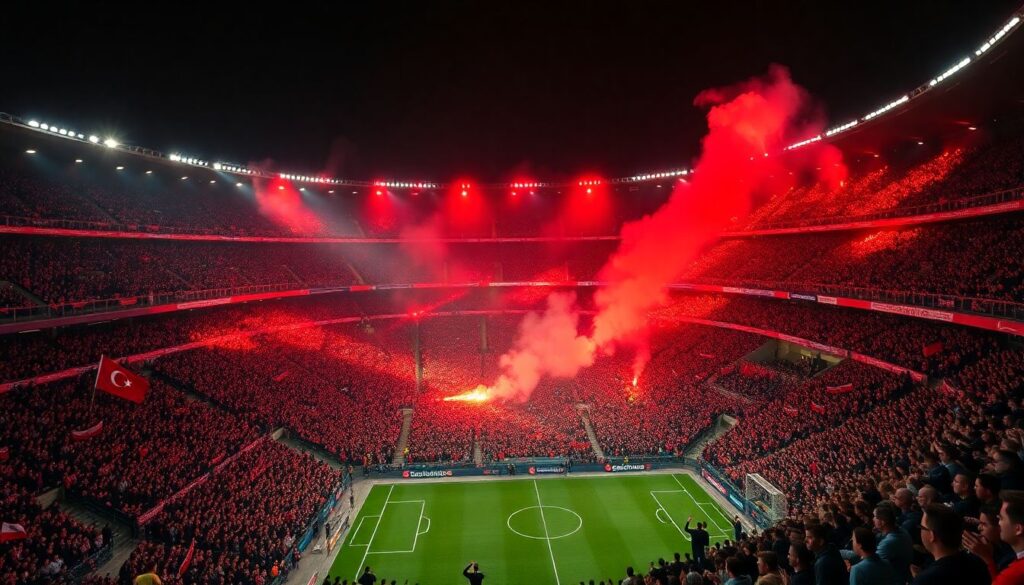
If you compare Türkiye to, for example, German or Dutch ultra scenes, the melodic complexity is sometimes lower but the density and volume are higher. In Italy or Argentina, you can find long, melodically rich songs; in Türkiye, the design goal often prioritizes “maximum dB with maximum participation” rather than artistic sophistication. For a neutral listener, it can feel less like singing and more like a rhythmic engine—a kind of living bassline driving the players forward. That difference becomes obvious when a Turkish club travels away in Europe: the away end may be outnumbered, but the acoustic impression is often disproportionate to its size, precisely because of that design choice.
Case study 2: Beşiktaş, Vodafone Park, and controlled chaos
Beşiktaş and its primary group Çarşı have long been known for political banners and humor, but if you attend a big European night at Vodafone Park, the most striking feature is the “Growl” that builds up when the opponent touches the ball. This is not random; it is a cultivated habit: every time the opposition enters certain zones of the pitch, the stadium responds with a pre-agreed sound pattern, creating a psychological field. Compared with Anfield’s famous “You’ll Never Walk Alone,” which is emotionally powerful but largely confined to pre-kickoff moments, Beşiktaş’ noise output operates as a continuous interference signal. Opposing players notoriously complain about communication difficulties, especially for defenders trying to pass under pressure.
Acoustic diagram in text: noise as pressure zones
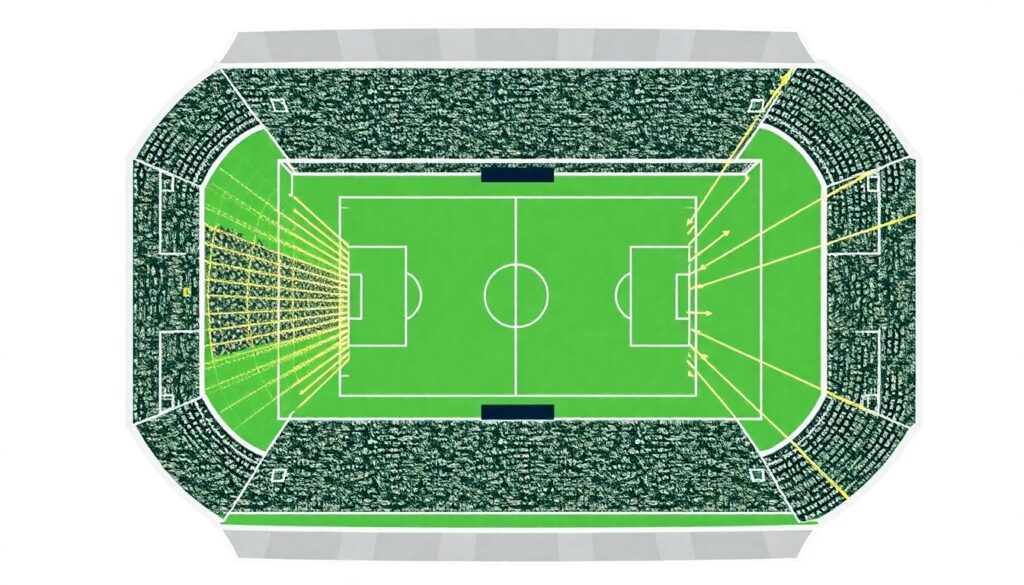
Picture a top-down diagram of the pitch where different stands are “emitters” of sound:
– South stand (ultras): baseline continuous bandwidth noise (chants, drums)
– North stand: reactive, event-driven bursts after fouls or referee calls
– Side stands: directional booing, whistles during opposition buildup
In Vodafone Park, these emitters are coordinated such that at least one is “peaking” during any high-risk opposition phase. In engineering terms, it is a multi-source noise field designed to reduce opponent signal clarity (verbal commands) and raise stress levels, which is quite different from more “ceremonial” atmospheres in England or France.
Tickets, travel, and the tourism layer of Turkish fan culture
In recent years, intense atmospheres have become a tourism product. Foreign visitors search for turkey football ultras tickets not just to “see a game” but to experience a specific type of social environment that is hard to replicate elsewhere. This has led to specialized agencies building turkey football match travel packages, which bundle hotel, matchday logistics, local fan-guide escorts, and sometimes even controlled access to pre-match ultras gatherings (within legal and safety constraints). Compared with Spain or England, where the tourism product often centers on stadium museums and legends tours, the Turkish offering sells live, noisy chaos as a premium. That said, sales for high-risk derbies remain tightly controlled due to security protocols, ID requirements, and local regulations aimed at minimizing violence.
Case: a foreign group at a Galatasaray Champions League night
One real example: a group of Scandinavian fans booked a package that included match tickets, translation support, and a mini “ultras 101” briefing before a Galatasaray Champions League game. The local guide taught them basic Turkish chants, hand signals, and do’s and don’ts (no filming ultras faces in sensitive areas, no political slogans, respect capo instructions). During the match, these visitors integrated smoothly into the home fan block. Post-game feedback emphasized that the preparatory briefing was essential; without understanding the unwritten rules, they would likely have behaved like tourists, breaking the flow and possibly causing friction with locals who expect full participation, not passive observation.
Stadium tours and off-match experiences for global fans
Outside matchdays, many fans want to see the “infrastructure of atmosphere”: tunnels, dressing rooms, and the stands from the players’ perspective. Istanbul has some of the best stadium tours in istanbul for football fans, particularly at Galatasaray’s Rams Park, Fenerbahçe’s Ülker Stadium, and Beşiktaş’s Vodafone Park. These tours usually emphasize trophies, museum exhibits, and corporate history, but for serious fan culture enthusiasts the real value is seeing where the capos stand, how tifo rigging points are installed, and how acoustic architecture amplifies noise. Compared with, say, Camp Nou or Old Trafford tours, Turkish tours are slowly adding more content about ultras and chants because that is precisely what many visitors associate with the local game.
Tourism vs. authenticity: a fine balance
There is an ongoing tension between preserving organic fan culture and packaging it for visitors. If you over-commercialize, you get “safe, sanitized” atmosphere that looks good on Instagram but feels fake to locals. Turkish clubs are experimenting with ways to keep control with the ultras while still monetizing interest: for example, scheduling tours at times when fan workers are installing tifos, or offering Q&A sessions with former capos rather than turning the home end into a photo-op zone filled with props. So far, the balance is imperfect but evolving, and observers from other leagues are watching closely as a potential model for monetizing intense support without flattening it.
Merchandise and visual identity: from scarves to subculture
One often-overlooked technical layer is merchandise. In Türkiye, football fan merchandise turkey clubs is not just shirts and scarves; it includes ultra-branded hoodies, limited-edition scarves for specific away games, and tifo-related items that double as everyday wear. While big European clubs tend to centralize merchandising under corporate logos, Turkish ultras often maintain parallel micro-brands with their own symbols, fonts, and iconography. This leads to a more granular visual ecosystem in stands: you see official jerseys mixed with group-specific gear, making it easy to visually map sub-communities inside the stadium. Compared with the more homogenous visuals of, say, Premier League family stands, Turkish terraces look closer to a fabric of small tribes, each with slightly different aesthetics, but aligned behind the same club crest.
Diagram in text: layers of visual branding
Visual branding in a Turkish stadium can be described in three nested circles:
– Outer circle: Official club branding (jerseys, sponsored scarves, flags)
– Middle circle: Ultras group branding (logos, slogans, exclusive designs)
– Inner circle: Micro-collectives (local fan clubs, regional buses, friend groups)
The interplay between these circles generates a rich but coherent visual field that contributes heavily to TV broadcast aesthetics, and thus to global perception of “what Turkish football looks like” even for viewers who never attend in person.
Safety, regulation, and the evolution of ultras behavior
Any honest comparison between Türkiye and the rest of the world must address risk management. Historically, there have been serious incidents in and around Turkish stadiums, especially in derbies, which led authorities to introduce strict measures: electronic ticketing tied to ID, camera coverage of stands, and heavy on-site policing. Similar trends exist in Italy, Poland, and South America, but in Türkiye they intersect with a culture that strongly values matchday freedom. As a result, ultras have adapted: pyrotechnics are used more strategically, choreography planning often includes risk assessment, and there is growing use of social media to coordinate peaceful but intense behavior. Compared with some South American scenes where violence remains more normalized, Turkish groups are under closer institutional scrutiny, which, paradoxically, can push them to be more creative in legal and semi-legal displays rather than direct confrontation.
Case study 3: Trabzonspor and regional intensity
Fan culture in Türkiye is not limited to Istanbul giants. Trabzonspor’s supporters on the Black Sea coast are a textbook case of how regional identity amplifies fan behavior. The city has fewer alternative entertainment ecosystems than Istanbul, so the club is a primary identity anchor. On big nights at Papara Park, the atmosphere rivals that of Istanbul derbies, but with a different flavor: more regional folk influences in chants, different types of drums, and a stronger sense that “everyone in town is in the same tribe.” Compared with a mid-table club in, for instance, France or England, the ratio of ultras-style behavior to population size is much higher; whole neighborhoods transform on matchday, not just areas around the ground.
Global context: where Türkiye sits in the fan culture landscape
If you place Turkish fan culture on a global map, it sits somewhere between South American emotional intensity and European organizational rigor. It is not as militarized as some Eastern European ultra scenes, not as festival-like as many German matchdays, and not as corporate as top Premier League games. Instead, it is a hybrid model: extremely loud, heavily choreographed, yet still deeply rooted in local city politics, neighborhood rivalries, and generational traditions. For a neutral observer, this makes Türkiye a kind of laboratory for modern fan culture: you see how older forms of terrace behavior adapt to digital coordination, tourism demand, and broadcasting economics, without losing their core identity.
Practical tips for experiencing Turkish fan culture firsthand
– If you plan to attend a big match, work with trusted local partners or official channels; for high-risk games, spontaneous purchase is often impossible due to ID-linked systems.
– Learn at least a couple of basic chants and hand signals; local fans appreciate visible effort and you will blend in more easily.
– Respect no-go zones for filming or posting ultras faces online, especially in active blocks; treat it like entering a semi-private space with its own norms.
For clubs and analysts: what can be learned
For practitioners in other countries—club executives, security managers, or supporter liaison officers—Türkiye offers useful reference points. You can study how Turkish clubs collaborate or clash with ultras, how police and stewards handle extremely loud but mostly peaceful crowds, and how sound and light are used as tactical tools rather than just decoration. While you might not want flares and 120 dB noise in every league, the underlying principle—treating atmosphere as a system to be designed and maintained—translates well. In that sense, watching a night game in Istanbul or Trabzon is not only a visceral fan experience; it is also an advanced case study in applied crowd dynamics.