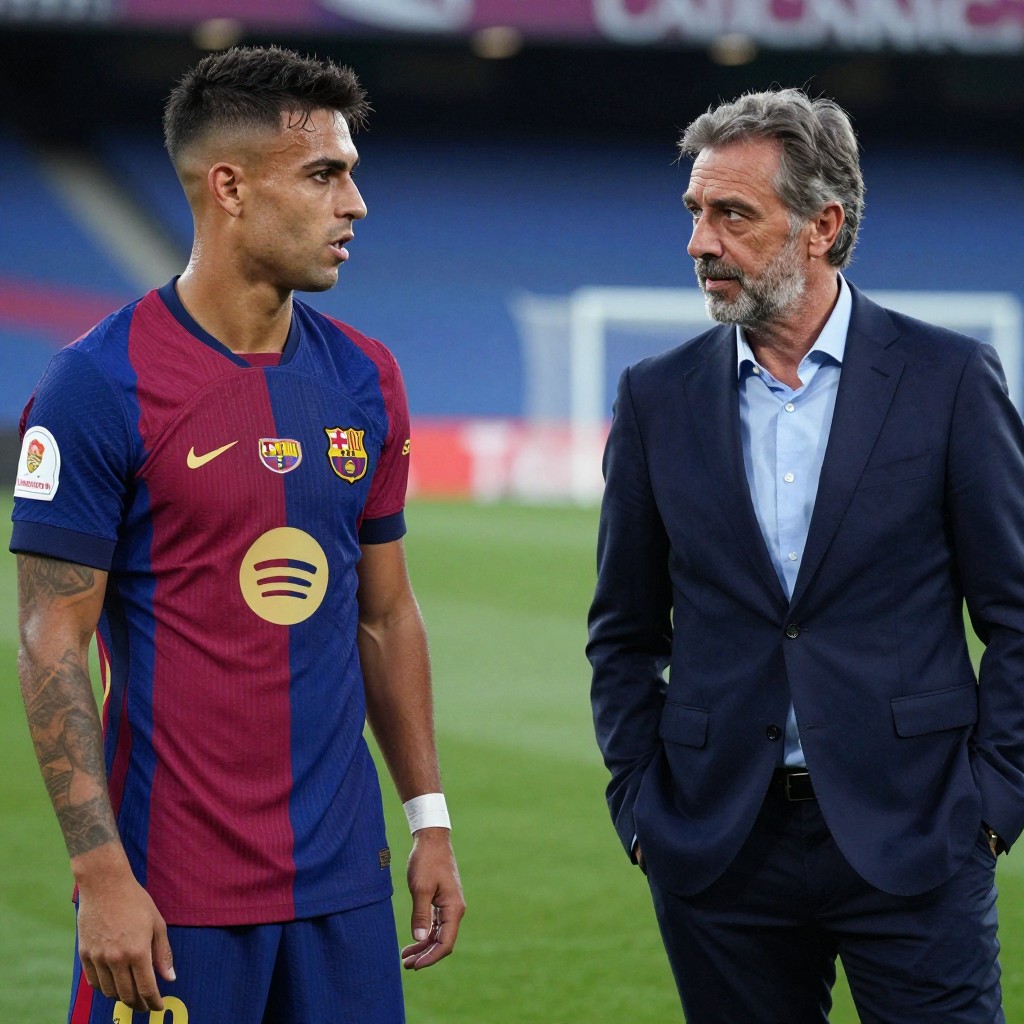
“We spoke with Inter about Martinez”
Barcelona president Joan Laporta has revealed that he contacted Inter directly about signing striker Lautaro Martínez during the summer transfer window. The discussions did not progress: Inter made clear that the Argentina international was not available, and Barcelona chose not to press the issue.
Speaking about the approach, Laporta said he called Inter president Beppe Marotta himself, without involving intermediaries. He told Marotta that he greatly admired Martínez and wanted the forward in his team. But, according to Laporta, the response was immediate and unequivocal.
Marotta did not allow the conversation to develop into a formal negotiation, Laporta explained. Inter’s position was that Martínez was not for sale. The club president also indicated that the question of whether the player might leave was not one Marotta could settle on his own. Laporta accepted the answer and brought the matter to a close.
He said the decision to stop there reflected the relationship between the two clubs’ presidents. Laporta described his dealings with Marotta as being built on mutual trust, adding that Barcelona’s respect for both the Inter president and the Italian club meant there was no reason to pursue a transfer that Inter had already rejected.
The episode illustrates how quickly a transfer conversation can end when the selling club draws a firm line. Barcelona’s interest was clear, but admiration for a player does not automatically lead to negotiations: the club that holds his registration must also be willing to consider a departure. In Martínez’s case, Inter’s answer left little room for further discussion.
Laporta also spoke about Cesc Fàbregas, the former Barcelona academy product who is now coaching Como. He praised Fàbregas’s work and said he particularly liked the coach’s mentality. In Laporta’s view, Fàbregas understands Barcelona’s football philosophy and has brought elements of it to his team in Italy.
Asked whether Fàbregas could one day manage Barcelona, Laporta did not present the possibility as a current plan. His comments acknowledged the coach’s qualities but stopped short of suggesting that a future appointment was under consideration. For now, Barcelona’s president left the question of Fàbregas’s return in a coaching role open rather than placing it on the club’s immediate agenda.
Laporta was more definite when discussing Lamine Yamal and the Ballon d’Or. He argued that the young Barcelona player deserved the award, saying Yamal belonged at the top of the list and was ready to win. Laporta’s view reflects the high expectations surrounding the forward, although the award itself is decided through a separate voting process.
His remarks link three different subjects: Barcelona’s recruitment ambitions, the development of a coach with deep ties to the club, and the rise of one of its most prominent young players. The Martínez approach was shaped by Inter’s refusal to sell, while Laporta’s comments on Fàbregas and Yamal focused on potential and achievement rather than immediate transfer decisions.
For Barcelona, the outcome of the Martínez conversation was straightforward. The club expressed its interest, received a clear refusal and respected Inter’s position. Laporta’s account also suggests that personal trust between club executives can help keep transfer discussions direct-even when they do not result in a deal.
The comments do not indicate that Barcelona made a formal offer or that Martínez was close to joining. Instead, they describe an initial conversation between the presidents and explain why it ended before negotiations went any further. Inter’s stance, as Laporta recounted it, was enough to settle the matter.
That distinction is important in assessing transfer reports. A club can admire a player and make contact without submitting a bid, reaching agreement or entering a prolonged negotiation. In this instance, Laporta’s description points to interest from Barcelona, but also to a swift decision not to challenge Inter’s position.