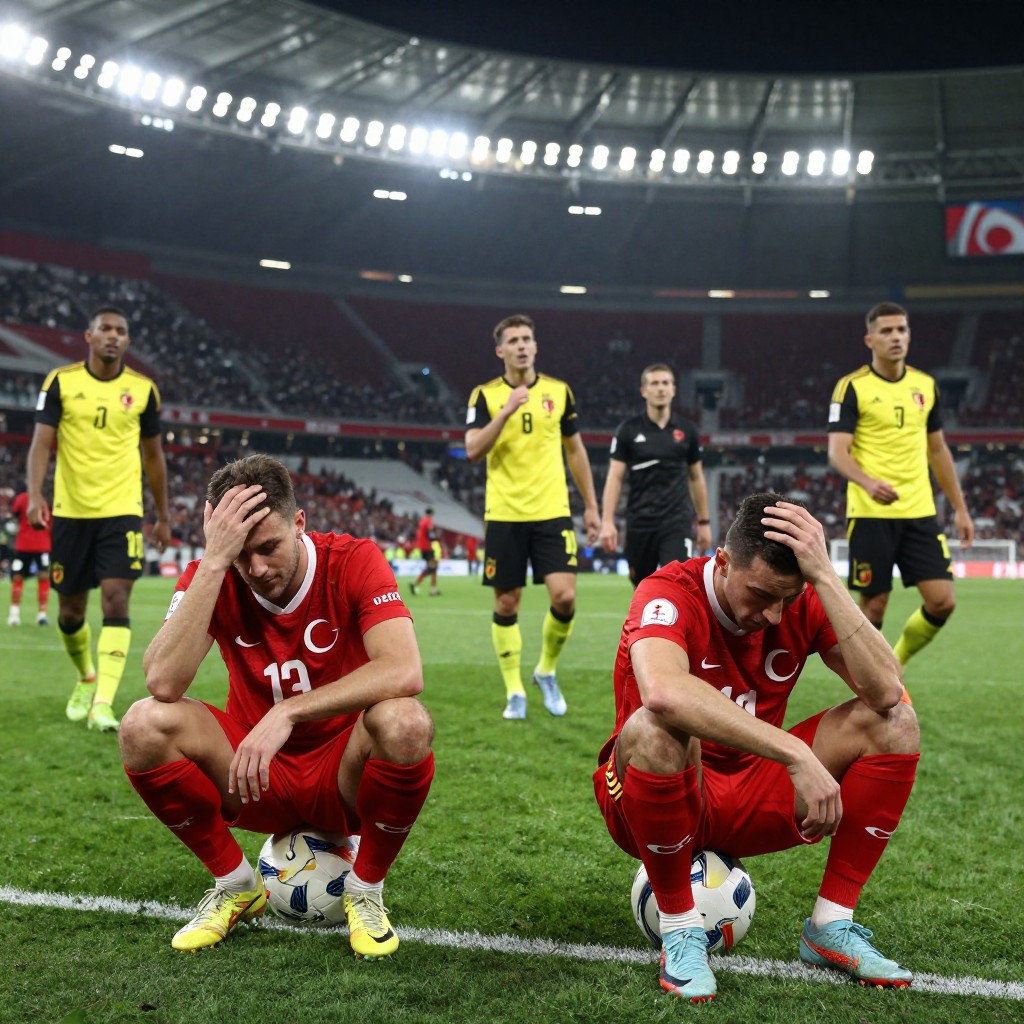
Turkish Sports Writers Assess the National Team After Belgium Defeat
Turkey’s 3-0 loss to Belgium in the UEFA Nations League A, Group 1, prompted sharp criticism from several prominent sports columnists. Their assessments focused not only on the result, but also on the team’s disjointed attack, selection decisions, defensive mistakes and the wider problems facing Turkish football.
A disorganized attack and deeper structural problems
Cem Dizdar argued that Turkey looked anxious and poorly coordinated, a reaction he linked both to losing its first two matches and to turmoil surrounding the country’s refereeing committee. Although Arda Güler helped shape some of the team’s attacks, Dizdar felt the side lacked clarity when it came to turning possession and forward movement into effective chances.
In his view, several players appeared uncomfortable in their positions. Turkey attempted to attack and shoot, but too often its moves broke down before they became genuinely dangerous. The opening goal, he wrote, followed a sequence of errors, with one mistake leading to another.
The national team began the second half with better use of the ball and created several threats through Arda. Yet improved spells did not translate into a goal. Turkey hit the post during an early attack, then conceded again in the 59th minute, when Kevin De Bruyne found the net. The visitors’ occasional response was not enough to change the course of a match in which they struggled to produce a decisive finish.
Dizdar also pointed to an imbalance in the player pool. Turkey has several options in areas such as central defence and midfield, he observed, but appears short of alternatives at right-back and centre-forward. Those gaps, he argued, are difficult to overlook at Nations League A level. He warned, too, against treating the coach as the sole explanation for the team’s difficulties: replacing a manager would not by itself resolve structural weaknesses in Turkish football.
Questions over selection and the coach’s future
Uğur Meleke focused on goalkeeper and striker choices. He noted that Turkey had conceded eight goals across its first three matches and attributed four of them to goalkeeper errors. At the same time, he highlighted Berke Özer’s regular appearances for Lille, a club competing near the top of the French league and in the Champions League. Berke had played in all six of Lille’s matches that season, keeping three clean sheets, Meleke said, and questioned why the issue surrounding his involvement with the national side had remained unresolved.
Meleke also questioned the absence of Enes Ünal, who was playing for Getafe in Spain. He cited the forward’s involvement in all nine of the club’s official matches that season, including seven starts, and contrasted that record with Turkey’s use of wide players such as Barış Alper Yılmaz and Kerem Aktürkoğlu in central attacking roles.
The columnist called for Vincenzo Montella’s departure, arguing that the team needed a fresh start. He also criticized the coach’s comments about Enes and raised concerns about reports of a possible compensation package worth €5 million for two years. Those figures were presented as media claims, but Meleke said that such a payment would be difficult to justify given the salaries of several prominent international coaches.
Looking ahead, he suggested that Eddie Howe would be his preferred choice for the job if he became president of the Turkish Football Federation, with Thomas Frank as another possibility. Meleke also argued that any foreign head coach should work alongside a promising Turkish assistant who could take charge of the Under-21 side. In his view, Arda Güler should be considered for the captaincy as part of a broader reset.
A demanding division, but no excuse for surrender
Güntekin Onay described the top tier of the Nations League as a difficult environment for Turkey, while stressing that the team should not be so easily overwhelmed. He said the side missed the quality of Kenan Yıldız and Hakan Çalhanoğlu and pointed to a troubling start: three matches played, no points earned, with away fixtures against Italy and France still to come.
Onay also questioned Montella’s repeated reliance on Kerem and Barış. He argued that the pair had not delivered enough in the roles assigned to them and criticized the decision to move Kerem into the centre-forward position again after Barış was substituted. The approach had been tried repeatedly without success, he said, and continuing to use it suggested that the coaching staff were not adapting.
Instead, Onay wanted to see more willingness to experiment. If Montella had been prepared to give Bartuğ a chance, he argued, players such as İlhan and Deniz could also have been considered from the start. A defeat after testing new combinations, in his view, would have been more useful than another loss produced by familiar choices.
Onay did not question the players’ effort or intentions, but maintained that commitment alone was not enough. A national team also needs a clear plan: coordinated movement without the ball, reliable options in attack and a system that makes individual strengths work together. Turkey’s problem, in this assessment, was not simply a lack of determination but a shortage of organization on the pitch.
What Turkey needs to address next
The columnists’ comments point to several separate decisions that should not be confused with one another. A change of manager may be considered, but it cannot fill a shortage of specialist players or repair weak development pathways. Likewise, adding new names to the squad will have limited effect unless they are given defined roles and the team has a consistent tactical identity.
The forward line is an especially visible concern. When wide players are repeatedly asked to operate as strikers, the team can lose both the movement needed to stretch a defence and a reliable presence in the penalty area. Turkey needs to decide whether to build around a natural centre-forward or use a different system-and then give that plan enough time to develop.
Selection also needs to be explained clearly. If an in-form player is left out, the coaching staff should be able to set out the footballing reasons. Transparent criteria would help prevent every omission from becoming a separate controversy and keep attention on performance rather than speculation.
For the defence, reducing avoidable mistakes must be a priority. The criticism of goalkeeping does not mean that every conceded goal has a single cause: defensive positioning, pressure on the ball and communication can all contribute. Reviewing the full sequence leading to each goal would offer a more useful response than assigning blame to one player.
Finally, the coming matches against Italy and France will test Turkey’s ability to respond under pressure. The score against Belgium exposed shortcomings, but the next step should be a practical one: select players suited to their positions, settle on a coherent approach and measure progress by the quality of the team’s play as well as the final result.