Turkey’s golden puzzle: three eras, one football identity
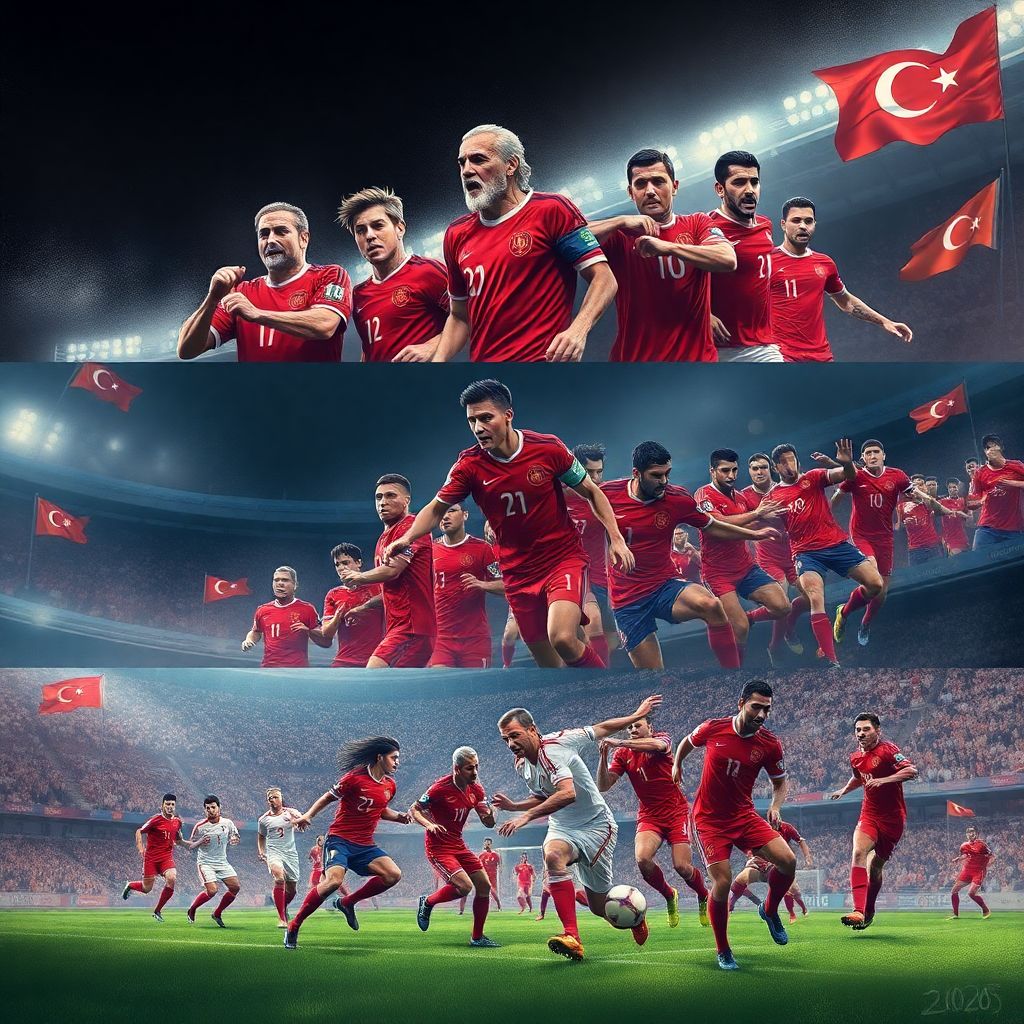
Turkey’s “golden generations” aren’t carbon copies of each other; they’re like three chapters of the same book written by different authors. The 2002 World Cup heroes, the Euro 2008 comeback kings and the adventurous Euro 2024 squad each solved the same problem in their own way: how to turn emotion, chaos and raw talent into something stable enough to beat the best. Instead of imagining one perfect template, it’s more honest to see an evolution: from warrior‑style football in 2002, к “organized chaos” в 2008 и до более европейской, проактивной модели в эпоху Euro 2024, где ставка делается на владение, прессинг и воспитание молодых звёзд.
—
Historical background: от сенсаций к устойчивости
2002: команда-сюрприз, которая никого не боялась
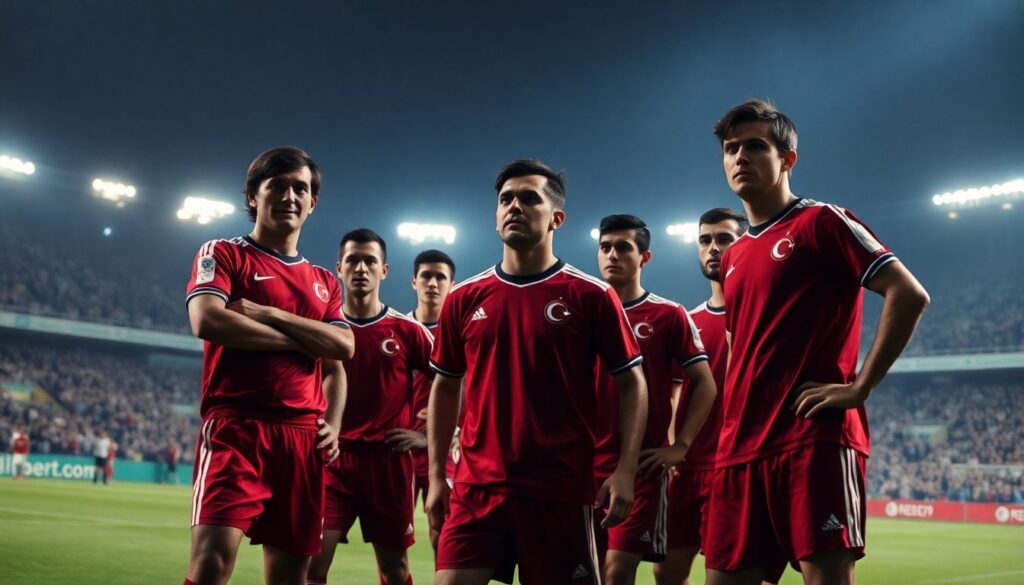
The 2002 side under Şenol Güneş came from a very different football world. Turkish players were battle‑hardened by fierce domestic derbies and deep European runs of Galatasaray, but the national team was still seen as an outsider. Güneş approached the problem pragmatically: compact 4‑1‑4‑1 / 4‑2‑3‑1, ruthless counters, and a mentality of “we suffer, then we strike.” They didn’t try to control every minute; they accepted long spells without the ball, betting on set pieces, individual brilliance from Hakan Şükür and Hasan Şaş, and a collectively aggressive mid‑block. In a way, this team solved its limitations — fitness, tactical depth, squad depth — through unity, simple roles and an “us against the world” mindset.
2008: отмена логики и культ камбэка
By Euro 2008, Fatih Terim faced a different challenge. Expectations were higher, opponents were more prepared, and Turkey could no longer surprise anyone just by running harder. Terim’s answer was to double down on emotion but blend it with tactical flexibility. The Euro 2008 squad became legendary for insane comebacks, but behind the drama stood a clear approach: heavy rotation, intelligent in‑game switches between back three and back four, and freedom for creative players like Nihat Kahveci and Arda Turan. This golden generation didn’t rely on sheer structure; it trusted improvisation within a loose framework, almost inviting chaos and believing they’d control its final act. That’s a very different philosophy from the relatively rigid 2002 model, even if both were fueled by the same national pride.
2024: поколение академий и европейской школы
Move to Euro 2024 and the environment changes completely. Turkish stars now grow up in Bundesliga, Premier League and Serie A academies, absorbing modern pressing schemes and positional play from day one. The current coaching staff faces a new problem: how to merge diverse club identities into one cohesive Turkey national team that can press high, keep the ball and still retain that emotional edge. Instead of reactive, tournament‑style football, the aim is continuity and a recognisable blueprint. Young talents like Arda Güler symbolise this shift: they’re comfortable as part of structured attacks, using rotation and overloads rather than just spontaneous dribbling. In this context, demand for Turkey national team Euro 2024 tickets is really a reflection of something deeper — fans sensing that this might be the first genuinely modern Turkish side built to last, not just to shock.
—
Basic principles: three different answers to the same question
Принцип 2002: минимализм, дисциплина и вертикальность
The 2002 approach started from scarcity. The staff assumed Turkey couldn’t out‑pass top teams over 90 minutes, so they narrowed the game: tight lines, limited risk in build‑up and very direct attacks once the ball was recovered. The core principle was verticality over aesthetics. Full‑backs overlapped selectively, the holding midfielder protected the centre like a bodyguard, and creative players had clear zones instead of free roaming. This model is like a well‑drilled underdog boxing clever: absorb pressure, wait for a mistake, punch hard. It solved the “we’re not favourites” problem with humility and discipline, and it worked because everyone bought into their role, even stars who were used to more freedom at club level.
Принцип 2008: доверие к хаосу и роли лидеров
In 2008, Terim almost flipped that logic. His basic principle was that Turkish players thrive when emotionally charged; instead of reducing variance, he embraced it. “Organized chaos” meant accepting open games, pushing numbers forward late on and trusting leaders to read the moment better than any pre‑planned pattern. Rather than one rigid attacking pattern, there were clusters: full‑backs high, midfielders interchanging, forwards drifting wide. It’s a high‑risk, high‑reward philosophy: you might concede more, but you also create surreal turnarounds — exactly what made that Euro run unforgettable. Compared to 2002’s rigid verticality, 2008 was about empowerment: players could bend the structure in real time, especially in the last 20–25 minutes.
Принцип 2024: позиционная игра, прессинг и глубина состава
The Euro 2024 generation tries to blend heart and brain. Its basic principles are closer to modern European trends: compact high pressing, structured build‑up from the back and clear positional roles in possession. Instead of only vertical balls into channels, you see deliberate creation of triangles, half‑space overloads and rotations between full‑backs and wingers. Crucially, the staff assumes squad depth is finally good enough to maintain intensity across a full tournament, unlike in 2002 and 2008, when suspensions and injuries forced improvisation. This shift is also visible off the pitch: fans who look for a Turkey football jersey 2024 buy online aren’t just chasing nostalgia; they’re buying into a new, more systematic identity that feels aligned with top European sides.
—
Implementation examples: how those ideas looked on the pitch
2002 in practice: set pieces, counters и геройские перформансы
On the field in 2002, Turkey implemented their philosophy through three main channels. First, set pieces were treated almost like a separate sport: rehearsed blocks, near‑post flicks, and second‑ball routines. Second, counters started from a clear trigger — regaining the ball in midfield and immediately looking for early passes into space for runners from wide areas. Third, there was room for “hero mode”: Rüştü Reçber saving the team with impossible stops or Hakan Şükür dragging defenders away to free partners. Instead of long, patient spells in possession, the team chased “moments.” They’d spend ten minutes under pressure, then explode in a 15‑second sequence that defined the match. This emphasis on decisive episodes is almost the opposite of the possession‑based control targeted in 2024.
2008 in practice: финишный штурм и гибкие схемы
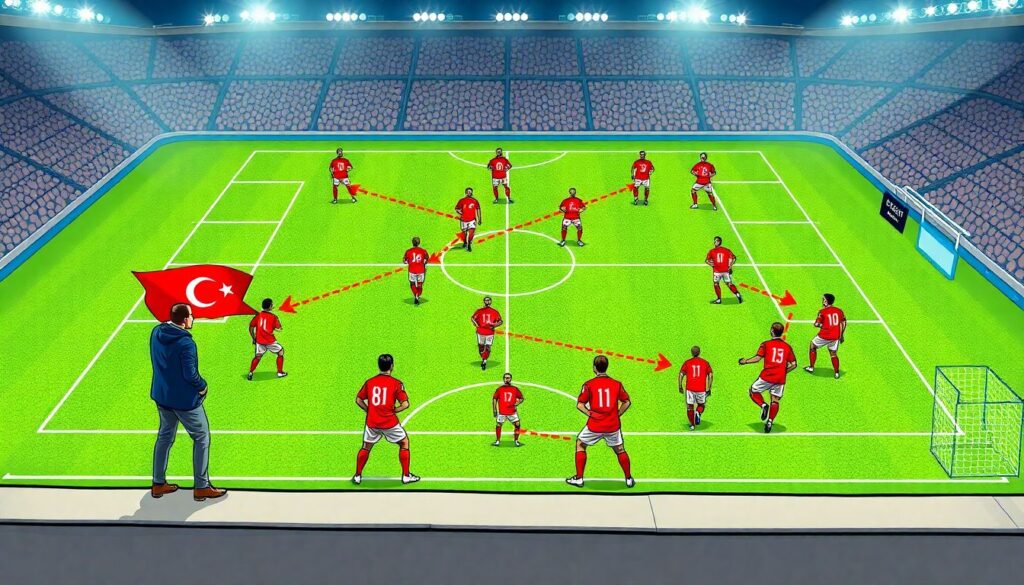
The Euro 2008 side translated its “organized chaos” idea into constant shape‑shifting. Terim wasn’t afraid to go from a back four to a back three mid‑match, or to overload one flank by pushing both full‑back and winger high while a midfielder covered. The most emblematic implementation is the late‑game siege: Turkey often looked almost reckless in the final minutes, with centre‑backs camped near the opponent’s box and long diagonal balls raining in. But there was method: second‑ball traps, crowding the edge of the box, and pre‑planned positions for shots from rebounds. These comebacks weren’t pure luck; they were the logical result of a strategy that saved emotional and physical peaks for crunch time, trusting that the opponent would mentally crumble before Turkey did.
2024 in practice: pressing triggers и “европейская” Турция
For Euro 2024, implementation is less about miracles and more about repeatable patterns. High pressing uses clear triggers: a bad first touch to the full‑back, a backward pass from the winger, or a centre‑back receiving on his weaker foot. Once triggered, the nearest forward jumps, the wingers tuck in to block passing lanes, and midfielders push up to compress space. In attack, you’ll see carefully rehearsed rotations: full‑back underlapping while the winger stays wide, or the No.10 dropping between centre‑backs to help in build‑up. Fans planning their matchdays — from choosing where to watch Euro 2024 live streaming Turkey coverage to travelling to stadiums — are witnessing a side that wants control from minute one, not only from minute eighty‑five. That’s a significant philosophical break from relying purely on late drama.
—
Different approaches to the same fan culture
Эмоция болельщиков: от шока 2002 к зрелой надежде 2024
Supporters are the constant across these eras, but how they experience the team has changed. In 2002 and 2008, qualifying deep into tournaments felt like a dream; the emotional high came from the shock value. People still treasure Turkey national team merchandise 2002 2008 retro kits because they capture a time when every big win felt like stealing something from giants. Now, with a more stable talent pipeline and stars shining in big European clubs, supporters approach Euro 2024 with a quieter, more mature belief. Buying a ticket or a jersey is less about “we might never see this again” and more about “this is who we are now.” That shift adds pressure but also pushes the federation and coaching staff to think long‑term instead of gambling everything on one golden summer.
Путешествия, билеты и новое измерение ожиданий
The professionalisation of the fan experience also mirrors the evolution on the pitch. In 2002, travelling to games was mostly an adventure for the most devoted. By Euro 2024, entire ecosystems exist: agencies promoting Euro 2024 travel packages for Turkey matches, fan groups coordinating meet‑ups, and families planning vacations around group‑stage fixtures. Likewise, the scramble for Turkey national team Euro 2024 tickets shows that people no longer see participation itself as the peak; they expect knock‑out runs as a realistic goal. This commercial and logistical side may seem distant from tactics, but it shapes the atmosphere in stadiums and even the players’ psychology, who now step onto the pitch knowing they’re backed by a sophisticated, well‑organised travelling army rather than a handful of daring fans.
—
Common misconceptions about Turkey’s golden generations
Миф 1: “2002 и 2008 – это просто везение и эмоции”
A popular misconception is that Turkey’s earlier golden generations relied purely on luck and raw passion. Yes, there were crazy rebounds and last‑minute goals, but behind them stood specific tactical choices. Güneş in 2002 built a compact, vertically ruthless side; Terim in 2008 designed late‑game scenarios almost like set plays. Calling those runs accidental ignores the planning that turned natural emotional intensity into a usable weapon. Nostalgia can blur details, yet when you rewatch full matches rather than highlights, you see carefully drilled patterns at both ends of the pitch. The difference with 2024 isn’t that tactics suddenly appeared; it’s that the toolkit expanded to include long possession phases, structured pressing and squad rotation based on data, not only on intuition.
Миф 2: “Современная Турция потеряла характер ради тактики”
Another myth claims that the Euro 2024 generation has sacrificed the famous Turkish fighting spirit in favour of sterile, over‑coached football. In reality, the goal is not to erase emotion but to choose when to unleash it. A side that can keep its shape, control tempo and limit chaos for 70 minutes can then pour its passion into targeted phases instead of burning out early. Modern sports science, analytics and tactical frameworks don’t kill character; they protect it. When supporters browse official gear or dig through Turkey national team merchandise 2002 2008 retro kits, they’re not abandoning the old identity by also picking up new designs. The same applies on the field: 2002 grit, 2008 drama and 2024 structure aren’t rivals, they’re layers of the same evolving football culture.
Миф 3: “Настоящая золотая генерация бывает только раз”
Finally, many insist that a “golden generation” is a one‑time miracle, never to be repeated. Turkey’s history suggests otherwise. The 2002 team sparked belief, the 2008 side proved resilience, and the Euro 2024 squad shows the benefits of systemic youth development and European integration. If anything, each wave has left tools for the next: mental toughness, tactical openness, and now a more professional environment around the team, from academies to how fans follow games, whether in stadiums or via where to watch Euro 2024 live streaming Turkey broadcasts. Instead of waiting for destiny to drop another once‑in‑a‑lifetime group, Turkish football is slowly learning to manufacture its own luck — turning isolated golden summers into a more consistent era of relevance on the world stage.