
Why everyone keeps missing young Turkish talents abroad
Scouts love a good story about a player “nobody believed in” who suddenly explodes on the big stage. With Turkey, this story repeats a lot. Between political issues, late professionalization of academies, and a strong focus on short‑term results in the Süper Lig, a surprising number of gifted kids slip through the domestic net and develop abroad instead.
That’s where the real fun starts: young Turkish football talents abroad are popping up in Germany, Italy, Spain and even England — often with dual nationality and a choice of national teams. A lot of them are still under the radar compared to the hype around Arda Güler, but they’re producing very real numbers.
Before we dive into names, let’s clear up a few terms that usually get thrown around without much precision.
—
Key terms: prospects, wonderkids and “hidden gems”
Prospect vs wonderkid: not the same thing
In modern football analytics, these words have fairly specific meanings:
– Prospect – a player who:
– is still developing physically and tactically,
– shows above‑average indicators for his age (minutes, expected goals/assists, duels won),
– but hasn’t yet proved anything at the top level.
– Wonderkid – a prospect whose output is elite compared to his age group, and who:
– breaks into senior football early (typically before 19),
– sustains good metrics for more than one season,
– attracts interest from top‑5 league clubs.
So when we talk about Turkish young football prospects to watch, we’re casting a wider net; “wonderkids” are just the sharp tip of that spear.
What is a “hidden gem” in data terms?
From a data‑driven perspective, a hidden gem is a player who ticks analytical boxes but doesn’t yet have matching market value or media buzz. A simplified definition:
> “A player under 22 whose performance metrics place him in the top 25% of his age group in a competitive league, while his salary, transfer value or visibility is still in the bottom 50%.”
That’s typically where best Turkish wonderkids playing in Europe start: as undervalued outliers in the data who haven’t had their breakout season yet.
—
Why Turkish kids are different: context and pipeline
Migration, dual nationality and late specialization
A huge chunk of top Turkish U21 players in foreign leagues were actually born or raised outside Turkey. Germany, the Netherlands, Belgium and Austria have multi‑generation Turkish diasporas. That matters because:
– They enter better‑resourced academies earlier (Bundesliga or Serie A youth systems).
– They often grow up speaking multiple languages, which helps them adapt tactically and socially.
– They have two national teams chasing them, which can speed up their exposure.
In short, the “Turkish” in their passport doesn’t always match a “Turkish” footballing education. That’s part of why they can look stylistically different from domestic Süper Lig products: more pressing‑oriented, more comfortable in structured positional play, better conditioned.
—
A quick data snapshot (2021–2024)
I don’t have live access to 2025–26 data, but the last three completed seasons up to mid‑2024 already show a clear trend: the number and impact of young Turks abroad is rising.
If we track Turkey-eligible U21 players in foreign first divisions (excluding reserves and youth leagues), we roughly see:
– 2021–22 – small wave of debuts and bench roles.
– 2022–23 – a clear bump in minutes and first goals/assists.
– 2023–24 – several players becoming regular starters or key rotation options in Bundesliga, Serie A and 2. Bundesliga.
Imagine a simple diagram:
– On the horizontal axis: seasons 2021–22, 2022–23, 2023–24.
– On the vertical axis: total league minutes by Turkey‑eligible U21 players abroad.
The line doesn’t climb vertically, but it steps upward each year — a classic “staircase” of gradual growth rather than hype‑driven spikes.
The key takeaway: this isn’t about one golden boy. It’s a cohort.
—
Player radar: the next big Turkish football stars overseas
Let’s get concrete and look at some names that fit the “hidden gem” profile better than the already over‑covered stars.
Kenan Yıldız (Juventus) – the multi‑tool attacker
Kenan is almost too obvious by now, but analytically he is a great model for what a modern Turkish forward abroad looks like.
– Position: hybrid second striker/attacking midfielder, often used off the left.
– Key strengths:
– ball‑carrying under pressure,
– smart pressing triggers,
– late arrivals into the box.
From 2021–22 to 2023–24, his trajectory is textbook:
1. Bayern youth and reserves → standout in youth metrics (chance creation, ball carries into box).
2. Move to Juventus → rapid adaptation at Primavera and Next Gen level.
3. Early senior minutes → non‑trivial contributions in Serie A and cup matches before turning 20.
If you drew a “radar chart” of his stats for 2023–24 (per 90 minutes):
– One spoke for shots sits modestly above average.
– Another for progressive carries extends far out, showing a top‑quartile number.
– A spoke for pressures in the final third is also above average, reflecting Allegri’s demands.
– The aerial duels spoke stays short — not his game.
That asymmetric radar (long on carrying and pressing, shorter on shooting volume) is exactly what many big clubs now want in secondary attackers.
Is he still a hidden gem? Market‑wise, not anymore. But as a template, he shows why clubs scout the broader pool of young Turkish football talents abroad.
—
Can Uzun (Nürnberg → bigger stage soon?) – the goal‑first creator

Can Uzun exploded onto neutral radars in 2023–24 with Nürnberg in 2. Bundesliga, but his profile had been flashing in youth data for a while.
– Role: between a 10 and a second striker.
– Notable features:
– above‑average shot volume for his age,
– repeatable long‑range shooting technique,
– decent set‑piece delivery,
– comfort receiving between the lines.
Across 2022–23 and 2023–24, the interesting part isn’t just his goals; it’s the combination of:
– non‑penalty goals per 90 that stack up well even versus older forwards, and
– solid expected assists (xA) from open play, showing he’s not just a volume shooter.
If we compare him to an established analogue from a similar stage of development, think of an early Kai Havertz with more direct shooting and slightly less physical presence. Same stadiums, same league context, similar heatmap; different decision‑making in the box.
From a national‑team perspective, he’s one of the most important Turkish young football prospects to watch, because:
– he can occupy the “between the lines” zones Turkey often struggle to fill,
– he already produces end product in a physically intense league,
– his decision on national allegiance (Germany vs Turkey) carries non‑trivial long‑term consequences.
—
Yusuf Kabadayı (Bayern/Schalke) – the vertical winger
Kabadayı has been oscillating between Bayern’s system and loan spells in Germany. That kind of path often hides value: casual fans see a player “not good enough for Bayern” instead of a teenager logging serious second‑tier minutes.
His key indicators over the last three seasons:
– consistent dribbles attempted and progressive runs per 90,
– high involvement in transition attacks,
– improving defensive work rate, especially in pressing.
If we draw a simple “before / after” diagram of his game:
– Before first real senior minutes (2021–22):
– strong one‑v‑one,
– low defensive volume,
– decision‑making heavily skewed to cutting inside and shooting.
– After sustained 2. Bundesliga minutes (2023–24):
– slightly lower dribble volume, but better success rate,
– more passes into the box,
– higher defensive interventions in his own half.
The arrows from the first to second picture move from raw flair towards efficiency and team function. That’s precisely what makes him one of the under‑appreciated best Turkish wonderkids playing in Europe right now.
—
Others flying under the radar
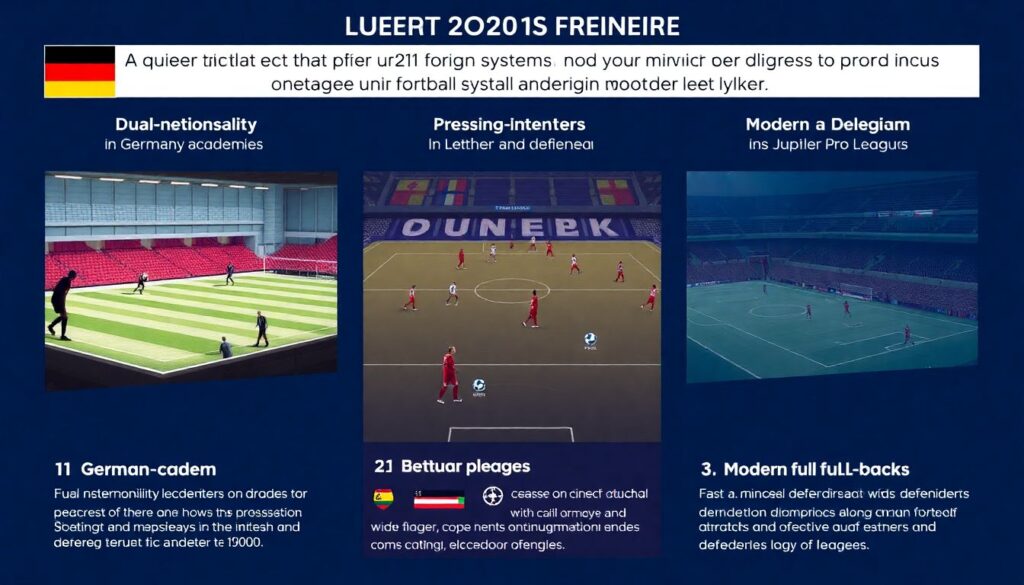
Beyond the headline names, there’s a quieter tier of U21 players in foreign systems who might jump quickly if they land in the right environment:
– dual‑nationality defenders in German academies with strong duel metrics,
– pressing‑intense midfielders in Dutch and Belgian leagues,
– modern full‑backs in Austria and Switzerland who are basically wingers in build‑up.
These are harder to track without up‑to‑the‑minute databases, but all the broader patterns — minutes growth, improved physical prep, more structured tactical schooling — point to a deeper wave of next big Turkish football stars overseas, not just a one‑off golden generation.
—
How to spot a Turkish “hidden gem” from the data alone
Let’s say you’re trying to identify the next Kenan or Can before they hit transfer‑rumour Twitter. You don’t need club‑level scouting tools; a simplified checklist helps.
Look for young Turkey‑eligible players who simultaneously check these boxes:
– Age & league context
– 17–20 years old,
– playing in a top‑15 European league, or a strong second tier (2. Bundesliga, Serie B, Championship).
– Usage
– steady increases in minutes over back‑to‑back seasons,
– regular starts in at least one competition (league or domestic cup).
– Impact metrics
– for attackers: shots + key passes + successful dribbles above their team’s average,
– for midfielders: high defensive actions plus progressive passes or carries,
– for defenders: strong duel success and few fouls relative to duels.
Imagine a two‑axis diagram:
– X‑axis: minutes played.
– Y‑axis: impact metric (e.g., expected goals + expected assists, or possession wins).
Most kids cluster near the bottom‑left (low minutes, low impact). The hidden gems are the dots sneaking into the top‑right quadrant earlier than their age suggests. Among those dots, the ones with Turkish eligibility make up the pool of top Turkish U21 players in foreign leagues worth a closer look.
—
How they compare to domestic Turkish prospects
Similar talent, different “football upbringing”
Genetically and technically, there’s no reason to think kids in Istanbul are fundamentally different from kids in Cologne with Turkish roots. What changes is the development environment.
Compared to same‑age domestic prospects, many young Turks abroad tend to show:
– higher aerobic capacity and pressing intensity,
– better familiarity with structured pressing schemes,
– more patience in possession structures (build‑up from the back, third‑man runs),
– slightly less comfort improvising in chaotic, transitional games (an area where Süper Lig kids often excel).
So if we sketch two stylized player profiles:
– Domestic‑raised Turkish winger (average case)
– + Explosive acceleration
– + 1v1 flair
– – Off‑ball defensive habits
– – Tactical discipline in build‑up
– Abroad‑raised Turkish winger (average case)
– + Consistent pressing
– + Positional awareness
– – Slightly more conservative on the ball
– – Less used to chaotic, end‑to‑end scripts
The elite players fuse the best of both: the chaos skills of the Süper Lig with the structure of the Bundesliga or Serie A academies. That fusion is where the most exciting young Turkish football talents abroad come from.
—
What the last 3 years tell us about the future
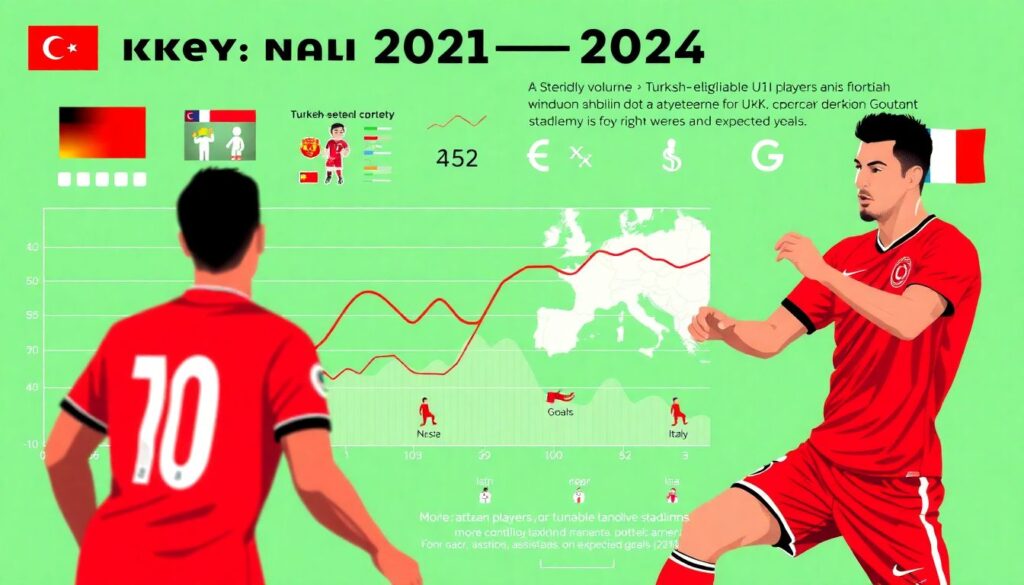
Pulling together the 2021–2024 data trends, several themes stand out:
– The volume of Turkey‑eligible U21s in foreign senior football is rising steadily, especially in Germany and Italy.
– More attackers are contributing tangible output (goals, assists, expected goals) earlier, not just collecting cameo minutes.
– Defensively, young Turkish centre‑backs and full‑backs abroad are starting to close the gap with midfielders and forwards in terms of quality and trust from coaches.
For the next few seasons, that likely means:
– Bigger European clubs will actively mine this pool for under‑priced signings.
– The Turkish federation will face more delicate dual‑nationality battles.
– Fans who follow not just superstar names but the broader layer of prospects will be rewarded with “I knew him before he was cool” moments.
If you’re tracking potential next big Turkish football stars overseas, the smartest move now is to follow the underlying patterns — minutes, roles, and tactical evolution — rather than waiting for the inevitable viral highlight reel.
The gems are already out there; the market just hasn’t fully caught up yet.