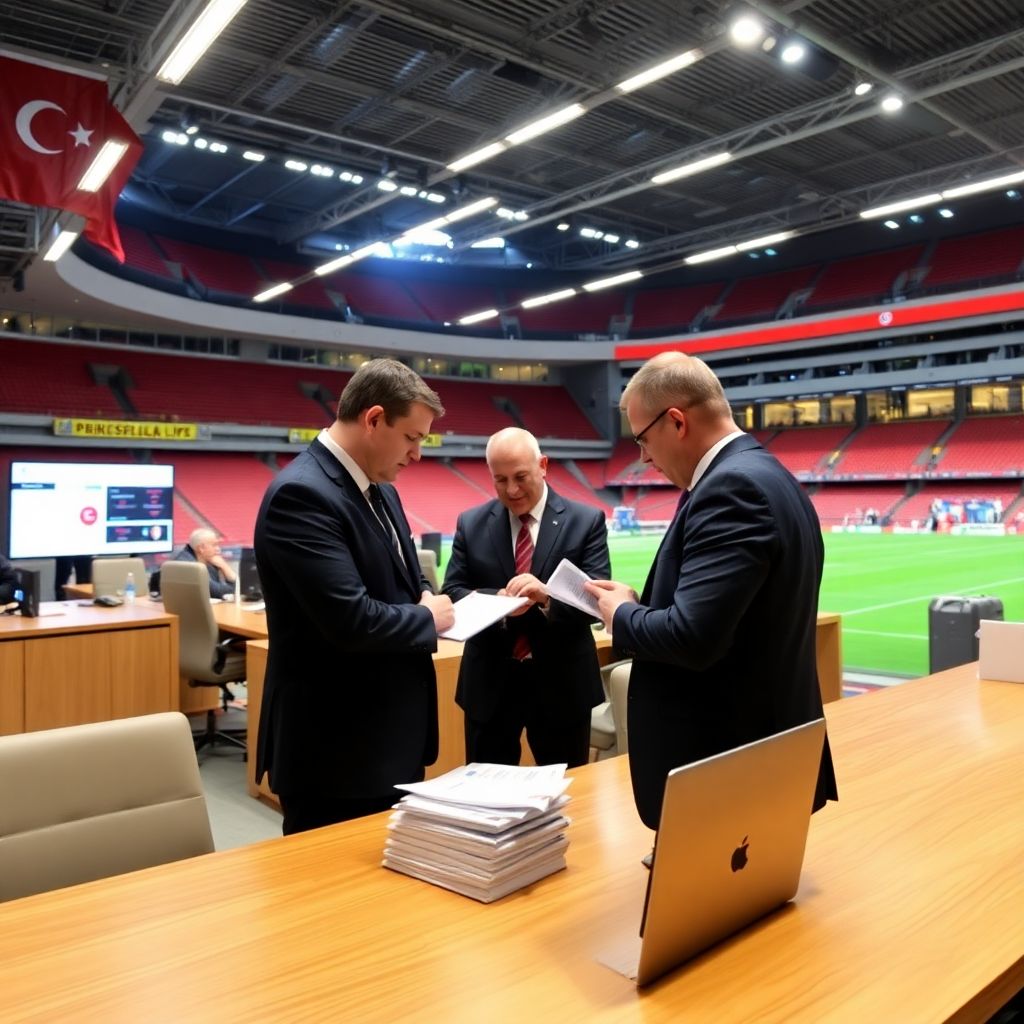
Financial fair play (FFP) in Turkey is a set of UEFA and TFF rules that limit losses, control debts and link sporting ambitions to sustainable income. For Süper Lig and TFF 1. Lig clubs this means tighter licensing, restricted transfers, wage discipline and closer monitoring, with real penalties when plans and reporting are weak.
Executive summary: How FFP reshapes Turkish professional football
- UEFA financial fair play rules Süper Lig clubs compliance is now directly tied to TFF licensing, domestic monitoring and access to European competitions.
- For TFF 1. Lig, FFP primarily constrains unpaid debts and reckless wage promises, reducing the risk of sudden collapses and point deductions.
- The financial fair play impact on Turkish club transfers is visible in shorter contracts, more loans and performance-based deals instead of big guaranteed wages.
- FFP shifts power inside clubs: finance departments, auditors and independent boards gain influence over coaches and sporting directors.
- Clubs that invest early in financial fair play consulting for Turkish football clubs and better budgeting tools adapt faster and suffer fewer sanctions.
- For policymakers, stronger financial fair play regulations Turkey club licensing services are the main lever to improve solvency and competitive balance.
Regulatory architecture: UEFA rules, TFF regulations and licensing procedures
Financial fair play in Turkey operates on two interconnected layers. First, UEFA sets overarching rules on break-even, overdue payables and long-term sustainability. Second, the Turkish Football Federation (TFF) embeds these standards into domestic regulations, licensing manuals and control mechanisms for both Süper Lig and TFF 1. Lig clubs.
At UEFA level, FFP focuses on clubs that qualify for European competitions. Turkish clubs must show they do not accumulate excessive losses relative to income, keep taxes, social security and transfer payments up to date and present credible forward-looking business plans. These requirements define who can participate in UEFA tournaments and under what financial conditions.
Domestically, TFF translates these rules into annual club licensing criteria, salary and squad registration restrictions, plus ongoing monitoring of payables to players, staff, other clubs and the state. This is where how financial fair play affects Süper Lig and TFF 1. Lig budgets becomes concrete: limits on squad costs, mandatory documentation and periodic reviews condition how much can be spent each season.
Licensing procedures tie everything together. Before each season, clubs apply for a license by submitting audited financial statements, future cash-flow projections, proof of no overdue payables and agreements with creditors if restructuring is in progress. TFF can grant full licenses, conditional licenses with specific targets or refuse licenses, which may lead to relegation, transfer bans or exclusion from competitions.
| Aspect | Süper Lig | TFF 1. Lig | Commonly observed effects |
|---|---|---|---|
| Main FFP reference | Directly aligned with UEFA break-even and overdue payables rules. | Focus on overdue payables, solvency and basic cost control. | Similar reporting templates, but stricter scrutiny for European participants. |
| Licensing authority | TFF Club Licensing Board plus UEFA for European qualifiers. | TFF Club Licensing Board only. | Uniform process, different risk thresholds and follow-up intensity. |
| Typical sanctions | Squad size limits, wage caps, transfer bans, UEFA revenue retention. | Transfer bans, point deductions, relegation threats. | Sanctions often phased and conditional on meeting short-term targets. |
| Observed club behavior | More loan deals, bonuses instead of fixed wages, sale of academy talents. | Shorter contracts, heavy reliance on free transfers, delayed but reduced wage bills. | Clubs hedge risk with flexible contracts to avoid future FFP breaches. |
Monitoring and enforcement: how TFF audits, sanctions and appeals work
- Pre-season licensing review: Clubs submit financial statements, aging of payables and budgets. TFF analyses data, compares to prior seasons and UEFA thresholds, then issues licenses with or without conditions.
- In-season monitoring rounds: At set cut-off dates, TFF checks whether salaries, transfer fees and taxes are paid on time. Overdue amounts trigger warnings, deadlines and potential automatic sanctions.
- Risk-based audits: Clubs with rapid wage growth, large short-term debts or inconsistent reporting may face deeper audits, including on-site reviews and requests for bank confirmations and original contracts.
- Corrective agreements: Instead of immediate heavy penalties, TFF often negotiates structured repayment plans and cost-cutting targets, monitoring execution via regular progress reports.
- Graduated sanctions: If targets are missed, TFF escalates from fines and squad registration limits to transfer bans, point deductions and, in extreme cases, license withdrawal.
- Appeal mechanisms: Clubs can appeal sanctions to TFF bodies and, for UEFA-related decisions, to the Court of Arbitration for Sport, but only if documentation, timelines and procedural rules were followed precisely.
- Typical mistake and quick fix: Many clubs submit incomplete documentation. A simple internal deadline two weeks earlier than TFF’s and a central digital archive drastically reduces this risk.
Immediate effects: transfers, wage bills and squad planning in Süper Lig
In Süper Lig, financial fair play impact on Turkish club transfers is most visible when clubs try to rebuild squads quickly. FFP pushes sporting directors to structure deals with lower fixed costs and more variability tied to performance, resale and qualification bonuses instead of guaranteed long-term wages.
- Big-name transfer under constraints: A club that previously signed stars on long, expensive contracts now uses short contracts plus large appearance and success bonuses. This keeps the break-even position safer while still attracting talent.
- Loan-heavy squad building: Clubs struggling with past losses rotate to multiple loan deals with buy options, shifting part of the cost and risk to the parent club and smoothing cash flows.
- Academy integration: To respect wage-to-revenue limits, coaches are encouraged to promote academy players. Their lower salaries help open room in the cap for two or three decisive experienced players.
- Timing of transfer fees: Payment schedules are carefully aligned with expected broadcasting and sponsorship income. Poorly aligned schedules are a frequent error; simple cash-flow mapping per month prevents surprise FFP breaches.
- Case sketch: A mid-table Süper Lig club once faced a partial transfer ban after several late transfer-fee installments. After hiring light-touch financial fair play consulting for Turkish football clubs, it introduced contract templates with clearer payment calendars and internal alerts tied to every due date.
Systemic outcomes: solvency, debt profiles and competitive balance in TFF 1. Lig
For TFF 1. Lig, the main story is survival and solvency. Clubs often have volatile income, depend heavily on local sponsors and municipal support and are more exposed to cash-flow shocks. FFP nudges them toward earlier restructuring of debts, more realistic wages and transparent budgeting.
At league level, stricter enforcement can reduce the most extreme overspending cases and some financial crises, but it does not automatically equalize budgets. Structural differences in market size, fan base and commercial potential remain, and poorly designed rules can even cement existing hierarchies if rich clubs adapt faster.
Positive structural effects
- Earlier identification of distressed clubs through standardized reporting and regular monitoring.
- Gradual reduction of chronic late payments to players and staff, improving trust in the league.
- More conservative contract lengths and wage promises, making insolvency less likely after relegation.
- Incentives for better youth development and scouting instead of pure chequebook solutions.
- Clearer expectations from creditors and local authorities, aiding debt restructuring negotiations.
Remaining limitations and risks
- FFP cannot fix weak governance: political interference, opaque ownership and poor boards still damage clubs.
- Creative accounting and related-party transactions remain a challenge if oversight and sanctions are inconsistent.
- Short-term compliance strategies, such as emergency player sales, can hurt sporting performance and fan relations.
- Smaller clubs may lack resources to prepare high-quality financial reports, increasing the risk of technical breaches.
- Without parallel reforms in revenue sharing and infrastructure, competitive balance gains may be modest.
Empirical cases: club-level evidence of compliance, penalties and recovery paths
- Mistake: treating FFP as a one-off hurdle. Many clubs focus only on passing this season’s licensing. FFP is cumulative: wage decisions today affect several seasons. Quick prevention: introduce three-year financial projections for every major signing.
- Mistake: overestimating future European income. Budgeting as if group-stage UEFA revenue is guaranteed is a common error. Prevention: prepare a conservative base budget without Europe and treat UEFA prize money as a bonus, not as a funding source for fixed wages.
- Mistake: ignoring non-cash obligations. Some boards focus only on bank debt and forget tax, social security and transfer payables, which are crucial in FFP tests. Prevention: maintain a unified payable schedule, updated monthly and reconciled with legal and HR departments.
- Myth: FFP blocks all investment. FFP restricts unsustainable losses, not smart long-term investment in infrastructure, academies and data. If these projects are financed transparently and do not create unmanageable short-term deficits, they are usually compatible with the rules.
- Myth: only big clubs get punished. Smaller clubs in TFF 1. Lig have faced transfer bans and point deductions due to overdue wages and taxes. Prevention: simple internal controls, basic cash-flow forecasting and early dialogue with financial fair play regulations Turkey club licensing services reduce this risk substantially.
- Recovery pattern: A club that accepted a transfer ban and wage cap for one season, cleared legacy debts and focused on academy talent often returned later with cleaner balance sheets and more stable performance.
Policy levers: practical reforms for stronger compliance and sustainable clubs
Policy options for TFF, leagues and clubs largely revolve around better information, clearer incentives and more predictable sanctions. The goal is to make compliance cheaper and more attractive than circumvention, especially for boards under pressure to deliver immediate sporting success.
One practical mini-case: a group of clubs in a hypothetical regional cluster creates a shared back-office service handling accounting, FFP reporting and budgeting, effectively acting as pooled financial fair play consulting for Turkish football clubs. Costs are split, expertise is higher and the risk of basic reporting errors drops sharply.
A simplified pseudo-workflow for a club’s FFP-safe transfer decision can look like this:
1. Estimate total cost of player (wages, bonuses, agent fees, add-ons).
2. Simulate impact on 3-year budget and key FFP ratios.
3. Stress-test with lower revenues (no Europe, relegation risk).
4. Approve only if all stress tests keep club within FFP thresholds.
5. Build performance triggers and resale clauses into the contract.
Such structured decision trees nudge clubs away from impulsive signings. Over time, they also generate internal data for better negotiations and more realistic valuations of players and staff.
End-of-article checklist for clubs, federations and policymakers
- Do we maintain a rolling three-year budget that clearly shows how financial fair play affects Süper Lig and TFF 1. Lig budgets at our club?
- Is every new contract stress-tested against worst-case revenue scenarios before signature?
- Do we have a single, up-to-date schedule of all payables (players, staff, clubs, tax) checked monthly?
- Have board members and key staff received basic training on UEFA financial fair play rules Süper Lig clubs compliance and domestic TFF rules?
- Are we using external or shared financial expertise instead of relying solely on sporting staff for financial decisions?
Practical clarifications on enforcement, penalties and club obligations
How often does TFF review club finances for FFP purposes?
TFF conducts a full review during the annual licensing process and additional monitoring at defined in-season dates. High-risk clubs can face extra audits if warning signs such as rapidly rising wages or overdue payables appear.
Can a club sign new players while under a conditional FFP agreement?
Yes, but usually only within strict limits. Conditional agreements often cap total squad cost or require that new signings are offset by savings elsewhere, and TFF may need to approve major incoming transfers individually.
What happens if a club misses a payment by a few days?
Minor delays can trigger warnings and short grace periods, but repeated or significant delays are treated as overdue payables. These can lead to fines, transfer bans or point deductions, depending on the severity and the club’s history.
Are youth and infrastructure investments restricted by FFP?
FFP mainly targets the operating deficit linked to players and wages, not long-term infrastructure. Training grounds, academies and stadium improvements are generally allowed if financing is transparent and does not hide disguised owner subsidies.
Do clubs need external advisors for FFP compliance?
It is not mandatory, but many clubs benefit from specialized advisors or shared services. External financial fair play regulations Turkey club licensing services can help interpret rules, prepare documentation and design budgets that minimize the risk of sanctions.
Can a club appeal every FFP-related sanction?

Most sanctions have an internal TFF appeal route, and UEFA-related decisions may go to international arbitration. However, appeals succeed mainly when procedure, evidence or proportionality is clearly flawed, not just because a club disagrees with the outcome.
Does FFP apply differently to relegated or newly promoted clubs?
The core principles are the same, but monitoring often focuses on transition risk, such as wage commitments that are too high for the lower division. Newly promoted clubs must adapt quickly to stricter reporting and budgeting requirements.